750 Watt Hub Motor Number Of Magnets Checker: Tool Result + Deep Decision Report
Run the checker first to get a 750 W pole-count recommendation window and risk status (with wheel-rpm plus gear-ratio handling), then use the report layer to validate method, evidence, market boundaries, and risk controls before design lock, including the 750 watts hub motor 46 magnets decision case.
Published: April 18, 2026 | Evidence updated: April 20, 2026 (stage1b round3: 46-magnet boundary + eCFR/CPSC/UK refresh)
Evidence breadth
26 dated sources
Legal, controller, and supply evidence is tier-tagged to reduce source-mixing errors.
Risk coverage
10 named risks
Each risk has explicit impact and minimum mitigation action.
Decision reproducibility
3 sample runs
Same page model is executed with fixed inputs to expose cadence and thermal boundary changes.
Quick starts
Start with the 750W baseline, then change one variable at a time so you can attribute risk changes to a specific assumption.
Use wheel rpm here. If geared, set gear ratio below to map wheel speed to motor speed.
Set 1.0 for direct drive. Typical geared hubs can be around 4-7 depending on design and revision.
Typical Br: 1.37-1.42 T. Common SH-grade baseline for traction hubs; keep thermal margin explicit for summer duty.
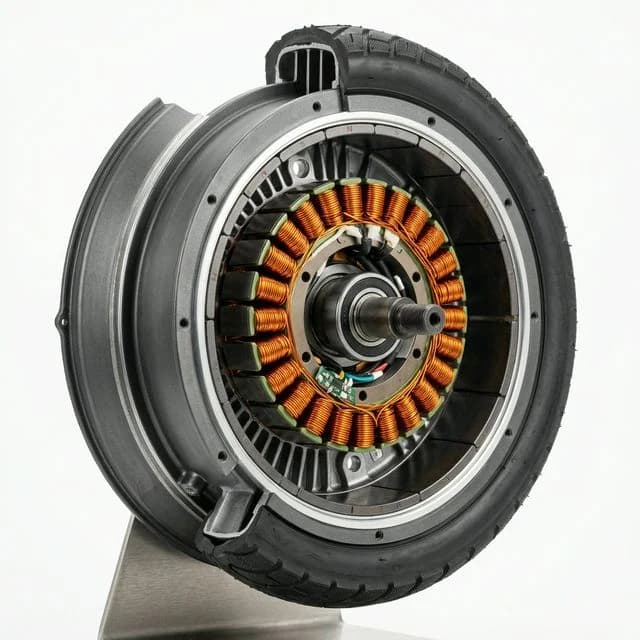
Report summary: key conclusions and key numbers
This baseline window is for direct-drive style assumptions. For geared hubs, convert wheel rpm with gear ratio first, then re-evaluate electrical pacing and eRPM stress.
Fractional-slot concentrated winding zones can be valid, but low-q combinations increase sensitivity to cogging, ripple, and acoustic variation.
When electrical frequency climbs, six-step commutation ripple becomes harder to ignore and FOC often becomes the practical path.
A 750 W screen can be valid for U.S. and some state classes, but EU EPAC exclusion text uses <=0.25 kW and 25 km/h cutoff, so legal class must be locked before architecture freeze.
If modeled hotspot approaches grade limits, result confidence drops and the minimum path is thermal test plus lot-level B-H confirmation.
| Audience | Suitable? | Why | Not suitable when |
|---|---|---|---|
| Urban commuter e-bike platform | Suitable with validation | target-pole hubs commonly align with low-to-mid speed requirements when controller and thermal path are matched. | Unknown winding quality or uncontrolled thermal duty. |
| Cargo and delivery continuous duty | Conditional | Works when current and hotspot are controlled with robust cooling and conservative continuous rating. | Natural-air only cooling under high ambient with aggressive current targets. |
| High-speed wheel concepts | Conditional to risky | Feasible only when inverter bandwidth, sensing, and mechanical retention are engineered together. | Six-step strategy with strict NVH/efficiency constraints above high electrical-frequency zones. |
| Retrofit with unknown teardown data | Not suitable yet | Screening can guide what to measure first. | Decision is frozen before confirming pole/slot/grade/thermal facts. |
| Area | Gap found | Impact | Repair | Severity |
|---|---|---|---|---|
| 46-magnet decision execution gap | The page did not give a dedicated 46-magnet speed-chain boundary table, so users had to mentally convert 23 pole pairs and geared ratios. | Teams could pass a direct-drive-safe setup into controller over-speed when moving to geared hubs. | Added a 46-magnet boundary table with wheel rpm / gear ratio / pole pairs / eRPM chain and explicit trigger actions. | high |
| Cross-market legal scope completeness | Cross-market legal boundary was strong for U.S./California/EU but lacked explicit U.S. CPSC testing condition and UK EAPC thresholds. | Decision memos could over-generalize "750 W legal" language across jurisdictions. | Added eCFR/CPSC and GOV.UK EAPC evidence rows with explicit watt/speed thresholds and consequences when outside scope. | high |
| Jurisdiction boundary | The page used 750 W as a technical class but did not clearly separate U.S./state classes from EU EPAC legal limits. | Teams could ship a technically valid setup into the wrong legal category. | Added U.S. federal, California, and EU legal-threshold evidence with explicit numeric limits and date context. | high |
| Geared-hub rpm interpretation | Wheel rpm was treated as motor rpm everywhere, with no explicit gear-ratio conversion boundary. | Electrical frequency and controller stress could be under-estimated by multiples on geared hubs. | Added gear-ratio input, effective pole-pair math, and eRPM boundary examples from controller manuals. | high |
| Evidence stratification | Primary regulations and vendor manuals were presented in one flat source list. | Readers could not quickly distinguish normative constraints from implementation examples. | Annotated core decisions with regulation-first references, while keeping vendor manuals explicitly scoped as architecture examples. | high |
| Comparison with counterexamples | Comparison lacked direct-drive vs geared numeric counterexamples and controller-limit triggers. | Users could miss the point where a "good" pole count becomes non-viable under real controller limits. | Added decision matrix rows for effective pole pairs, eRPM threshold examples, and legal-class mismatch triggers. | medium |
| Unknown-data disclosure | Dataset limitations were stated, but source volatility and model-year drift risks were not explicit. | A fixed pole-count assumption could survive too long even after supplier-side spec changes. | Added vendor-spec volatility note and an execution path: lock versioned docs + BOM revision trace before release. | medium |
Deep layer: method and evidence
1. Normalize assumptions
Lock the 750 W screening basis first, then enter even magnet count, slot count, phase count, wheel rpm, gear ratio, and ambient/cooling context.
2. Compute electromagnetic pacing
Derive pole pairs, q-value, electrical frequency, and commutation cadence for the selected control mode.
3. Estimate thermal and load indicators
Estimate torque constant, continuous torque potential, radial-load index, and hotspot margin versus chosen grade.
4. Map to action bands
Convert indicators into fit/caution/high-risk bands with explicit uncertainty and minimum next action.
5. Screen concentration and compliance exposure
Check sourcing concentration and policy thresholds before locking BOM assumptions for production programs.
| Case | Input snapshot | Output snapshot | Verdict | Minimum next action |
|---|---|---|---|---|
| 46 magnets direct-drive commuter | 46 poles / 42 slots / 520 wheel rpm / ratio 1.00 | 199.3 Hz · 30/100 | fit | Proceed to FEA + thermal test planning using this configuration as baseline, then lock supplier-grade data pack. |
| 46 magnets geared commuter (5:1) | 46 poles / 42 slots / 520 wheel rpm / ratio 5.00 | 996.7 Hz · 86/100 | high-risk | Take the minimum executable path: normalize power basis, reduce stress drivers (rpm/current), and rerun before committing tooling or BOM. |
| 46 magnets cargo climb (4:1) | 46 poles / 42 slots / 380 wheel rpm / ratio 4.00 | 582.7 Hz · 86/100 | high-risk | Take the minimum executable path: normalize power basis, reduce stress drivers (rpm/current), and rerun before committing tooling or BOM. |
| Market scope | Numeric threshold | Why it matters | Minimum action | Source |
|---|---|---|---|---|
| U.S. federal low-speed e-bike scope | Motor less than 750 W and less than 20 mph on motor power alone (with operable pedals). | Supports using 750 W as a screening class in U.S.-focused commuter programs. | Use as initial legal-scope anchor, then verify state-level class constraints. | R0 |
| U.S. CPSC low-speed definition test condition (16 CFR 1512.2) | Low-speed e-bike definition uses fully operable pedals, motor less than 750 W, and less than 20 mph on paved level surface with a 170 lb operator. | Adds the federal test-condition detail frequently missed in product and compliance handoffs. | Keep benchmark inputs aligned to this condition before asserting federal low-speed equivalence. | R23 |
| California classes (updated law text) | Class 1/2/3 retain <=750 W, with Class 3 pedal-assist cutoff at 28 mph and amended text effective January 1, 2025. | Shows that speed class and labeling obligations matter even when wattage is unchanged. | Freeze class target in requirements before motor/control calibration. | R16 |
| EU EPAC exclusion boundary (Regulation 168/2013) | Pedal assistance exclusion text uses maximum continuous rated power <=0.25 kW and assistance progressively cut at 25 km/h. | A U.S.-style 750 W assumption does not directly map to EPAC legal scope. | If EU launch is in scope, run a separate compliance path before committing architecture. | R17 |
| Great Britain EAPC practical legal threshold | EAPC guidance uses max continuous rated power <=250 W and assistance cut-off at 15.5 mph; non-qualifying vehicles are treated as motor vehicles. | Prevents carrying 750 W assumptions into UK launch planning without a class remap. | If UK market is in scope, branch to EAPC/LPM assessment before commercialization. | R24 |
| Case | Input signal | Implication | Action | Source |
|---|---|---|---|---|
| Direct-drive baseline math | 40 magnets => 20 pole pairs; controller-limited example at 28,000 eRPM. | Mechanical rpm limit is about 1,400 rpm (28,000 / 20) in that controller family. | Use as a quick pace check only; final limit depends on your specific controller and sensing mode. | R18 |
| Geared-hub conversion example | 32 magnets => 16 pole pairs and 7:1 reduction ratio on the drivetrain side. | Equivalent wheel rpm can collapse to about 250 rpm when the same 28,000 eRPM cap is applied. | Always convert wheel rpm to motor mechanical rpm before interpreting checker cadence. | R18 |
| Controller effective pole pairs | Phaserunner guidance treats geared hubs with effective pole pairs = magnetic pole pairs x gear ratio. | Effective control settings can be much higher than physical rotor pole pairs. | Track physical and controller-effective pole values separately in commissioning sheets. | R19 |
| Case | Wheel rpm | Gear ratio | Pole pairs | Estimated eRPM | Decision implication | Source |
|---|---|---|---|---|---|---|
| 46 magnets direct-drive commuter baseline | 520 rpm | 1.0 | 23 | ~11,960 eRPM | Usually below common controller benchmark examples, but still requires control-mode and thermal checks. | R2, R18 |
| 46 magnets geared commuter with 5:1 reduction | 520 rpm | 5.0 | 23 (effective becomes much higher in controller settings) | ~59,800 eRPM | Can exceed controller-family examples quickly; wheel-rpm-only checks will understate risk. | R18, R19, R25 |
| 46 magnets cargo climb with 4:1 reduction | 380 rpm | 4.0 | 23 | ~34,960 eRPM | May still breach conservative sensorless eRPM examples depending on controller architecture. | R18, R25 |
| Boundary | Valid when | Fails when | Minimum action | Source |
|---|---|---|---|---|
| Magnet count parity | Even magnet count; checker range 20-80. | Odd count or outside range. | Correct pole count first, then rerun. | R2 |
| Slot-pole-phase q window | q roughly 0.2-0.55 for this stage-1 screen. | q below 0.2 or above 0.55 without special design intent. | Re-evaluate slot/pole pairing and winding strategy. | R1, R11 |
| Commutation pacing | Electrical frequency and cadence remain within controller bandwidth. | High electrical frequency with six-step mode under strict NVH targets. | Switch to FOC or lower target rpm before geometry freeze. | R2, R3 |
| Wheel-rpm vs motor-rpm mapping | Direct-drive uses gear ratio = 1.0, or geared hubs apply measured reduction ratio before electrical-frequency checks. | Geared hubs are screened with wheel rpm as if it were rotor rpm. | Use motor mechanical rpm = wheel rpm x gear ratio, then recalculate electrical frequency and effective pole pairs. | R18, R19 |
| Hall sensor geometry mapping | Mechanical Hall placement is converted from electrical angle using actual pole count. | Electrical-angle assumptions are reused without recalculating mechanical placement. | Recalculate commissioning geometry before releasing Hall sensor fixture and calibration plan. | R3 |
| Thermal confidence | Estimated thermal margin >= 15 C. | Margin below 15 C or hotspot estimate uncertain. | Run thermal test + lot-level magnetic curve confirmation. | R4, R5 |
| Power-basis consistency | Inputs and targets are locked to one declared continuous/rated basis. | Peak-only marketing values are mixed into continuous screening. | Convert all benchmark points to a continuous basis (or explicitly stay in peak basis) before comparison. | R6, R7 |
| Market legal-class fit | Target market is declared and motor/speed limits are mapped to that market class before release. | A single 750 W assumption is reused across markets without legal-class remap. | Lock jurisdiction scope (U.S./state/EU etc.) and run class-specific compliance review before SOP freeze. | R0, R16, R17, R24 |
| Federal low-speed test-condition alignment | Motor-only speed and rider/test assumptions are aligned with the declared legal definition basis. | Marketing speed or rider assumptions are mixed into legal-class claims without condition mapping. | Record rider/test condition with each legal claim in requirement docs and compliance checklists. | R22, R23 |
| Supply concentration and compliance exposure | Single-country dependence and sourcing plan are explicitly checked against policy and business limits. | Program assumes stable supply with no diversification path despite concentrated value-chain signals. | Run sourcing stress test and define dual-source or fallback-grade path before SOP freeze. | R8, R9, R10 |
| ID | Source | Key data | Decision use | Date / scope |
|---|---|---|---|---|
| R0 | U.S. Code (govinfo) 15 U.S.C. 2085 low-speed electric bicycle definition | Defines low-speed electric bicycle scope with operable pedals, less than 20 mph on motor power alone, and motor output of less than 750 watts. | Anchors the U.S.-centric 750 W screening class so this page does not over-claim global legal applicability. | U.S. Code 2023 package (published Feb 2026), accessed April 18, 2026 |
| R1 | Emetor glossary: slots per pole per phase | Defines q = S / (P × m) and clarifies fractional-slot concentrated winding context. | Used for q-value definition in this checker; treated as a secondary explainer, not a formal standard. | Accessed April 18, 2026 |
| R2 | Microchip BLDC six-step documentation | Six-step uses 6 sectors per electrical cycle, 60 electrical degrees each, and Np electrical cycles per one mechanical revolution. | Used for cadence model and control-mode guidance at high electrical frequency. | Accessed April 18, 2026 |
| R3 | TI SLVAEG3 hall commutation brief | For a 12-pole example, 120 electrical degree Hall separation maps to about +/-20 mechanical degrees. | Used to explain why pole count and controller phasing cannot be separated in commissioning. | Published 2023, accessed April 18, 2026 |
| R4 | NASA/TM-20230010737 electric machine winding guidance | Round-conductor slot fill is commonly around 35%-55% for first-pass assumptions; 40% is suggested as conservative initial estimate. | Used for manufacturability and thermal-risk boundary when slot fill assumptions are optimistic. | September 2023, accessed April 18, 2026 |
| R5 | Arnold magnetic materials catalog (vendor data) | Public grade tables list NdFeB/SmCo remanence and temperature-class tradeoffs; values are catalog-level and not a universal standard. | Used as indicative grade-screening reference only; final limits still need supplier lot data. | Catalog accessed April 18, 2026 |
| R6 | UN Regulation No. 85 (UNECE official text) | Defines maximum 30 minutes power as the average over 30 minutes; requires defined conditioning and controlled power band for test. | Used to lock power-basis interpretation and avoid peak-vs-continuous mixing in design screening. | Revision 1 text (2013), accessed April 18, 2026 |
| R7 | EMRAX 228 datasheet v1.6 | Publishes peak (S2, 2 min) and continuous (S1) ratings side by side in one product sheet. | Used as practical evidence for keeping peak and continuous basis separate in checker input. | Version 1.6 March 2025, accessed April 18, 2026 |
| R8 | USGS Mineral Commodity Summaries 2026: Rare Earths | U.S. net import reliance is listed as 67% in 2025; China share of U.S. imports is listed as 71% (2021-2024). | Used for sourcing-risk and concentration-risk framing in procurement decisions. | February 2026 |
| R9 | IEA Rare Earth Elements executive summary | For 2024, China share is stated as 60% in mining, 91% in refining, and 94% in permanent-magnet production. | Used for concentration-risk and diversification urgency in long-term platform planning. | 2026 report, accessed April 18, 2026 |
| R10 | European Commission Critical Raw Materials Act page | States 2030 benchmarks: extraction >=10%, processing >=40%, recycling >=25%, and <=65% from one third country. | Used to set compliance-aware sourcing boundaries for EU-facing programs. | CRMA adopted in 2024, accessed April 18, 2026 |
| R11 | LUT academic work on fractional-slot PM synchronous machines | Documents that q < 1 concentrated winding configurations can increase harmonic, cogging, and torque-ripple sensitivity. | Used to justify treating low-q combinations as validation-heavy instead of auto-accepting by rule of thumb. | Academic publication, accessed April 18, 2026 |
| R12 | BAFANG workbook 2024 (official PDF) | Lists hub-motor models that include 750 W class configurations, illustrating that "750 W" is a power class while magnetic/electromagnetic implementation differs by model. | Used to justify that magnet-count decisions cannot be inferred from wattage alone. | Workbook 2024 PDF, accessed April 18, 2026 |
| R13 | Grin Baserunner manual (motor settings table) | Documents that geared hubs can use effective pole-pair settings that differ from physical rotor pole count in controller configuration. | Used for the "effective pole pairs vs physical poles" boundary and to prevent controller-setting confusion. | Rev 1.0 PDF, accessed April 18, 2026 |
| R14 | Grin G62 hub motor product page | Lists a geared motor type with power range 600-1200 W and controller-facing magnetic pole-pair settings (50). | Used as a vendor-level geared architecture example where controller settings can be much higher than physical rotor pairs. | Accessed April 18, 2026 |
| R15 | QS Motor product page (hub motor pole-pair diversity) | Publishes hub-motor variants with explicit pole-pair specifications, reinforcing that pole count is architecture-specific and not a direct function of rated wattage. | Used as comparison evidence for "do not infer exact magnet count from wattage alone." | Accessed April 18, 2026 |
| R16 | California Vehicle Code section 312.5 | Defines Class 1/2/3 e-bikes with <=750 W and class-specific speed boundaries including 28 mph pedal-assist for Class 3, with amended text effective January 1, 2025. | Used to show that wattage alone is not enough; legal class and speed cutoff must be part of architecture decisions for California programs. | Updated by SB 1271 (2024), effective Jan 1, 2025; accessed April 18, 2026 |
| R17 | Regulation (EU) No 168/2013 consolidated text (Article 2(2)(h)) | Article 2(2)(h) excludes pedal-assist cycles only when maximum continuous rated power <=0.25 kW and assistance is progressively cut and finally cut before 25 km/h. | Used to mark explicit non-equivalence between U.S.-style 750 W assumptions and EU EPAC legal framing. | Consolidated text dated Feb 20, 2019; accessed April 18, 2026 |
| R18 | Grinfineon controller manual v2.1 | Documents controller-side eRPM guidance, including a 28,000 eRPM sensorless benchmark and conversion examples for direct-drive and geared hubs. | Used to add executable geared-hub conversion boundaries and to prevent wheel-rpm interpretation errors. | Rev 2.1 PDF, accessed April 18, 2026 |
| R19 | Phaserunner manual rev2.0 | States that geared hubs require effective pole pairs = magnetic pole pairs x gear reduction ratio and provides common DD/geared examples. | Used to formalize the checker boundary between physical poles and controller-effective pole settings. | Rev 2.0 PDF, accessed April 18, 2026 |
| R20 | BAFANG workbook 2024 (official PDF) | Shows mixed rated-power variants (including 750 W and 1000 W) within related motor families and includes a note that specifications are for reference and subject to change. | Used to prevent hard-coding a magnet-count rule from a single catalog snapshot and to require model-year/version traceability. | Workbook 2024 PDF, accessed April 18, 2026 |
| R21 | Grin DD45 direct-drive product page | Lists direct-drive motor type with lower controller-facing pole-pair settings (23) than geared examples on the same vendor platform. | Used as a counterexample pair with geared listings to show architecture-driven pole-setting divergence. | Accessed April 18, 2026 |
| R22 | U.S. CPSC summary report: Electric and Non-Powered Bicycle Standards | States 16 CFR Part 1512 requirements apply to low-speed e-bikes and summarizes low-speed definition alignment with <750 W and <20 mph motor-only scope. | Used to separate federal consumer product safety scope from state class rules in decision documentation. | October 2024 report, accessed April 20, 2026 |
| R23 | eCFR 16 CFR 1512.2 definition text | Defines low-speed e-bike with fully operable pedals, motor less than 750 W, and less than 20 mph on paved level surface with a 170 lb operator. | Used to pin legal test condition details and reduce ambiguous "750 W compliant" statements. | Current eCFR page, accessed April 20, 2026 |
| R24 | GOV.UK EAPC standards and legal requirements | States EAPC threshold at <=250 W continuous rated power with assist cut-off at 15.5 mph and classifies non-qualifying vehicles as motor vehicles. | Used to prevent UK market misuse of U.S.-centric 750 W assumptions in commercialization decisions. | Public update marker Dec 10, 2024; accessed April 20, 2026 |
| R25 | ODrive API reference (electrical vs mechanical revolutions) | Documents that electrical-revolution quantities are tied to pole pairs and must be converted to motor turns by dividing by pole pairs for certain calibration fields. | Used as an independent technical cross-check that physical/mechanical and electrical bases must be tracked separately. | Docs v0.6.11 page, accessed April 20, 2026 |
| Tier | Scope | IDs | How to use in decisions |
|---|---|---|---|
| Tier A: normative/legal constraints | Binding legal definitions, vehicle class boundaries, and regulatory test conditions. | R0, R6, R16, R17, R22, R23, R24 | Use first for go/no-go legal framing; do not override with vendor examples. |
| Tier B: primary technical control references | Controller/commutation/electrical-basis references used for executable engineering checks. | R2, R3, R18, R19, R25 | Use for cadence math, effective pole-pair settings, and commissioning boundaries. |
| Tier C: market and product examples | Vendor catalogs/product docs showing architecture diversity and spec drift risk. | R12, R13, R14, R15, R20, R21 | Use as counterexamples and feasibility context, not as universal rules. |
| Tier D: evidence gaps | High-impact areas without reliable public cross-vendor datasets. | Known-unknown table | Mark as pending and require internal validation data before release decisions. |
| Topic | New fact with explicit time | Decision impact | Source |
|---|---|---|---|
| 750 W class anchor | U.S. federal low-speed e-bike text explicitly includes the less-than-750-watt limit with less-than-20-mph motor-only scope. | Keeps this page scoped to one legal context instead of mixing commuter and high-power classes blindly. | R0 |
| State-level class constraints | California section 312.5 keeps <=750 W but separates Class 1/2/3 by assist/throttle behavior and speed thresholds, with amended text effective January 1, 2025. | A "750 W only" decision can still fail class-fit requirements if speed/control behavior is mismatched. | R16 |
| EU legal boundary | EU 168/2013 Article 2(2)(h) uses <=0.25 kW continuous and 25 km/h assist cutoff for EPAC exclusion. | Prevents direct reuse of U.S.-style 750 W assumptions in EU-bound product planning. | R17 |
| Federal low-speed test condition details | eCFR 16 CFR 1512.2 includes a 170 lb operator condition alongside <750 W and <20 mph motor-only criteria in the low-speed definition. | Prevents legal-class claims from being detached from test-condition assumptions. | R23 |
| CPSC applicability framing | CPSC 2024 summary states 16 CFR Part 1512 applies to low-speed e-bikes as well as non-powered bicycles in consumer-safety context. | Keeps product-safety obligations visible instead of treating wattage labels as sufficient compliance evidence. | R22 |
| Great Britain EAPC boundary | GOV.UK EAPC guidance uses <=250 W continuous rated power and 15.5 mph assist cut-off; outside this boundary, vehicle handling shifts to motor-vehicle rules. | Adds a practical cross-market counterexample against reusing U.S.-centric 750 W assumptions. | R24 |
| Six-step commutation cadence | Six-step uses 6 sectors at 60 electrical degrees each, and electrical cycles scale with pole-pair count. | A target-pole motor (23 pole pairs) reaches high electrical cadence quickly, so controller strategy becomes an early architecture constraint. | R2 |
| Hall geometry conversion | TI shows that in a 12-pole case, 120 electrical degrees maps to about +/-20 mechanical degrees. | Pole-count changes require re-commissioning Hall geometry; reusing old fixtures increases startup and commutation risk. | R3 |
| Continuous rating basis | UN R85 defines maximum 30-minute power as a 30-minute average under specified conditions. | Prevents peak-only claims from being treated as continuous capability in thermal sizing and supplier selection. | R6, R7 |
| Geared-hub eRPM conversion | Controller guidance gives worked examples where 28,000 eRPM maps to very different wheel rpm once pole pairs and gear ratio are applied (for example 32 magnets with 7:1 gearing -> about 250 wheel rpm). | Wheel-rpm input must be converted before cadence judgment, or risk is systematically under-estimated. | R18 |
| Effective pole-pair boundary | Phaserunner guidance states geared effective pole pairs are calculated from magnetic pole pairs multiplied by reduction ratio. | Explains why controller settings can differ from physical rotor pole counts without implying a data error. | R19 |
| Electrical vs mechanical basis conversion | ODrive API reference documents electrical-revolution values that must be converted through pole-pair relationships to get motor-turn values. | Adds an independent technical source supporting the same physical-vs-effective separation used in geared-hub checks. | R25 |
| Architecture counterexample pair | The same vendor context can show geared examples around 50 controller-facing pole pairs while direct-drive examples can sit near 23. | Demonstrates that rated power alone does not identify a unique pole-count target. | R14, R21 |
| Slot-fill realism | NASA TM cites 35%-55% round-conductor slot fill with 40% as a conservative first estimate. | Overstating slot fill inflates torque expectation and can hide hotspot risk during early screening. | R4 |
| Rare-earth supply concentration | USGS reports 67% U.S. net import reliance (2025), while IEA reports 2024 concentration at 60% mining, 91% refining, and 94% magnets in China. | Single-source assumptions create cost and availability risk for long-life programs. | R8, R9 |
| Policy boundary for diversification | EU CRMA 2030 benchmarks include <=65% dependence on one third country plus extraction/processing/recycling targets. | Programs serving EU markets need sourcing plans aligned to policy-driven diversification expectations. | R10 |
| Catalog volatility disclosure | Official BAFANG workbook notes specifications are for reference and subject to change across versions. | Enforces model-year and document-version checks before using catalog numbers as hard design constraints. | R20 |
Comparison and alternatives
| Dimension | 750W baseline signal | Counterexample / limitation | Minimum action | Source |
|---|---|---|---|---|
| Electrical pacing at top speed | 40 poles => 20 pole pairs; at 520 rpm this is about 173 Hz electrical in a typical 750 W baseline. | Higher-pole options (for example 46 poles) can raise electrical frequency quickly at the same wheel speed. | Decide topology with controller bandwidth and NVH targets in the same design review. | R2 |
| Geared-hub cadence conversion | Controller manuals show eRPM checks must include both pole pairs and gear ratio, not wheel rpm alone. | A wheel-rpm-only check can hide controller stress by multiples when reduction ratio is high. | Compute motor mechanical rpm = wheel rpm x gear ratio before finalizing pole-count decisions. | R18, R19 |
| 46-magnet (23 pole-pair) speed-chain stress test | At 520 wheel rpm with direct drive, 46 magnets implies about 11,960 eRPM (23 x 520). | At the same wheel rpm with 5:1 gearing, motor-side pacing jumps to about 59,800 eRPM. | Always run the full chain (wheel rpm x ratio x pole pairs) before accepting a 46-magnet target. | R2, R18, R25 |
| Commutation commissioning | Hall placement must be converted from electrical to mechanical angle using actual pole count. | A Hall fixture that works on one pole count can miscommutate after pole-count changes. | Recompute Hall geometry and re-run startup/ripple validation after any pole-count change. | R3 |
| Legal class alignment by market | U.S./California definitions preserve <=750 W classes, while EU/UK practical boundaries use <=0.25 kW or <=250 W with 25 km/h or 15.5 mph assist cutoffs. | A design that is compliant in one region can fall into the wrong legal vehicle class in another. | Lock market-jurisdiction target before freezing control limits, top speed, and product labeling. | R0, R16, R17, R24 |
| Continuous torque and power claims | R85 and product datasheets distinguish continuous (S1/rated) from short-duration peak (S2). | Using peak numbers as continuous inputs can make a high-risk architecture look acceptable. | Lock one rating basis in requirements and reject mixed-basis supplier comparisons. | R6, R7 |
| Winding-risk sensitivity (q and harmonics) | q-value is useful for screening, and low-q concentrated winding can raise ripple sensitivity. | q alone does not predict final torque ripple without geometry-specific simulation and tests. | Treat low-q outcomes as validation-heavy, not as automatic fail/pass. | R1, R11 |
| Sourcing resilience and policy fit | USGS/IEA signal concentrated rare-earth supply; EU CRMA adds diversification benchmarks. | A cost-optimal single-source BOM may fail resilience or compliance expectations in later gates. | Add dual-source/fallback-grade plan before SOP and before long-term price negotiation. | R8, R9, R10 |
| Physical poles vs controller-effective poles | Vendor docs can show geared examples with controller-facing pole-pair settings far above direct-drive examples. | Copying one controller pole-pair number as rotor magnet count can produce wrong BOM or wrong replacement orders. | Record both physical poles and controller-effective poles in validation sheets before procurement. | R14, R19, R21 |
| Catalog-version stability | Official vendor catalogs can include explicit notes that specifications are references and subject to change. | A historical catalog value can become stale before production lock and silently invalidate assumptions. | Version-pin supplier docs and tie every key motor parameter to a dated revision record. | R20 |
| Option | Strengths | Tradeoffs | Use when |
|---|---|---|---|
| 40-pole direct-drive baseline (750 W commuter screen) | Balanced low-speed torque potential, straightforward wheel-rpm interpretation, and stable first-pass controller tuning. | Electrical frequency still rises at speed, and retention/thermal path must be validated for sustained duty. | Urban direct-drive e-bike or scooter programs with validated thermal assumptions and FOC-ready control. |
| Geared hub with high effective pole pairs | Can improve launch feel and packaging flexibility while keeping wheel torque competitive. | Effective pole-pair count can become much higher than physical poles, increasing eRPM/controller-limit sensitivity. | Low-to-mid speed duty where reduction ratio and controller limits are modeled together from day one. |
| High-pole direct-drive architecture | Higher magnetic event density can improve low-speed smoothness and startup behavior. | Higher electrical pacing pressure with stronger dependence on commutation strategy and NVH tolerance. | Heavy-load low-speed duty with robust controller bandwidth and measured thermal margin. |
| Mid-drive IPM/PMSM alternative | Can reduce unsprung mass and move thermal load away from wheel hub. | Introduces drivetrain complexity, gearbox losses, and packaging differences. | When suspension dynamics or high-continuous power density dominates architecture choice. |
Directional estimate for screening only; not a release-level guarantee.
Below 15 C enters caution gate in this workflow.
High or low extremes increase retention and ripple risk.
Risk controls and boundaries
Magnet delamination under repeated thermal cycling
Impact: Air-gap damage, torque ripple growth, and potential catastrophic rotor contact in severe cases.
Mitigation: Validate adhesive system at duty-cycle temperature profile and run mechanical overspeed margin tests.
Geared-hub eRPM miscalculation
Impact: Controller commissioning and cadence risk are underestimated when wheel rpm is used without ratio conversion.
Mitigation: Record gear ratio explicitly, convert wheel rpm to motor rpm, and validate controller eRPM margin before release.
Controller mismatch at high electrical frequency
Impact: Commutation loss, acoustic noise, and lower efficiency near top-speed band.
Mitigation: Run controller-inverter co-validation with electrical-frequency target from checker output.
Over-optimistic slot fill assumptions
Impact: Copper loss and hotspot rise exceed expectation, invalidating nominal torque plan.
Mitigation: Use process-realistic fill assumptions and verify with winding-process capability data.
Cross-market legal-class mismatch
Impact: A configuration approved in one market can require different class handling or approval path in another market.
Mitigation: Freeze target jurisdiction early and map motor/speed/control settings to that jurisdiction before tooling lock.
Low-speed definition condition mismatch
Impact: A project can appear compliant by watt label but fail legal definition context when rider/test assumptions are inconsistent.
Mitigation: Document definition basis (including operator/test assumptions) in compliance gates and supplier claims.
Peak-vs-continuous basis confusion
Impact: Design appears feasible on paper but fails continuous thermal validation.
Mitigation: Freeze one declared power basis before architecture comparison and supplier shortlisting.
Catalog drift and stale assumptions
Impact: Model-year or revision changes can invalidate magnet-count and rating assumptions used in earlier decisions.
Mitigation: Tie critical parameters to dated supplier revisions and re-check before RFQ closure.
Rare-earth supply concentration shock
Impact: Lead-time and price volatility can invalidate launch timing and margin assumptions.
Mitigation: Use dual-source/fallback-grade planning and contract clauses linked to concentration-risk events.
Policy-misaligned sourcing for EU-facing programs
Impact: Late-stage compliance and customer acceptance risk if diversification expectations are ignored.
Mitigation: Run a CRMA-aware sourcing check before RFQ closure and before long-term nomination.
| Topic | Status | Decision impact | Minimum executable path |
|---|---|---|---|
| Open dataset of 46-magnet adoption by model year | No reliable public cross-vendor dataset quantifies 46-magnet prevalence by model year and controller firmware. | High impact on retrofit and procurement assumptions. | Build an internal model-year trace table linking physical poles, firmware settings, and validated teardown records. |
| Global mapping of hub-motor power class vs magnet count | No reliable public dataset yet (暂无可靠公开数据). | High impact on benchmarking and teardown-based assumptions. | Build an internal benchmark dataset from verified teardown and dyno-linked records before setting hard rules. |
| Public crosswalk of physical poles vs controller-effective pairs | No reliable open dataset spans model-year changes across major hub vendors. | High impact on retrofit and replacement accuracy. | Maintain an internal traceable map (model, firmware, physical poles, effective pairs, ratio). |
| Lot-level irreversible demag curves at actual hotspot | Public catalog values are not enough for final confidence. | High impact on overload and abuse-case durability. | Request supplier lot data + run elevated-temperature demag verification. |
| Rotor retention margin at overspeed | Depends on adhesive, sleeve, and manufacturing process details. | High safety and reliability impact. | Mechanical FEA + burst/overspeed test before SOP freeze. |
| Real road thermal boundary for enclosed hubs | Vehicle airflow and riding profile create high variance. | Medium-high impact on continuous torque promise. | Instrumented road cycle + thermal calibration loop. |
| Long-term supply volatility exposure | Depends on contract terms and regional sourcing footprint. | Medium impact on cost and lead-time resilience. | Dual-source plan with grade fallback and inventory trigger policy. |
Scenario examples
Assumptions: 3-phase, 36 slots, FOC control, natural-air cooling, moderate ambient conditions.
Expected outcome: Usually lands in fit/caution boundary depending on electrical cadence and thermal margin.
Assumptions: Higher current, lower rpm, elevated ambient, long duty period.
Expected outcome: Thermal margin often becomes the dominant risk trigger even when q-value looks acceptable.
Assumptions: Near 1000 rpm wheel speed and high bus voltage target.
Expected outcome: Electrical frequency and controller pacing become first-order constraints.
Assumptions: Missing confirmed slot count, grade, and hotspot behavior.
Expected outcome: Output should be treated as directional only; minimum path is teardown + measurement.
Assumptions: Wheel rpm appears moderate, but internal reduction ratio is above 4:1 and controller eRPM headroom is limited.
Expected outcome: Risk can jump from fit to caution/high-risk once motor-side cadence is converted correctly.
Related internal routes
Use for broader hub-motor decisions beyond the 750 W envelope.
Use when slot-pole commutation questions dominate design iteration.
Use for mid-drive/IPM alternatives and higher-speed architecture tradeoffs.
Use when topology migration beyond radial hub architecture is under review.
Use when moving from hub pole-count checks to OD-around-89 mm arc-segment sourcing and retention screening.
Use when you want the dedicated 46-magnet route with geared-boundary defaults.
Use for direct execution after screening output is stable and assumptions are version-locked.
Use this anchor for direct tool access in internal SOP and QA handoffs.
FAQ for decision intent
blocker
0
high
0
medium
0
low
0