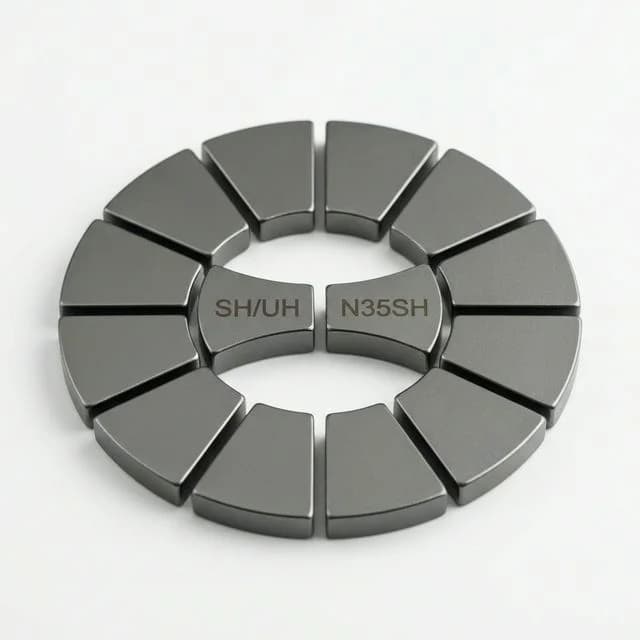
89mm Arc Magnets Neodymium Magnet Checker
First screen solves the tool intent: input your geometry and operating constraints, then get a deterministic fit verdict with next action. Deeper sections provide evidence, boundary conditions, tradeoffs, and procurement-risk controls for this exact dimension query.
Published: April 21, 2026
Evidence updated: April 21, 2026 (stage1b round-2: USGS + IEA + DOE + ECHA + EUR-Lex + Henkel)
Review cadence: every 6 months or earlier when material-policy data shifts.
Distinct angle: this page focuses on one OD-around-89 mm cluster and turns listing-level intent into engineering and sourcing decisions in one URL.
Tool Layer: Run The Fit Checker
Input geometry and operating assumptions, then get interpreted output, uncertainty, and a direct next step.
Empty state
Run checker to generate geometry fit, thermal margin, retention margin, and an action-oriented verdict.
Report Summary: Conclusions, Numbers, Fit/Unfit
This layer translates calculator output into decisions with boundaries and audience fit guidance.
1) Tool-first intent is size-specific
Public listings for this exact SKU publish dimensions, grade, polarity split, and max temperature, so users expect an immediate fit/readiness answer, not generic magnet theory [S1][S2].
2) Thermal and retention are the two critical failure gates
A “dimension match” alone does not imply readiness. Thermal margin and retention margin determine practical reliability. This page keeps both as explicit screening gates with disclosed evidence and limits. The adhesive baseline is anchored to ISO 10123 steel pin/collar test context in LOCTITE 648 data, so production transfer must still be validated [S5].
3) Supply concentration is a first-order risk variable
IEA 2025 reports top-three refining share for key energy minerals rose from 82% to 86% (2020 to 2024), with around 90% of refined supply growth from the top single supplier. This means quote timing and second-source readiness should be controlled like technical gates [S13].
4) Grade choice is a tradeoff, not a one-way upgrade
SH/SmCo paths can reduce heat risk but can increase cost, lead time, and process complexity. DOE 2023 still classifies Nd/Pr/Dy/Tb as critical for EV/wind magnet chains, so grade-switch decisions should include supply-risk criteria, not only thermal criteria [S15].
5) EU-bound programs need both compliance and diversification gates
Candidate List currently shows 253 entries and REACH/RoHS obligations trigger from explicit thresholds (>0.1% w/w and related notification windows), so document ownership must be locked before shipment planning. CRMA adds 2030 diversification signals (10/40/25 capacity benchmarks and 65% single-country dependency cap) that should shape contract language earlier in the cycle [S9][S10][S11][S14].
Geometry
Coverage window
Thermal margin
Retention buffer
| Profile | Fit | Reason |
|---|---|---|
| Replacement job with known duty cycle and compatible pole layout | Suitable | Dimension-specific stock path plus checker can quickly validate geometry and boundary conditions. |
| High-temperature continuous-duty traction case | Conditional | Often needs SH/SmCo path and stronger retention strategy beyond stock assumptions. |
| Cost-first project with weak process control | Not suitable | Without tolerance, curing, and QC control, failure risk can exceed savings from a cheaper listing. |
Methodology And Evidence
Tool logic, source chain, and known unknowns are disclosed so users can judge confidence boundaries.
- Parse and validate geometry/operating inputs with explicit ranges.
- Compute geometric metrics (thickness, arc length, chord, coverage).
- Compute thermal and retention screening metrics with grade/safety assumptions.
- Output verdict, uncertainty, and minimum executable next action.
Evidence is layered from direct size-intent listings to material and retention references, then supply-risk context. Items without strong public evidence are explicitly marked as unknown.
Known unknowns
- Public listing data can show grade and polarity direction, but usually omits full tolerance stack, coating-thickness distribution, and lot-acceptance method.
- No reliable public retention-fatigue dataset currently covers exact 89 mm OD-class geometry across full RPM-temperature-life combinations.
- Lead-time and MOQ volatility are region and quarter dependent.
| Area | Gap before enhancement | Effective information increment | Status |
|---|---|---|---|
| Macro supply concentration evidence | Page had U.S.-centric price/import data, but lacked a global concentration baseline. | Added IEA 2025 concentration metrics (top-three refining share 82%->86% and export-control expansion) to connect pricing risk with concentration structure [S13]. | Closed |
| EU procurement boundary | RoHS/REACH obligations were present, but diversification policy boundaries were not explicit. | Added CRMA 2030 benchmarks and <=65% single-country dependency boundary for strategic raw materials [S14]. | Closed |
| Core material criticality context | Fit checker emphasized geometry and thermal gates but underexplained long-cycle material criticality. | Added DOE critical-material context for Nd/Pr/Dy/Tb in EV and wind magnet value chains [S15]. | Closed |
| Retention-fatigue certainty boundary | Boundary text mentioned uncertainty, but did not expose a status-style decision label. | Explicitly marked this area as pending confirmation (暂无可靠公开数据) and kept a minimum validation path. | Closed with explicit uncertainty |
| ID | Source | Key data | Context | Date marker |
|---|---|---|---|---|
| S1 | ALB Materials - Arc magnets for motors | Article groups arc-magnet OD ranges and includes a 45.0-89.9 mm bucket with motor-focused inquiry fields (OD/ID, angle, thickness, length, grade, coating). | Supports the dominant pattern for this keyword cluster: size-first custom RFQ rather than one fixed retail SKU. | Article accessed on April 21, 2026 |
| S2 | Stanford Magnets - Neodymium arc magnets | Supplier page states broad size inventory and explicitly requests custom quotes for sizes not listed, while listing motor/generator usage and geometry-specific orientation constraints. | Used to justify why a 89mm query needs a tool+RFQ path with explicit geometry fields instead of SKU-only selection. | Page accessed on April 21, 2026 |
| S3 | Arnold Magnetic Technologies NdFeB grade reference | Public grade table distinguishes H/SH/UH classes and shows thermal-performance tradeoffs across NdFeB grades. | Used for grade-boundary and thermal-margin interpretation. | Reference accessed on April 18, 2026 |
| S4 | Arnold RECOMA SmCo reference | Sm2Co17 table lists high-temperature operating capability relative to NdFeB classes. | Supports high-temperature fallback comparison in this page. | Reference accessed on April 18, 2026 |
| S5 | Henkel LOCTITE 648 technical data sheet | TDS reports ISO 10123 compressive shear values (steel pins/collars): 13.5 N/mm2 at 15 min and 31 N/mm2 at 72 h, with cure-speed/gap sensitivity. | Used to calibrate retention-screening assumptions and to disclose lab-test geometry limits. | TDS May 2021, accessed on April 18, 2026 |
| S6 | USGS Mineral Commodity Summaries 2026 - Rare Earths | USGS reports Nd oxide 56->73 $/kg (2024->2025), NdPr oxide 55->69 $/kg, import compounds 8,120->21,000 t, and net import reliance 53%->67%. | Used in procurement volatility and risk-mitigation sections. | USGS report published in February 2026 |
| S7 | NEMA MG-1 Part 12 | NEMA guidance notes best performance when terminal voltage unbalance stays within 1%. | Used as a downstream motor-validation boundary after magnet selection screening. | Watermark PDF accessed on April 18, 2026 |
| S8 | Apex Magnets arc-motor category listing | Category listing exposes dimension-based SKUs, set polarity splits, and product-level pull-force fields, confirming buyers compare geometry + stock + lead-time in one pass. | Adds transactional SERP evidence for structured dimension filters even when exact 89 mm stock items vary by supplier cycle. | Category page accessed on April 21, 2026 |
| S9 | ECHA Candidate List table | Candidate List page shows 253 entries in total; latest inclusion date displayed as 04-Feb-2026. | Used to set REACH/SVHC volatility checks for EU-bound magnet procurement. | ECHA page accessed on April 18, 2026 |
| S10 | ECHA Candidate List obligations | For articles >0.1% w/w SVHC, suppliers must communicate safe-use info; consumer requests require response within 45 days; producer/importer notification applies above 0.1% w/w and >1 t/y, due within 6 months. | Used in compliance-gate and RFQ document-check sections. | ECHA page accessed on April 18, 2026 |
| S11 | EUR-Lex Commission Delegated Directive (EU) 2015/863 | RoHS Annex II lists ten restricted substances with limits 0.1% w/w (most) and 0.01% for cadmium in homogeneous material. | Used to define baseline RoHS evidence pack requirements for EU deliveries. | Directive text accessed on April 18, 2026 |
| S12 | USGS Mineral Commodity Summaries 2026 - Rare Earths (Heavy) | USGS reports heavy rare-earth import reliance at 100% and notes April 2025 export-control tightening followed by partial suspension in November 2025. | Used to frame heavy-rare-earth shock scenarios in contingency sourcing plans. | USGS report published in February 2026 |
| S13 | IEA Global Critical Minerals Outlook 2025 - Executive Summary | IEA reports rare-earth demand grew 6-8% in 2024; top-three refining share for key energy minerals rose 82%->86% (2020->2024); more than half of a broader mineral set is now under export controls. | Adds concentration and policy-shock evidence that affects lead-time and second-source strategy beyond one quote cycle. | IEA report year 2025, page accessed on April 21, 2026 |
| S14 | EUR-Lex Regulation (EU) 2024/1252 (Critical Raw Materials Act) | Regulation states 2030 EU benchmarks (10% extraction, 40% processing, 25% recycling) and a diversification target: no more than 65% from one third country at any processing stage for any strategic raw material. | Defines procurement boundary conditions for EU-facing programs and contract clauses on diversification. | Published in OJ on May 3, 2024; page accessed on April 21, 2026 |
| S15 | U.S. DOE Critical Materials Assessment 2023 | DOE highlights Nd, Pr, Dy, and Tb as critical for clean-energy deployment, specifically noting rare-earth magnets in EV motors and wind generators. | Used to separate short-term SKU availability from structural material criticality risk in long-cycle programs. | DOE report published in July 2023; accessed on April 21, 2026 |
| Metric | 2024 | 2025 | Decision impact | Source |
|---|---|---|---|---|
| Neodymium oxide average price | 56 $/kg | 73 $/kg | Quote validity windows should be shorter for Nd-heavy options. | S6 |
| NdPr oxide average price | 55 $/kg | 69 $/kg | Fallback grade and re-quote trigger clauses should be pre-defined. | S6 |
| U.S. imports of rare-earth compounds | 8,120 t | 21,000 t | Lead-time assumptions should include dependency on external refined supply. | S6 |
| Net import reliance (compounds + metals) | 53% | 67% | Single-source contracts are more exposed to policy and logistics shocks. | S6 |
| Gate | Threshold | Deadline / scope | Procurement action | Source |
|---|---|---|---|---|
| RoHS restricted substances in homogeneous material | 0.1% w/w for Pb/Hg/Cr6+/PBB/PBDE/DEHP/BBP/DBP/DIBP; 0.01% for Cd | EU EEE market access baseline | Request supplier declaration explicitly mapped to Annex II substances. | S11 |
| REACH Article 33 communication | SVHC in article >0.1% w/w | Consumer requests must be answered within 45 days | Prepare customer-facing safe-use response template before shipment. | S10 |
| REACH Article 7(2) notification to ECHA | SVHC >0.1% w/w and >1 tonne/year per producer or importer | Submit no later than 6 months after list inclusion | Assign importer-of-record responsibility and calendar legal deadline. | S10 |
| SCIP database submission (WFD route) | Article contains Candidate List substance >0.1% w/w | Applies when placing article on EU market | Confirm SCIP submission owner and evidence archive before EU dispatch. | S10 |
| Metric | Baseline | Latest | Decision impact | Source |
|---|---|---|---|---|
| Top-three refining share (key energy minerals) | 82% (2020) | 86% (2024) | Dual-source plans should be validated before pilot lock, not after first quote. | S13 |
| Top-three mining share (key energy minerals) | 73% (2020) | 77% (2024) | Mine-side concentration still rises; schedule buffers should be treated as supply-risk controls. | S13 |
| Share of refined supply growth from top single supplier | N/A | ~90% of 2020-2024 growth | Single-country processing disruptions can propagate even when spot prices look stable. | S13 |
| Heavy rare-earth U.S. net import reliance | 100% (2024) | 100% (2025e) | Programs requiring Dy/Tb buffering should pre-approve fallback grades and schedule contingencies. | S12 |
| Benchmark | Target | Procurement implication | Source |
|---|---|---|---|
| EU strategic raw-material extraction capacity | At least 10% of annual EU consumption | EU customer RFQs increasingly expect visibility into upstream extraction plans and risk controls. | S14 |
| EU strategic raw-material processing capacity | At least 40% of annual EU consumption | Processing-stage bottlenecks can drive long lead times even when ore availability looks sufficient. | S14 |
| EU strategic raw-material recycling capacity | At least 25% of annual EU consumption | Secondary-material pathways can become a required backup for high-volatility procurement windows. | S14 |
| Single-country dependency cap | No more than 65% of supply from one third country at any processing stage | Contract strategy should include diversification clauses rather than treating them as optional. | S14 |
| Gate | Current rule | Evidence basis | Limitation | Minimum next action |
|---|---|---|---|---|
| Thermal margin gate | Flag when thermal margin < 15 C | Grade temperature classes from NdFeB/SmCo references plus duty uncertainty buffer [S3][S4]. | No universal public standard defines 15 C as a pass/fail threshold for every motor architecture. | Treat as screening trigger; validate with duty-cycle thermal test or calibrated model. |
| Retention margin gate | Flag when retention margin < 3 MPa | Derived from adhesive baseline and ISO 10123 steel pin/collar shear data in LOCTITE 648 TDS [S5]. | TDS geometry and curing setup differ from coated arc magnets in production assemblies. | Run process-specific coupon/rotor tests before reliability sign-off. |
| Coverage-ratio gate | Preferred window 0.85-1.10 | Geometric fit heuristic based on arc angle versus pole pitch relation in this checker. | No open standard maps one ratio window to all slot/pole combinations and harmonic targets. | Verify with electromagnetic simulation or measured back-EMF/cogging data. |
| High tip-speed escalation | Escalate when tip speed > 80 m/s | Conservative internal trigger to force mechanical-retention review at higher centrifugal stress. | No reliable public dataset currently covers fatigue-retention limits for exact 89 mm OD-class arcs across full life cycles. Status: pending confirmation (暂无可靠公开数据). | Use sleeve/groove retention path and run overspeed plus thermal cycling tests. |
Comparison And Tradeoffs
Alternative options are compared with explicit tradeoffs instead of one-way recommendation language.
| Option | Temperature path | Procurement profile | Main risk | Best for |
|---|---|---|---|---|
| Stock catalog arcs near 89 mm OD class (N45H/N48H) | Moderate thermal window (~120 C class) | Fastest when inventory exists; lowest qualification overhead | Catalog geometry may miss your exact ID/angle/tolerance stack. | Prototype turns where drawing tolerance and duty envelope are still flexible |
| Custom N48SH / N52SH 89 mm program | Higher thermal class (~150 C) with stronger coercivity path | Higher MOQ and quoting cycle with drawing/tolerance alignment | Higher cost and longer lead-time exposure in volatile Nd windows | Programs that need stable thermal headroom and repeatable supply |
| Sm2Co17 custom arc segment | High-temperature capability (up to ~300 C class) | Specialized vendors and longer machining/inspection cycle | Lower magnetic loading and higher material brittleness/cost | High-heat environments where NdFeB thermal margin is persistently negative |
| Geometry fallback (same grade, lower RPM / sleeve / improved cooling) | Depends on system thermal redesign | Can keep existing grade if mechanical/thermal redesign is feasible | Program delay if redesign is discovered late | Projects with fixed BOM contracts but flexible rotor/mechanical design |
| Scenario | Mistaken decision | Failure mode | Minimum correction | Source |
|---|---|---|---|---|
| Thermal/retention metrics pass in checker | Assume shipment readiness and release PO without compliance package review. | RoHS/REACH/SVHC obligations can still block EU delivery despite a technically acceptable geometry result. | Run compliance-gate checklist in parallel with technical screening before PO release. | S9/S10/S11 |
| Adhesive shear value looks high in TDS | Scale steel pin/collar ISO 10123 numbers directly to coated arc magnets in rotor duty. | Bond-gap, substrate, curing, and thermal cycling differences can invalidate direct transfer of TDS values. | Use coupon/rotor tests with production process windows before reliability sign-off. | S5 |
| Spot market appears calm during RFQ week | Lock single-source pricing and skip contingency language in supply contract. | Concentrated refining and export-control shifts can re-open lead-time and cost risk mid-program. | Add re-quote trigger and second-source fallback at contract stage. | S12/S13/S14 |
Assumption: Need an OD-around-89 mm arc set quickly and existing thermal/RPM envelope is already validated.
Recommended path: Use stock-grade path, run checker, require retention margin >= 3 MPa and thermal margin >= 15 C before order.
Expected outcome: Shortest turnaround with bounded risk if operating envelope remains unchanged.
Assumption: Ambient rises from 35 C to 60 C, and duty cycle extends to near-continuous operation.
Recommended path: Switch to high-temp preset, evaluate SH/SmCo branch, and verify whether cooling or grade change is lower total risk.
Expected outcome: Avoids underestimating demagnetization and adhesive aging risk in high-heat use.
Assumption: RPM target increases while OD remains near 89 mm and packaging envelope cannot grow.
Recommended path: Run high-speed preset, focus on retention demand and coverage ratio, then decide sleeve vs RPM rollback.
Expected outcome: Prevents hidden centrifugal retention failure after prototype pass.
Assumption: Program needs cost reduction without missing delivery schedule in a volatile rare-earth market.
Recommended path: Use comparison matrix: grade fallback vs geometry redesign; lock re-quote thresholds and dual-source backup.
Expected outcome: Turns market volatility into explicit decision gates instead of last-minute firefighting.
Risk Matrix And Mitigation
Misuse risk, cost risk, and scenario mismatch are presented with concrete triggers and actions.
Prioritize rows with high impact + medium/high probability before any PO release.
Rare-earth pricing and policy shocks are treated as schedule-risk inputs, not just purchasing data. Use contract-level re-quote and fallback clauses before pilot freeze. USGS 2026 records both 2025 price moves and export-control volatility signals, while IEA 2025 adds concentration escalation context [S6][S12][S13].
| Risk | Probability | Impact | Trigger | Mitigation |
|---|---|---|---|---|
| Thermal overload causes irreversible flux loss | Medium | High | Thermal margin < 15 C in peak duty or seasonal high ambient | Upgrade grade class, reduce hotspot through cooling path changes, and validate with worst-case thermal profile. |
| Adhesive-only retention margin is insufficient at target RPM | Medium | High | Retention margin < 3 MPa after safety factor | Add mechanical retention (sleeve/groove), increase cured shear baseline, or reduce tip speed. |
| Segment count / arc angle mismatch creates flux ripple or assembly gap | Medium | Medium | Coverage ratio outside 0.85-1.10 screening window | Recalculate pole pitch, adjust arc angle, and verify assembly stack-up tolerances before PO release. |
| Procurement shock from rare-earth price and policy changes | High | Medium | Nd/NdPr market jump or export-policy updates during RFQ cycle | Use dual-source qualification, re-quote trigger clauses, and grade fallback paths in the sourcing plan. |
| False confidence from incomplete public listing data | High | Medium | Missing tolerance stack, coating-thickness distribution, or lot-level retention-test evidence | Force critical spec checklist: tolerance, coating, magnetization orientation, and incoming QC method. |
| EU shipment risk from incomplete RoHS/REACH evidence | Medium | High | Supplier quote lacks RoHS substance declaration and SVHC article statement for the latest Candidate List cycle | Gate PO release on RoHS Annex II declaration, REACH Article 33 communication template, and SVHC/SCIP responsibility confirmation. |
FAQ By Decision Intent
Grouped FAQ keeps the page actionable for sizing, reliability, and procurement decisions.
Arc earth magnets checker and decision report
Arc magnet neodymium RFQ readiness checker
90 arc magnets for sale checker and RFQ report
90 degree arc magnets hybrid checker and report
1105 brushless motor N52SH arc magnets checker
1407 motor N52SH arc magnets checker
Hub motor tool-and-report page
Advantages of eccentric arc sintered NdFeB magnets checker
Applications of eccentric arc sintered NdFeB magnets checker and report
Minimum package: OD/ID/length, arc angle, segment count, magnetization orientation, coating, RPM envelope, and hotspot estimate.
If thermal margin < 15 C or retention margin < 3 MPa, mark it as blocker in your request so fallback options are prioritized.
Include target RPM and duty cycle; these two inputs drive retention stress and decision branch selection.
Attach current supplier specs if available so we can run a direct delta check instead of generic recommendations.
Need adjacent context before RFQ?