EVMotorMagnets logoEV Motor Magnets
  • About Factory
  • Blog Insights
  • Contact Inquiry
EVMotorMagnets logoEV Motor Magnets

China factory for EV and industrial motor magnets with OEM customization support

Products
  • EV Traction Motor Magnets
  • Axial Flux Generator Magnet Notes
  • Back-EMF Engineering Knowledge
Capabilities
  • OEM Customization
  • Prototype and Small-Batch
  • Quality and Traceability
  • FAQ
Resources
  • Learn Resources
  • Blog Insights
  • OEM Process
  • Contact Inquiry
Company
  • About Factory
  • Contact Inquiry
Legal
  • Cookie Policy
  • Privacy Policy
  • Terms of Service
© 2026 EV Motor Magnets. All Rights Reserved.
Hybrid page: tool-first + decision report in one URL

Interior Permanent Magnet Motor Checker for 2 Pole IPM Synchronous Motor Decisions

This canonical page answers both interior permanent magnet motor and 2 pole ipm synchronous motor intent in one place: run the checker first, then validate with boundaries, evidence, and tradeoff guidance below.

Published: April 12, 2026 | Evidence updated: April 12, 2026

2 pole ipm synchronous motor checkerkey conclusionsstage1b auditmethod and evidencetopology comparisonrelated routesdecision FAQ
Tool Layer: 2-pole IPM screening input
Enter your rated basis and evaluate one run. The checker returns deterministic risk bands, uncertainty notes, and actionable next steps.

Quick starts

Start with rated (continuous) values, not burst peak-only values. Use one preset and adjust one variable at a time for clean sensitivity checks.

Typical Br: 1.37-1.42 T. Catalog-level SH range for screening only. Confirm lot-level B-H curves before freezing geometry.

Fixed context: this page assumes 2 poles (1 pole pair) and focuses on the alias query 2 pole ipm synchronous motor under a canonical interior permanent magnet motor URL.
Open main CTA
Result Layer: interpreted output + next action
Includes empty/loading/error/boundary states, not just raw numbers.
Empty state
Start with default inputs and click Evaluate. You will get a deterministic fit/caution/high-risk verdict with explicit next action.
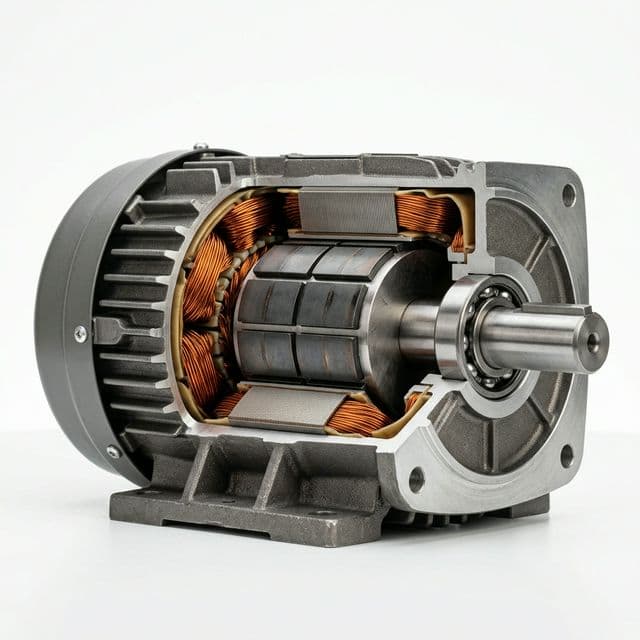
Interior permanent magnet motor cutaway with embedded rotor magnets
Use the checker first for 2-pole IPM assumptions, then validate decision boundaries with the report layer.
Tool-first promise and main CTA
Run the checker, review boundary notes, then move to engineering inquiry with your assumptions.

This hybrid page keeps one canonical URL so users do not split between a thin calculator page and a separate report page. The tool solves the immediate task, and the report sections below explain why the output can or cannot be trusted.

If your run lands in caution or high-risk, use the comparison and risk sections before you commit to drawings, supplier RFQ, or inverter parameter lock.

Inquiry Email

[email protected]

Open email appStart inquiry (opens email app)
ToolConclusionsAuditMethodComparisonRisksUnknownsScenariosRelatedFAQCTA

Report summary: key conclusions and key numbers

Default risk
8/100

22 kW @ 3000 rpm baseline

2-pole electrical frequency
50.0 Hz

rpm / 60 relationship

Default thermal margin
17.0 C

N48SH + forced-air assumption

Field-weakening reserve
44%

saliency-derived screening index

ConclusionKey numberSuitable audienceNot suitable audienceEvidence
Power-basis discipline is mandatory: electric drive ratings should be interpreted on a declared test basis, not mixed peak snapshots.UN/ECE R85 defines maximum 30-minute average power test conditionsAny automotive-style benchmarking where teams compare motors from different suppliers.Datasheets that provide only marketing peak claims without repeatable test setup.M1, M8
Rare-earth supply concentration remains a design variable, not only a purchasing topic, because controls and concentration can shift cost and lead time quickly.IEA 2025: top-3 refining share ~86% in 2024; outside leading supplier, battery metals and rare-earth supply covers ~half of 2035 residual demandPrograms locking NdFeB-dependent architecture for SOP within 12-24 months.Projects assuming historical material prices and export conditions are stable by default.M2, M3
High-speed capability is not exclusive to 2-pole architecture; pole-count choice must be made with voltage, mechanics, and thermal stack constraints together.DOE/ORNL benchmark: 6-pole IPM HSG at 15,750 rpm (2013); NREL/ORNL concept: 20,000 rpm PM traction design (2020)Teams debating 2-pole as a blanket rule for high-speed operation.Decisions made from pole count alone without inverter and rotor-stress validation.M5, M6, M7
2025-2026 public data shows non-trivial material dependency risk for magnet programs and should be reflected in architecture tradeoffs.USGS 2026: U.S. rare-earth compounds/metals imports +169% in 2025; net import reliance for compounds/metals ~67%Early concept filtering and supplier comparison.Plans that treat magnet-grade selection as purely electromagnetic without supply contingency.M4
Stage1b audit: identified gaps and repairs
This table records what was weak in the previous version and what evidence-backed changes were applied in this round.
Gap foundDecision riskStage1b repair
Material and thermal statements were previously dominated by vendor-level sources.Creates confidence risk when users treat catalog ranges as universal engineering limits.Re-centered core conclusions on regulatory, intergovernmental, and national-lab evidence (M1-M7); vendor data is explicitly marked as secondary (M8).
Pole-count discussion lacked strong counterexamples.Users could incorrectly infer that 2-pole is a mandatory condition for high-speed programs.Added benchmarked counterexamples (6-pole at 15,750 rpm and PM concept at 20,000 rpm) and tied them to boundary conditions.
Sourcing-risk block had limited dated facts.Risk and lead-time tradeoff looked qualitative instead of decision-grade.Added 2025-2026 dated indicators from IEA and USGS including concentration and import-reliance changes.
Some thresholds could be read as standards.May cause misuse of checker bands as compliance thresholds.Marked risk-score bands and margin guidance as internal screening heuristics and not regulatory limits.
Audience typeProfileWhy this fit status
Likely fitTeams designing high-speed drives that need broad field-weakening range and can support robust thermal control.2-pole IPM reduces electrical-frequency pressure at a given speed and supports efficient high-rpm operation.
Conditional fitMid-speed EV auxiliary systems or industrial drives with tight packaging and moderate cooling.Can work if saliency ratio, current headroom, and hotspot margin are all controlled.
Likely not fitLow-speed high-torque direct-drive programs where torque-per-volume is dominant and speed is limited.2-pole architecture usually gives weaker low-speed torque density than higher-pole alternatives.
Needs evidence before decisionPrograms with uncertain duty cycle, incomplete hotspot model, or no lot-level B-H data from suppliers.Screening can rank options, but design freeze should wait for temperature-dependent magnetic data and system tests.

Deep layer: method and evidence

Method flow (encoded SVG)
The checker follows a fixed four-step reasoning path so inputs, outputs, and trust limits stay auditable.
Input BasisRated power + speed2-Pole EnvelopeHz, tip speed, A-headroomBoundary ScoreThermal + current + saliencyAction PathFit / caution / high-riskDeterministic stage-1 flow. Final design decisions require FEA + test evidence.
Methodology details

1. Normalize input basis

Use continuous/rated power, declared base speed, and line-voltage assumptions. Reject mixed peak/rated values.

2. Compute 2-pole operating envelope

Estimate rated torque, electrical frequency (rpm/60), tip speed, current headroom, and thermal margin.

3. Apply boundary scoring

Combine frequency, mechanical speed, current loading, saliency, and thermal margin into deterministic risk score bands. These bands are internal screening heuristics, not regulatory limits.

4. Convert score into action

Return fit/caution/high-risk with explicit next action and conditions where the output is no longer trustworthy.

Concept boundaries and applicability
These boundaries define where the checker output is valid and where escalation is required.
BoundaryValid whenFails whenMinimum actionSource
Electrical frequency relation2-pole synchronous assumption holds (1 pole pair), so f_e = rpm / 60 for this tool.Pole count, synchronous condition, or slip behavior changes.Recompute with f_e = (pole count / 2) * rpm / 60 before cross-topology comparison.Model assumption
Rated versus peak power inputPower value follows a defined continuous basis (for vehicle-style benchmarking, use a declared 30-minute basis).Peak-only or mixed duty data is entered as baseline.Run rated case first; analyze peak as separate overload scenario.M1, M8
Thermal margin guidance in this checkerUsed as early-stage screen before detailed coupled electro-thermal simulation.Used as universal demagnetization guarantee across all geometries and lots.Require lot-level B-H-temperature data and validate with full simulation/test loops.M5, M7
Supply-risk assumptionsProcurement lead times and export licensing remain similar to 2025-2026 conditions.Policy scope or licensing behavior changes materially.Refresh risk score with latest IEA/USGS updates before RFQ and SOP lock.M2, M3, M4
Evidence table with date context
Time-sensitive context is date-stamped to avoid stale interpretation.
IDSourceTierKey dataDecision useDate / scope
M1UN/ECE Regulation No. 85 (Revision 1)Regulatory standardDefines net power and maximum 30-minute power test method for electric drive trains, including 25 C +/- 5 C conditioning and 30-minute averaging conditions.Used to enforce rated-basis input discipline and to separate continuous versus short-duration claims.UNECE publication August 21, 2013; accessed April 12, 2026
M2IEA Global Critical Minerals Outlook 2025 (Executive summary)Intergovernmental reportReports top-3 refining concentration near 86% in 2024 and states that, for battery metals and rare earths, supply outside the leading producer meets about half of remaining 2035 demand.Used for sourcing-risk weighting and dual-source planning gates in architecture selection.IEA report year 2025; accessed April 12, 2026
M3IEA Commentary: export controls and concentration risk (critical minerals)Intergovernmental analysis noteDetails April and October 2025 rare-earth export-control actions and reports sharp regional price dislocation after restrictions.Used to justify contingency and fallback-grade planning before procurement lock.Published December 11, 2025; accessed April 12, 2026
M4USGS Mineral Commodity Summaries 2026: Rare Earths chapterGovernment statisticsShows U.S. 2025 rare-earth compounds/metals import increase (+169%) and net import reliance around 67% for compounds/metals.Used for 2025-2026 supply-exposure scoring in material and sourcing decisions.USGS publication February 2026; accessed April 12, 2026
M5NREL/ORNL conference paper: High-speed non-heavy-rare-earth PM traction motorDOE national lab technical paperPresents a 20,000-rpm PM traction motor concept with demagnetization, thermal, and mechanical analyses and explicit 150 C PM-temperature fault checks.Used as counterexample against the claim that high speed is inherently incompatible with PM traction designs.NREL/CP-5400-75994, October 2020
M6DOE/ORNL Benchmarking presentation (2013 Annual Merit Review)DOE program benchmarkLists a 6-pole IPM hybrid starter-generator benchmark with a published 15,750 rpm operating point.Provides pole-count counterexample for speed-range decisions and discourages pole-count-only reasoning.May 14, 2013
M7ORNL report: 16,000-rpm IPM reluctance machine with BFEDOE national lab reportDocuments mechanical-stress challenge at 16,000 rpm and demonstrates field-adjustment use to reduce high-speed losses in test programs.Supports boundary messaging that high-speed feasibility depends on rotor integrity and control strategy, not a single geometry choice.ORNL/TM-2007/167, October 2007
M8EMRAX 228 datasheet v1.6Vendor datasheet (secondary)Separates continuous S1 and short-duration S2 ratings in one document, illustrating why mixed rating basis can distort feasibility.Secondary corroboration for input normalization when supplier data is incomplete.Version 1.6, March 2025

Comparison: IPM vs alternatives

Topology comparison table
Use identical rating basis when comparing options; avoid brochure-level apples-to-oranges decisions.
TopologyHigh-speed rangeLow-speed torque densityField weakeningMagnet riskControl complexityUse when
2-pole IPMStrongMediumStrong (saliency assisted)Medium (depends on hotspot control)Medium-HighNeed high base speed and efficiency with controlled thermal architecture.
SPMMediumMedium-HighModerateMedium-High at high temperatureMediumSimplicity and predictable PM flux path matter more than wide weakening range.
Induction motorStrongMediumStrongLow (no PM demag)Medium-HighMagnet supply-risk reduction is more important than peak efficiency.
SynRMMedium-StrongMediumStrongLow-NoneHigh (rotor anisotropy sensitive)Need magnet-minimized architecture with strong drive/control capability.
Counterexamples and limitations
These cases prevent over-generalized rules and show where design decisions must remain conditional.
Common claimCounterexampleDecision implicationEvidence
High speed requires 2-pole architecture.DOE/ORNL benchmark includes a 6-pole IPM hybrid starter-generator with a published 15,750 rpm operating point.Use pole count as one variable among inverter voltage, mechanical retention, and cooling constraints.M6
PM traction concepts become impractical above 16,000 rpm.NREL/ORNL reports a 20,000-rpm PM traction concept with explicit demagnetization and mechanical validation work.Treat high-speed PM as feasible but complexity-sensitive; include thermal and mechanical validation budget.M5
Field-weakening benefit is only a control-theory claim.ORNL 16,000-rpm test program documents measurable high-speed loss reduction when field is reduced.Include control-strategy and flux-adjustment choices in architecture trade studies.M7

Risk and boundary controls

Thermal-current matrix (encoded SVG)
The point marker updates with current result values when available.
Thermal margin axisCurrent headroom axisLow margin / low headroomHealthier zone
Risk register

Peak-power misuse

Impact: Can overstate feasibility and understate thermal/current limits.

Mitigation: Use continuous/rated input first; run peak as separate overload scenario.

Magnet thermal overrun

Impact: Irreversible demagnetization and torque degradation risk.

Mitigation: Keep thermal margin >= 15 C and request temperature-dependent B-H data by lot.

Insufficient current headroom

Impact: Torque target not met under real duty cycle and voltage sag.

Mitigation: Increase DC bus, relax peak torque target, or adjust rotor/stator geometry.

Single-source magnet procurement

Impact: Schedule and BOM volatility under disruption scenarios.

Mitigation: Dual-source grades and qualify one fallback material route before SOP lock.

Over-generalized topology comparison

Impact: Wrong architecture chosen for the actual objective function.

Mitigation: Compare options under same duty cycle, cooling path, and rating basis.

Known unknowns (pending confirmation or no reliable public data)
Items in this list are intentionally not converted into hard conclusions.
TopicStatusDecision impactMinimum executable path
Universal rotor tip-speed limit for all IPM geometriesNo single reliable public standard threshold foundOne fixed m/s cutoff can over- or under-estimate risk across materials and retention methods.Use project-specific stress analysis and overspeed test criteria before release.
Cross-supplier SH/UH/SmCo demagnetization equivalenceInsufficient public lot-level evidenceCatalog classes alone cannot guarantee equivalent irreversible demag behavior.Collect supplier lot B-H-temperature curves and re-evaluate checker assumptions.
2026 full-year impact of 2025 export-control changesPending additional public dataPrice and lead-time assumptions may drift through 2026 policy updates.Refresh sourcing assumptions with next IEA/USGS release before procurement freeze.

Scenario examples

2-pole high-speed spindle baseline

Assumptions: 30 kW, 6000 rpm, 600 V, 160 A, rotor OD 140 mm, liquid cooling.

Expected outcome: Usually stays in fit/caution boundary if thermal margin remains above 15 C.

Same machine with natural-air cooling

Assumptions: All baseline assumptions held except cooling path switched to natural-air.

Expected outcome: Thermal margin typically drops and verdict shifts toward caution/high-risk.

Aggressive torque request at fixed current

Assumptions: Peak torque raised while current limit and bus voltage remain unchanged.

Expected outcome: Torque-per-amp burden increases quickly; current headroom and field-weakening reserve collapse.

Material thermal upgrade without geometry update

Assumptions: Switch from SH to UH/SmCo while keeping same electromagnetic geometry targets.

Expected outcome: Thermal risk improves, but magnetic loading drop can require re-optimization of turns/current/diameter.

Related internal routes

Next pages for decision depth
Use semantic internal anchors to continue from this 2-pole IPM screen into topology, controls, and sourcing decision paths.
axial flux motor magnets comparison

Compare topology tradeoffs when your team is evaluating IPM against axial architectures under the same rating basis.

10 kw axial flux generator boundary checker

Reuse the same tool-first screening mindset for high-speed frequency and thermal assumptions in generator programs.

1 phase to 3 phase backemf conversion guide

Validate electrical interpretation before locking control assumptions in IPM and PMSM system studies.

ev motor magnet manufacturers sourcing checklist

Connect architecture decisions with supplier capability, quality controls, and execution risk before RFQ freeze.

FAQ for decision intent

Tool usage and output interpretation

Design boundaries and technical tradeoffs

Sourcing, compliance, and execution

Final CTA: move from screening to engineering execution
Share your duty cycle, speed map, and thermal assumptions. We can translate checker results into an OEM-ready magnet and validation path.
Re-run checker2 pole ipm synchronous motor anchor

Inquiry Email

[email protected]

Open email appStart inquiry (opens email app)