SPM Motor Checker and Decision Report
Looking for about spm motor? This page is the canonical answer at one URL. Run the tool first, then validate your decision with method, evidence, risks, and next-step actions.
about spm motor into the canonical spm motor URL and does not create a separate route.Run the SPM motor checker first
Input your baseline assumptions, validate boundary conditions, and get a deterministic fit/caution/high-risk output with immediate next steps.
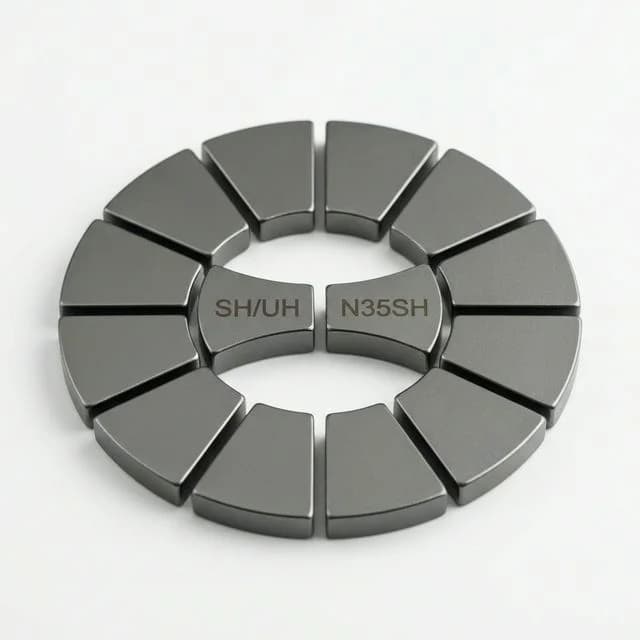
N42SH
Typical Br: 1.30-1.34 T
Max operating temperature: 150 C
Common SPM baseline for EV traction prototypes where cost and thermal margin must stay balanced.
Interpreted result with boundary-aware action
The output is more than a score: it includes uncertainty, explicit boundary notes, and a practical next step for your current state.
Core conclusions and decision boundaries
This middle layer turns raw checker output into strategic guidance: key numbers, where to trust, and who should or should not use this path.
| Audience | Suitable | Reason |
|---|---|---|
| Traction motor system engineer | Yes | Can quickly triage pole/slot/frequency/thermal constraints before simulation backlog. |
| Procurement + quality team | Yes | Can map grade choice to sourcing concentration and compliance-side constraints early. |
| Student-level conceptual learning only | Partially | Useful for structured understanding, but detailed formulas and project assumptions may be heavy. |
| Final production sign-off authority | No (alone) | Stage-1 output must be followed by simulation + bench + reliability evidence. |
| Area | Gap | Fix | Severity |
|---|---|---|---|
| Evidence recency and authority | Several conclusions depended on vendor/docs-style references and lacked 2025-2026 policy/market updates. | Replaced core sourcing evidence with USGS 2026, IEA 2025/2026, and EU CRMA benchmarks including explicit date markers. | high |
| Boundary over-generalization | Field-weakening guidance risked being read as a universal hard cap. | Added ORNL/UW counterexample (10:1 CPSR in SPM demonstrators) and reframed >3x as a screening trigger, not an absolute rejection rule. | high |
| Retention claim traceability | Tip-speed risk existed but lacked direct high-speed SPM case linkage. | Added ORNL 2023 outer-rotor SPM (20,000 rpm) retention evidence to support sleeve stress and overspeed-test escalation. | medium |
| Unknown-data disclosure depth | Only one unknown item was stated, leaving other high-impact blind spots implicit. | Expanded known-unknown section into structured N/A entries with impact and minimum evidence path. | medium |
How the checker works and where it fails
Method transparency is required for trust. Each step and boundary includes a reproducible decision-use statement.
| Step | Detail |
|---|---|
| 1. Lock declared basis | Use rated/continuous power basis, base speed, max speed, voltage, and current from one consistent duty definition. |
| 2. Compute electromagnetic pacing | Derive pole pairs, q-value, electrical frequency at max speed, and field-weakening ratio from declared geometry and speed range. |
| 3. Estimate thermal and retention proxies | Combine current, frequency, ambient, cooling path, and tip speed to estimate thermal margin and retention stress index. |
| 4. Convert to risk bands | Map indicators to fit/caution/high-risk verdict with explicit uncertainty and boundary notes close to output values. |
| 5. Attach sourcing and compliance constraints | Map grade and sourcing decisions to dated policy/market constraints (for example USGS/IEA concentration data and EU CRMA thresholds) before releasing long-lead procurement decisions. |
| Boundary | Valid when | Fails when | Action | Source |
|---|---|---|---|---|
| Rotor pole parity | Even pole count between 4 and 20 in this stage-1 checker. | Odd count or out-of-range values. | Correct pole count first and rerun all derived metrics. | Model constraint (deterministic checker rule) |
| Slot-pole-phase q window | q between 0.25 and 0.65 can be used as a first-pass triage window only. | q is outside that range and no winding/NVH validation evidence exists. | Treat this as heuristic only (not a regulatory threshold); close with FEA + NVH/ripple tests. | Heuristic (public standardized threshold: pending confirmation) |
| Electrical frequency at max speed | Frequency remains inside inverter and control-loop bandwidth plan. | High pole count + high max speed pushes control margin near limits. | Reduce pole count or max speed target, or re-architect inverter control plan. | Model arithmetic + control validation requirement |
| Field-weakening ratio | Many traction programs use roughly 2-3x base speed with validated current and voltage reserve. | Ratio above 3 is treated as universally impossible, or is targeted without explicit control-map and winding evidence. | Use >3x as a screening escalation trigger; evaluate FSCW/inductance design when wide CPSR is required. | R2 |
| Thermal margin | Estimated margin >= 15 C and the power basis is consistent (rated/net/30-min contexts are not mixed). | Margin < 15 C, hotspot confidence is low, or peak values are mixed into continuous assumptions. | Run thermal matrix and require supplier lot-level BH/demagnetization evidence before freeze. | R1, supplier lot validation required |
| Retention stress | Tip speed is within screened limits and sleeve/banding assumptions are already validated. | Tip speed > 120 m/s or no sleeve-stress/overspeed evidence exists for the selected rotor concept. | Escalate mechanical FEA, sleeve design review, and overspeed testing as pre-freeze gates. | R3 |
| Supply concentration and policy exposure | Program has approved dual-path sourcing and can satisfy market/policy constraints for target regions. | Single-path sourcing remains and dependency breaches program constraints (for EU-facing programs, 65% single-country cap is a critical reference line). | Create dual-path sourcing and compliance mapping before SOP schedule lock. | R4, R5, R6, R7, R8 |
Evidence gain, sources, and known unknowns
Core conclusions are source-backed with date markers. Unknown data is explicitly labeled as N/A instead of being guessed.
| Topic | Fact | Why it matters | Source |
|---|---|---|---|
| Power basis discipline | UN R85 keeps net power and maximum 30-minute power as separate regulated contexts for electric drive-train declarations. | Prevents peak/continuous basis mixing in early feasibility claims and RFQ communication. | R1 |
| Field-weakening counterexample | An ORNL-cited SPM demonstrator path reports 6 kW and 30 kW continuous machines achieving 10:1 constant-power speed operation with FSCW. | Prevents false binary decisions where SPM is rejected solely due to assumed fixed CPSR limits. | R2 |
| Retention evidence at high speed | ORNL 2023 reports a 20,000-rpm outer-rotor SPM case requiring explicit carbon-fiber sleeve stress validation. | Shifts rotor mechanical validation to a pre-freeze gate for high-speed programs. | R3 |
| Import dependence (U.S. 2025) | USGS reports net import reliance of 67% for rare-earth compounds/metals, with 71% of 2021-24 import sources attributed to China. | Quantifies concentration risk instead of relying on generic sourcing cautions. | R4 |
| Export-control timeline risk | USGS heavy-rare-earth chapter documents 2025 export-control changes that tightened license risk for several heavy REE materials. | Adds a concrete trigger for dual-path qualification and inventory policy. | R5 |
| Demand and concentration trajectory | IEA 2025 projects magnet-REE demand from 91 kt (2024) to 123 kt (2030); IEA 2026 release notes concentration around 60% mining, >90% refining, and nearly 95% permanent magnets. | Shows that supply pressure and concentration risk are both structural, not short-lived anomalies. | R6, R7 |
| Policy-side hard thresholds | EU CRMA public benchmarks target 10% extraction, 40% processing, 25% recycling, and <=65% single-country dependency by 2030. | Creates explicit compliance gates for EU-facing programs and procurement strategy. | R8 |
| ID | Source | Key data | Decision use | Date/context |
|---|---|---|---|---|
| R1 | UN Regulation No. 85 (UNECE) | Defines the framework for measuring net power and maximum 30-minute power of electric drive trains. | Used to keep power-basis language disciplined and avoid mixing incomparable power declarations in stage-1 screening. | Regulation title context (in-force updates listed through 2025), accessed April 23, 2026 |
| R2 | ORNL DOE report: Assessment of motor technologies for traction drives | Cites UW-Madison SPM demonstrators (6 kW and 30 kW continuous) reporting constant-power operation over a 10:1 speed range when FSCW is intentionally designed for flux weakening. | Used as a counterexample to prevent over-generalizing SPM field-weakening limits as absolute. | DOE/ORNL publication (2011), accessed April 23, 2026 |
| R3 | ORNL/IEEE 2023: Mechanical analysis of carbon-fiber sleeve for high-speed outer-rotor SPM | Analyzes a 20,000-rpm outer-rotor SPM and reports sleeve stress below material yield in the studied configuration. | Used to justify early retention-gate escalation for high-tip-speed SPM concepts. | Conference publication (October 2023), accessed April 23, 2026 |
| R4 | USGS Mineral Commodity Summaries 2026: Rare Earths | Reports U.S. net import reliance for compounds/metals at 67% in 2025; import sources in 2021-24 include China 71%, Malaysia 13%, Japan 5%, and Estonia 5%. | Used to quantify sourcing concentration and fallback-path urgency in NdFeB/SmCo planning. | USGS MCS (February 2026) |
| R5 | USGS Mineral Commodity Summaries 2026: Heavy Rare Earths | Documents 2025 export-control timeline changes affecting medium/heavy rare-earth elements and license conditions. | Used for scenario-level supply-shock risk framing and procurement contingency triggers. | USGS MCS (February 2026) |
| R6 | IEA Rare Earth Elements 2025 | STEPS table reports total magnet-REE demand 91 kt (2024) to 123 kt (2030), with top-three refining share 97% (2024) and 92% (2030). | Used to anchor demand-growth and concentration trajectory in mid-term sourcing assumptions. | IEA report (2025), accessed April 23, 2026 |
| R7 | IEA Rare Earth Elements 2026 release summary | States magnet rare-earth demand doubled since 2015 and is projected to rise >30% by 2030; cites concentration around 60% mining, >90% refining, and nearly 95% magnets, with estimated diversification investment need of $60 billion. | Used for strategic risk sizing, including capacity-gap and investment-readiness discussions. | IEA news release (April 2026) |
| R8 | European Commission: Critical Raw Materials Act implementation page | Lists 2030 benchmarks: 10% extraction, 40% processing, 25% recycling, and no more than 65% from a single third country; also indicates 27-month extraction and 15-month processing/recycling permitting paths for strategic projects. | Used as compliance boundary input for EU-facing sourcing and permitting timelines. | Regulation adopted 2024; page accessed April 23, 2026 |
| Topic | Current status | Decision impact | Minimum evidence path |
|---|---|---|---|
| Global SPM share by EV power band and year | No standardized open dataset with consistent topology labeling across regions and years. | Any global-share claim can be misleading if based on teardown anecdotes. | Use internal teardown + shipment evidence with explicit geography/time scope before publishing share claims. |
| SPM vs IPM cost delta under one normalized RFQ | Public benchmark data is N/A for same-duty, same-validation-scope comparisons. | Blanket cost-winner statements risk incorrect architecture choice. | Build a program-specific RFQ model with matched duty cycle, reliability scope, and sourcing assumptions. |
| Lot-level demagnetization margin by grade and supplier | Catalog envelopes are public, but lot-level BH and irreversible-demag test data are generally non-public. | Thermal margin may be overstated if only catalog envelopes are used. | Require supplier lot-level magnetic test reports at target temperatures before design freeze. |
Alternatives, tradeoffs, and concrete risk controls
Use this layer to avoid single-metric decisions. Architecture choice must account for performance, manufacturability, sourcing, and compliance.
| Option | Strengths | Risks | Best for | Avoid when |
|---|---|---|---|---|
| SPM motor (surface PM) | Simple rotor manufacturing path, strong torque density, fast prototype iteration. | Field-weakening ceiling and retention stress can dominate at high speed. | Mid-speed traction and programs prioritizing manufacturing simplicity. | Very wide constant-power speed range without current margin evidence. |
| IPM motor (interior PM) | Reluctance torque contribution and wider field-weakening capability in many designs. | Rotor geometry complexity and manufacturability constraints. | High speed-range programs requiring broad field-weakening windows and efficiency shaping. | Program timeline cannot absorb rotor complexity and validation load. |
| Induction motor | No permanent magnets and less direct rare-earth dependency. | Typically higher rotor losses and cooling load for equal torque targets. | Programs prioritizing magnet-free strategy and robust high-speed behavior. | Low-speed efficiency and compact torque density are top priorities. |
| Axial-flux PM variants | High torque density potential and packaging flexibility in some form factors. | Manufacturing maturity, cooling path complexity, and supply constraints vary by architecture. | Platform-level redesign where packaging and torque density justify integration changes. | Existing radial-flux production line cannot absorb architecture disruption. |
Prioritize mitigation where probability and impact both sit in upper bands.
| Risk | Probability | Impact | Mitigation |
|---|---|---|---|
| Misused power basis (peak as continuous) | Medium | High | Force one declared rated/continuous basis in RFQ and checker input gate; keep peak as separate scenario. |
| Overstated field-weakening expectation | Medium | High | Lock speed-ratio target with current reserve, voltage margin, and control-map verification. |
| Retention failure at high tip speed | Low-Medium | Critical | Add sleeve/banding design review and overspeed test before geometry freeze. |
| Thermal margin erosion in hot ambient duty | Medium | High | Run thermal matrix including worst-case ambient and coolant boundary conditions. |
| Single-path material sourcing exposure | Medium | High | Define grade fallback and region diversification triggers before long-lead PO; use USGS/IEA concentration data and EU CRMA thresholds as formal gate criteria. |
| Export-control shock on heavy rare-earth supply | Medium | High | Build inventory and supplier redundancy plans around known 2025 export-control volatility patterns; avoid one-license-path dependency. |
Three execution scenarios with premise-process-outcome
Scenario framing prevents abstract recommendations and helps teams map this page to real project decisions.
Premise
Program keeps 400 V inverter and targets moderate top speed with cost-sensitive BOM.
Process
Run balanced preset, confirm q-window and thermal margin, then compare N42SH vs N35UH fallback path.
Outcome
SPM stays viable when thermal margin >= 15 C and speed ratio remains near 2.5 with validated control reserve.
Premise
Program target pushes max speed above 13k rpm with strict NVH and durability targets.
Process
Run high-speed preset, monitor electrical frequency and tip speed thresholds, and force retention validation path.
Outcome
Often lands in caution/high-risk until field-weakening and retention evidence is closed.
Premise
Vehicle operates in 50+ C ambient with long uphill continuous load exposure.
Process
Run high-temperature preset and compare grade options with cooling-mode constraints.
Outcome
SmCo or higher thermal class may be justified only when lifecycle cost and supply fallback are pre-approved.
FAQ grouped by decision intent
Questions are grouped by practical intent so users can move from uncertainty to action quickly.
Move from screening to engineering execution
Use the copied summary in your internal review, then request support for geometry, grade, or sourcing strategy validation.