Arc Magnets for Motors: Sizing, Grades & Risks
Motor arc magnets (NdFeB, SmCo, Ferrite) must be matched precisely to thermal and mechanical limits. Use this checker to determine material suitability, required grades, and identify demagnetization or centrifugal risks before finalizing your rotor design.
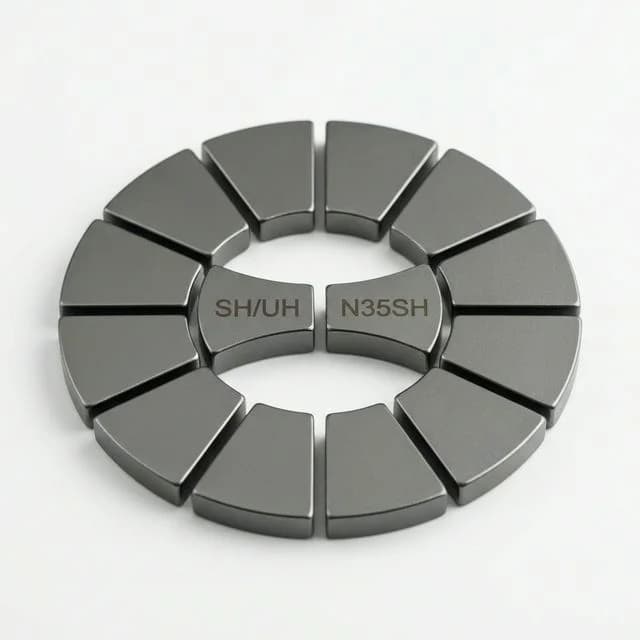
Motor Arc Magnet Suitability Checker
Input your basic motor parameters to screen for material limits and structural risks.
Screening range: -40°C to 350°C magnet temperature and 0 to 100,000 RPM. Empty or out-of-range values return recovery guidance instead of a broken result.
Ready to Evaluate
Enter your motor parameters and click Check Suitability to see material recommendations and risks.
Motor Arc Magnet Design Report
This report details the methodology behind motor arc magnet selection, focusing on thermal boundaries, retention under speed, and material choices backed by industry standards.
Published: July 26, 2026. Updated: July 26, 2026. Evidence access dates are listed in the source table.
Material choice by motor constraint
| Material path | Best fit | Watchout | Action |
|---|---|---|---|
| NdFeB arc magnets | Compact BLDC/PMSM rotors needing high torque density. | Coercivity falls with temperature; coating and grade suffix must match duty cycle. | Use SH/UH/EH family and corrosion coating when heat or moisture is present. |
| SmCo arc magnets | High-temperature, high-speed, aerospace, motorsport, or corrosive motor environments. | Higher material cost and brittle machining behavior require earlier supplier review. | Use when NdFeB thermal margin is weak or corrosion exposure dominates the design. |
| Ferrite arc magnets | Cost-sensitive DC, fan, pump, and larger low-torque motor housings. | Lower energy density means larger magnet volume and weaker compact motor torque density. | Choose only when package size, low torque, and commodity supply matter more than compact output. |
Risk boundaries and mitigation
| Risk | Trigger | Mitigation |
|---|---|---|
| Thermal demagnetization | Continuous or peak magnet temperature exceeds grade margin. | Request full BH curves, model load-line margin, add temperature sensors, and derate peak current. |
| Magnet lift-off at speed | Surface-mounted inner rotor arcs above moderate RPM without retention analysis. | Use carbon-fiber/Inconel sleeve, banding, or move to IPM geometry before high-speed testing. |
| Corrosion and adhesion loss | NdFeB exposed to humidity, salt spray, coolant vapor, or weak adhesive process control. | Specify epoxy or NiCuNi+epoxy coating, bonding surface prep, and validation coupons. |
| Eddy-current heating | High electrical frequency, PWM harmonics, or conductive rare-earth magnets in thin air gaps. | Compare segmented or laminated arc magnets in electromagnetic and thermal simulation. |
Evidence & Guidelines
Recommendations are based on mechanical and magnetic limits for surface-mounted and interior permanent magnets in radial flux motors.
| Source Context | Engineering Signal | Impact on Selection |
|---|---|---|
| Arnold Magnetic Technologies NdFeB grade catalogAccessed July 26, 2026Source | Public NdFeB grade data lists standard N grades with 80°C maximum use temperature and higher-temperature suffix families for motor duty. | Sets the checker grade suffix ladder and warns when standard N grades are used above normal temperature limits. |
| Arnold Magnetic Technologies RECOMA SmCo product dataAccessed July 26, 2026Source | RECOMA SmCo is positioned for high-speed, high-temperature, and corrosive environments, including electric motors and generators. | Shifts recommendation from NdFeB to SmCo when temperature or corrosive exposure becomes the dominant constraint. |
| Dura Magnetics NdFeB corrosion resistance guideAccessed July 26, 2026Source | NdFeB has poor corrosion resistance and commonly needs protective coating; multi-layer Ni-Cu-Ni may still be insufficient for every environment. | Drives the humid/corrosive coating warning instead of treating coating as a cosmetic option. |
| MMPA Standard No. 0100-00 permanent magnet materialsAccessed July 26, 2026Source | The standard frames permanent magnet material properties with magnetic, thermal, physical, and mechanical dimensions rather than price alone. | Keeps the report comparison focused on reproducible design dimensions: energy density, temperature, corrosion, and mechanical risk. |
| Arnold Wraptite carbon-fiber encapsulationAccessed July 26, 2026Source | Composite sleeves are presented as a containment option for high-performance systems where rotational speeds can exceed 50K RPM. | Supports the high-speed retention recommendation for carbon fiber or metallic sleeves rather than adhesive-only fixation. |
| Calnetix rotor retention and loss reduction noteAccessed July 26, 2026Source | High-speed permanent-magnet rotors need retention choices that balance sleeve strength, magnetic gap, and losses. | Explains why the checker escalates from adhesive to banding or sleeve recommendations as RPM increases. |
| Electric Machines & Control Application PM segmentation studyAccessed July 26, 2026Source | Segmented permanent magnets are analyzed as an eddy-current loss reduction method for surface permanent magnet synchronous motors. | Supports the report boundary that high-speed/frequency programs should evaluate segmentation or lamination in FEA. |
| DOE rare earth permanent magnets supply chain reportAccessed July 26, 2026Source | DOE identifies NdFeB permanent magnets as critical components for advanced motor systems and details concentration, volatility, and supply resilience risks. | Frames cost and continuity risk as dated sourcing assumptions that must be rechecked at RFQ time. |
Next decision paths
Frequently Asked Questions
Magnet Types & Materials
Engineering Risks
Design & Sourcing
Ready to finalize your motor magnet specification?
Whether you need a custom NdFeB arc for a high-speed BLDC or an SmCo segment for extreme temperatures, our engineering team can review your design limits and provide an actionable quote.