Enter the quote fields you know. The checker returns whether your arc magnet request is a budget request, RFQ-ready, non-comparable, or needs engineering hold before price ranking.
Tool first
Result in one run
Quote pack
12 core fields
Evidence dated
June 14, 2026
Boundary: 5-400
Boundary: 1-390
Boundary: 5-180
Boundary: 2-180
Boundary: 1-1000000
Boundary: 1-12
Boundary: 3-240
Boundary: -40-320
Boundary: 0-60000
Required for comparable delivered-cost quotes; budget requests may leave it provisional.
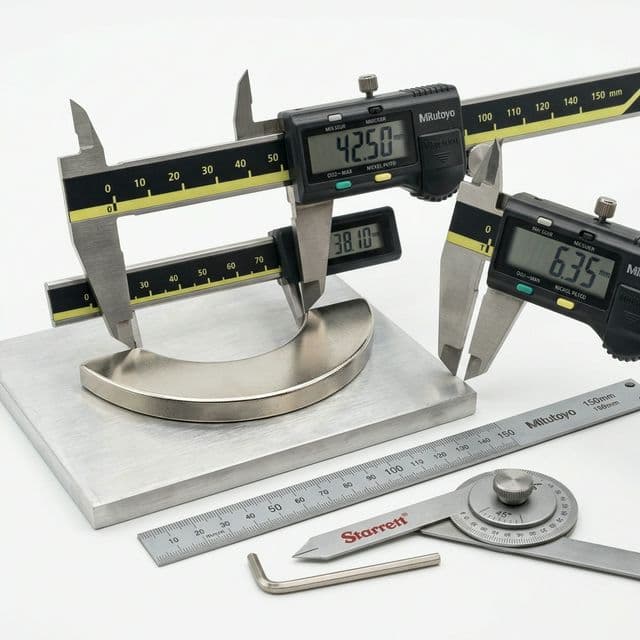
The RFQ package should tie every supplier response back to the same OD, ID, arc angle, length, tolerance convention, and drawing revision. Visual measurement context makes the quote request easier to audit than a price-only email thread.
Quote readiness score
Run the checker to classify quote readiness and expose missing RFQ fields.
Radial thickness
Pending
Arc length
Pending
Approx. volume
Pending
Tip speed
Pending
Missing or watch fields
Suitable for
Not suitable for
The dominant useful intent is quote preparation and supplier comparison. The page keeps price estimation, pricelist generation, and manufacturer qualification as adjacent routes instead of duplicating them here.
OD, ID, arc angle, length, material, grade, coating, magnetization, quantity, lead time, operating temperature, and destination should be normalized before quote comparison.
One quote can set a budget signal; three or more supplier responses are a more defensible baseline for commercial comparison.
A quote can confirm commercial intent, but magnetic performance, retention, coating, and thermal behavior still need supplier evidence and sample tests.
Official reports, standards pages, supplier RFQ pages, and trade guidance were checked on June 14, 2026. Supplier prices, stock, export controls, and quote validity are time-sensitive.
Quote lines that say only N42, N48SH, or SmCo grade are incomplete unless measured properties and a test method are attached.
Regulated products may need origin, composition, recyclability, recycled-content, DFARS/customer flow-down, or import documentation before purchase.
The scoring is deterministic. It rewards drawing control, material clarity, magnetization, coating, supplier count, evidence maturity, and destination clarity, then penalizes high heat, high speed, compressed schedule, or material uncertainty.
| Step | Inputs | Output | Boundary |
|---|---|---|---|
| Specification completeness | Geometry, material, coating, magnetization, destination | Spec completeness score and missing-field list | The tool does not verify drawing tolerances or supplier interpretation of arc/chord definitions. |
| Quote comparability | Quote goal, buyer stage, suppliers to compare, evidence level | Quote readiness and comparability status | It cannot pull live supplier stock, currency, freight, tariff, or tooling offers. |
| Application risk screen | Temperature, RPM, material family, set quantity, lead time | Engineering-hold flags for heat, speed, schedule, and material uncertainty | Final release still needs magnetic, thermal, mechanical, coating, and assembly validation. |
| RFQ package output | All user fields plus checker result | Quote pack, next action, supplier inquiry body | Supplier commercial terms and technical acceptance criteria must still be negotiated. |
A quote pack should let suppliers respond to the same technical, evidence, and commercial baseline. Unknown values are allowed for early budgets, but they must be labeled as assumptions.
| Module | Include | Why it matters |
|---|---|---|
| Geometry package | OD, ID, arc angle, length, segment count, tolerances, drawing revision, and datum convention | Prevents suppliers from quoting incompatible radius, chord, or arc definitions. |
| Magnetic package | Material, grade, Br, HcB, HcJ, BHmax, test method, magnetization diagram, and operating temperature | Makes grade claims comparable and ties performance to application limits. |
| Surface and assembly package | Coating, corrosion target, adhesive/retention method, handling notes, inspection points | Controls coating failure, adhesive mismatch, and mechanical retention risk. |
| Commercial package | Sample, pilot, production quantities, target lead time, Incoterms 2020 rule, named place, destination, currency, and quote validity | Separates prototype price from production economics and logistics assumptions. |
| Logistics and customs package | Packaging, export paperwork, insurance basis, customs party, HS code assumption, freight exclusion/inclusion, and magnet shipping notes | Prevents a low part price from hiding shipment, documentation, or import-risk differences. |
| Compliance package | Origin, composition, RoHS/REACH, customer flow-downs, recycled-content/recyclability fields where relevant | Avoids treating compliance evidence as a post-order paperwork task. |
| Validation package | Sample plan, dimensional inspection, magnetic test method, certificate linkage, coating checks, retention review, and exception log | Keeps a quote from being mistaken for production or motor-performance approval. |
The checker does not estimate live supplier price, real-time stock, tooling cost, exchange rate, freight, tariff, yield, or sample performance.
Treat incomplete supplier responses as open questions, not as equivalent cheaper offers.
Public sources support the structure of the quote pack, but final acceptance values must come from your drawing, purchased standards where applicable, supplier certificates, and sample validation.
| ID | Source | Signal | Use on this page | Date |
|---|---|---|---|---|
| S1 | ASTM A1101-23 NdFeB magnet specification page | ASTM lists sintered and fully dense NdFeB permanent magnets as commercially available across wide compositions and magnetic properties, with Br and HcJ ranges shown in the public abstract. | Turns a quote line from a grade label into a request for magnetic properties, certificate linkage, and material acceptance evidence. | Accessed June 14, 2026 |
| S2 | IEC 60404-5:2015 permanent magnet measurement listing | IEC 60404-5:2015 defines measurement methods for flux density, magnetic polarization, field strength, demagnetization curve, and recoil line of permanent magnet materials. | Supports asking suppliers to identify the test method behind Br, HcJ, BHmax, and certificate claims. | Accessed June 14, 2026 |
| S3 | USGS Mineral Commodity Summaries 2026: Rare Earths | USGS reports 2025 U.S. rare-earth mine output at 51,000 metric tons REO in mineral concentrates; rare-earth compounds/metals imports rose 169% in 2025, and magnets were the leading global end use. | Adds date-bound supply-risk context; it does not convert directly into a per-piece arc magnet quote. | 2026 report, accessed June 14, 2026 |
| S4 | USGS Mineral Commodity Summaries 2026: Heavy Rare Earths | USGS identifies terbium and dysprosium among heavy rare earths used in high-strength magnets and reports China export-control changes in April, October, and November 2025. | Supports quote-validity, Dy/Tb exposure, allocation, and fallback-grade questions for high-HcJ or high-temperature magnets. | 2026 report, accessed June 14, 2026 |
| S5 | European Commission Critical Raw Materials Act page | The Commission describes 2030 strategic raw material benchmarks: 10% extraction, 40% processing, 25% recycling, and no more than 65% from a single third country; it also references permanent magnet recyclability and recycled-content requirements. | Turns EU-bound quote requests into early origin, composition, recyclability, recycled-content, and safe-removal questions. | Accessed June 14, 2026 |
| S6 | European Court of Auditors Special Report 04/2026 | ECA treats rare-earth elements for permanent magnets as a strategic raw material grouping and reports EU dependence above 65% on China for processed rare-earth elements relevant to permanent magnets. | Explains why EU quote packs should ask for origin, supply-risk exceptions, and substitution notes without pretending public data can predict supplier capacity. | 2026 report, accessed June 14, 2026 |
| S7 | U.S. International Trade Administration Incoterms guidance | The ITA explains that Incoterms define seller and buyer responsibilities for shipment, insurance, documentation, customs clearance, tasks, costs, and risk. | Supports requiring an Incoterms 2020 rule and named place before comparing delivered quote lines. | Accessed June 14, 2026 |
| S8 | eCFR 16 CFR Part 1262 Safety Standard for Magnets | The U.S. rule covers certain consumer products with loose or separable magnets and excludes products sold solely to professional, commercial, or industrial users; covered small magnets must have flux index below 50 kG2 mm2. | Prevents overapplying consumer magnet rules to industrial motor arcs while flagging U.S. consumer-adjacent quote cases. | Accessed June 14, 2026 |
| S9 | Stanford Magnets neodymium arc magnets page | The supplier page presents arc magnets for motors/generators, states that specific sizes can be requested for a custom quote, and lists size, grade, coating, orientation, and drawing upload signals. | Supports the practical RFQ pack fields while keeping supplier claims separate from standards and macro supply evidence. | Accessed June 14, 2026 |
| S10 | K&J Magnetics custom neodymium magnets page | The supplier states custom magnet quotes can cover many shapes, sizes, and grades, with custom order minimum purchase and multi-week fulfillment notes. | Provides a public counterexample to instant stock pricing: custom quotes may include MOQ, lead time, and non-recurring assumptions. | Accessed June 14, 2026 |
| Claim | Evidence needed | Public support | Limitation |
|---|---|---|---|
| Custom arc magnet quote | Drawing revision, geometry convention, grade, coating, magnetization diagram, and quantity tiers | Supplier pages commonly invite custom quotes and exact specification submission. | Public pages do not prove the supplier can meet your exact tolerance, yield, or lead time. |
| N-grade or high-temperature NdFeB | Br, HcB, HcJ, BHmax, test method, test temperature, and certificate sample geometry | Arnold and standards listings show why magnetic property tradeoffs matter beyond grade names. | A batch certificate is not final assembled motor validation. |
| Fast quote for production quantity | Tooling status, fixture plan, process route, yield assumptions, quote validity, and shipment terms | Custom arc magnet pages indicate quote-first workflows; production repeatability still needs process evidence. | Live capacity, freight, tariff, and supplier allocation cannot be inferred from public snippets. |
| EU-ready or traceable magnet | Origin, composition, recyclability, recycled-content statement, safe-removal data, and customer flow-down mapping | EU Critical Raw Materials Act direction makes magnet circularity and traceability commercially relevant. | Exact obligations depend on product category, date, importer role, and customer contract. |
| Source family | RFQ question to ask | Decision use |
|---|---|---|
| ASTM / IEC | Which measured Br, HcB, HcJ, BHmax, temperature, and test method will appear on the certificate? | Reject quote lines that use only a grade label when the goal is pilot, production, or high-temperature comparison. |
| USGS rare earths | Does the quoted grade depend on Dy/Tb or another constrained heavy rare earth, and how long is price/material allocation valid? | Ask for fallback grades before locking a high-HcJ NdFeB or SmCo quote into a schedule. |
| EU CRM Act / ECA | For EU-bound programs, can the supplier state origin, composition, recyclability, recycled-content status, and safe-removal assumptions where in scope? | Keep unknown fields marked as pending; do not claim EU readiness from a generic supplier quote. |
| ITA Incoterms | What Incoterms 2020 rule, named place, insurance basis, documentation responsibility, and customs party does the price assume? | Normalize freight and import risk before ranking delivered or landed quote totals. |
| 16 CFR Part 1262 | Is the magnet sold solely for industrial/professional use, or could it become a U.S. consumer product with loose or separable magnets? | Document the commercial-use boundary or request flux-index/product-safety review before consumer-channel quoting. |
| Supplier RFQ pages | Are MOQ, tooling, magnetization fixture, sample lead time, production lead time, and exception notes separated? | Avoid comparing stock, prototype, and custom tooling economics as if they were the same offer. |
| Unconfirmed item | Why public evidence is insufficient | Minimum action |
|---|---|---|
| Live unit price | Public rare-earth and supplier pages do not map a generic arc geometry to tooling, yield, freight, tariff, and margin. | Use the checker for RFQ completeness, then request supplier price rows. |
| Supplier process capability | A public product page cannot prove tolerance capability, magnetization fixture readiness, coating yield, or repeatability for your drawing. | Ask for sample plan, inspection method, exception notes, and process evidence. |
| Final motor performance | Standards pages and certificates describe material evidence, not assembled air-gap flux, retention, heat soak, or torque validation. | Treat quotes as sourcing inputs and run sample-level validation before PO release. |
| Regulatory applicability | EU raw-material obligations and U.S. consumer magnet rules depend on product category, role, destination, and date. | Mark compliance fields pending until the importer, customer flow-downs, and sales channel are known. |
Quote requests can look similar while carrying very different technical and commercial risk. The table separates budget, comparable RFQ, PO-ready, and engineering-hold routes.
| Route | Best for | Required evidence | Risk | Action |
|---|---|---|---|---|
| Budget quote request | Early concept, investor estimate, supplier discovery | Basic geometry and target material assumptions | Wide quote spread; suppliers may quote different assumptions | Ask for ranges and list every assumption as provisional. |
| Comparable RFQ | Sample or pilot sourcing with at least three suppliers | Drawing, material/grade, coating, magnetization, quantity tiers | Missing certificate/test method can hide performance differences | Normalize fields and reject quote lines with unclosed assumptions. |
| PO-ready quote | Production program after sample and evidence review | Controlled drawing, certificate, inspection plan, delivery, packaging, compliance evidence | Quote may still fail if process capability or validation is incomplete | Freeze acceptance criteria and sample validation before purchase order. |
| Engineering hold | High heat, high RPM, unknown material, safety-critical use | Design assumptions, magnetic/thermal/mechanical review | Fast quote can encourage a poor material or geometry lock | Resolve engineering constraints before commercial comparison. |
| Risk | Trigger | Impact | Mitigation |
|---|---|---|---|
| Non-comparable quotes | Suppliers quote different grades, tolerances, coatings, or Incoterms. | The lowest line item may be the least complete offer. | Use one RFQ pack and require exception notes for every supplier deviation. |
| Magnetization ambiguity | The quote says arc magnet but omits radial, diametrical, or circumferential direction. | A physically fitting part may fail torque, sensor, or assembly requirements. | Attach a magnetization diagram and require supplier confirmation before samples. |
| Thermal demagnetization | High operating temperature with only an N-grade label and no HcJ evidence. | Samples can lose margin under peak duty even if room-temperature flux looks acceptable. | Ask for HcJ, irreversible loss data where available, and grade fallback options. |
| Tooling and fixture surprise | Custom arc, new magnetization fixture, or tight tolerance is not separated in the quote. | Unit price, lead time, and repeatability change after quote acceptance. | Split tooling, fixture, sample, and production rows in the supplier response template. |
| Compliance gap | Destination market, origin, chemical composition, or customer flow-down is absent. | A technically acceptable magnet can be rejected by the buyer or importer. | Name destination and compliance evidence in the first quote request. |
| Rare-earth supply exposure | High-temperature NdFeB, Dy/Tb exposure, or SmCo is quoted without validity and allocation notes. | Price and lead time can change before sample or production release. | Ask for quote validity, substitution plan, and heavy rare-earth exposure where relevant. |
Ask for a range and supplier assumptions, then create a controlled drawing before comparison.
Attach magnetization diagram and require certificate/test-method fields before price ranking.
Resolve HcJ, rare-earth exposure, retention, thermal margin, and compliance evidence before PO quoting.
Ask suppliers to quote against measured Br/HcJ/BHmax target or test a reference sample.
This route owns RFQ readiness and quote comparability. Use these pages for price bands, tiered pricelists, online buying, manufacturer qualification, and material-specific decisions.
Budget request
RFQ cleanup
Supplier screening