EVMotorMagnets logoEV Motor Magnets
  • About Factory
  • Blog Insights
  • Contact Inquiry
WhatsApp
EVMotorMagnets logoEV Motor Magnets

China factory for EV and industrial motor magnets with OEM customization support

Products
  • EV Traction Magnets + 5-Phase Checker
  • Axial Flux Generator Magnet Notes
  • Back-EMF Engineering Knowledge
  • About SPM Motor Checker
Capabilities
  • OEM Customization
  • Prototype and Small-Batch
  • Quality and Traceability
  • FAQ
Resources
  • Learn Resources
  • about spm motor guide
  • Blog Insights
  • OEM Process
  • Contact Inquiry
Company
  • About Factory
  • Contact Inquiry
Legal
  • Cookie Policy
  • Privacy Policy
  • Terms of Service
© 2026 EV Motor Magnets. All Rights Reserved.|Backed by Linkup Ai Co., Ltd. Manufacturing delivered by the Advanced Manufacturing Division of Linkup Precision.
Hybrid manufacturing process checker + report

Arc magnet manufacturing process checker

Screen the arc magnet manufacturing process behind a drawing before supplier DFM, quote, and sample planning. Then use the report layer to validate process steps, evidence, risks, and RFQ boundaries on the same URL.
Run the defaults first, then adjust the fields below for your drawing.

mm
mm
deg
mm
C
sets
weeks

Defaults model a pilot-stage sintered NdFeB motor arc. Boundary ranges are deliberately broad because this is a screening tool, not a release specification.

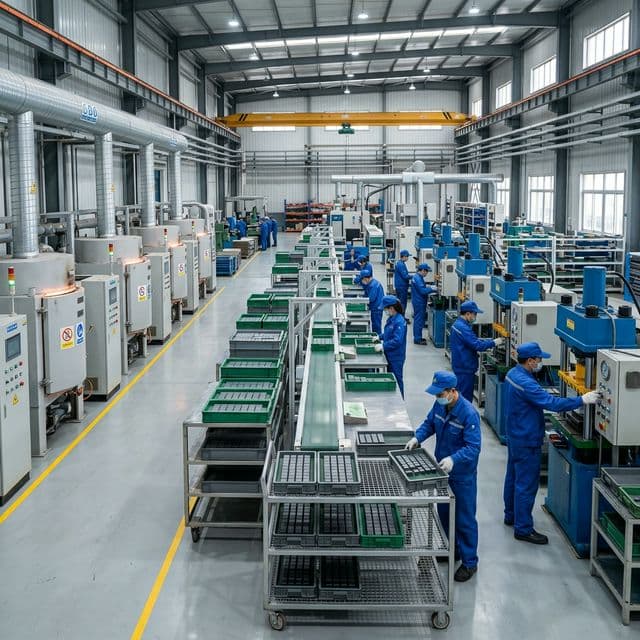
Arc magnet manufacturing process with machining, coating, magnetization, and inspection workflow
Screen arc magnet manufacturing process readiness first, then validate route evidence, risks, and RFQ actions in one hybrid flow.
Engineering review first
The manufacturing route is plausible, but the drawing or validation package needs engineering review before firm timing and yield assumptions.
70

Readiness

70/100

RFQ completeness

89%

Arc length

44.0 mm

Radial thickness

12.0 mm

Machining risk45/100
Coating risk38/100
Magnetization risk27/100
Next action
Run supplier DFM first: ask for machining yield, coating feasibility, magnetization fixture limits, and inspection-control proposal.

Process route

Alloying/strip casting -> hydrogen decrepitation -> jet milling -> alignment and pressing -> sintering/heat treatment -> arc machining -> coating -> magnetization -> inspection

Boundary notes

  • DOE deep-dive route plus supplier process disclosures
  • Simple constant-radius arc
  • Must be explicit in drawing and fixture capability.
  • Temperature is near or above the selected route screening limit.
  • Lead time allows a basic DFM/sample review path.

This is a screening model. It does not know supplier-specific fixtures, cutter geometry, coating chemistry, magnetizer field strength, actual material yield, or your assembly validation plan.

Inquiry Email

[email protected]

Open email appStart inquiry (opens email app)
RFQ completeness

89%

A drawing becomes quote-ready only when process-defining fields are explicit.

Machining exposure

45/100

Arc geometry usually concentrates cost and yield risk in grinding, slicing, and edge control.

Route boundary

Sintered NdFeB

Temperature, coating, and coercivity needs decide whether standard NdFeB, GBD, ferrite, or SmCo is plausible.

Report summary

Core conclusions for arc magnet manufacturing process decisions

The report layer explains why the checker asks for geometry, tolerance, coating, magnetization, temperature, volume, and lead time before supplier review.

Decision-grade conclusions
Each conclusion includes scope and a source trail. Do not treat these as universal pass/fail standards.
ConclusionKey numberApplies toNot forEvidence
Most motor-grade neodymium arc magnets are not pressed directly to final arc dimensions; they are commonly machined from sintered blanks before coating.DOE highlights machining as the largest material-loss stepSintered NdFeB arc, tile, sector, and irregular shapesInjection-bonded magnets or ferrite routes with different tooling economicsS1, S4
A manufacturing-process RFQ is incomplete if magnetization direction is not explicit.1 polarity map needed per assembly orientationRadial-flux motors, segment sets, and direction-sensitive field modelsEarly concept sketches that only compare rough material optionsS1, S5
Coating is a process gate, not a cosmetic finish, because NdFeB needs corrosion protection after machining.DOE cites nickel film around 5-10 microns in its process descriptionNdFeB arcs exposed to humidity, adhesive, or salt/fog validationUncoated SmCo or ferrite choices where corrosion path differsS1, S6
GBD can raise coercivity for hotter operation, but it adds process steps and supplier-qualification risk.Adds diffusion coating + heat-treatment gateHigh-temperature NdFeB motor arcs where Br loss must be limitedCost-first low-temperature products with sufficient SH/UH marginS2, S3
A quote-ready process package should include drawing, tolerance, grade, coating, magnetization map, inspection plan, and packaging constraints.7 minimum RFQ fields before supplier DFMPrototype, pilot, and SOP arc magnet sourcingInformal catalog lookup without custom manufacturing expectationS1-S7
IEC and ASTM magnet standards support property measurement and material specification, but they do not release a finished motor arc assembly by themselves.Separate material certificate from FAI, flux map, and coating validationSupplier qualification, incoming inspection, and engineering sign-offAssuming a standards-compliant material lot automatically passes rotor validationS3, S8
Process route visual
Tool output maps to a manufacturing flow, not only to a score.
AlloyPowderPressSinterMachineCoatMagnetizeArc-specific risk concentrates after sintering
Powder routeMaterial and grade
Shape routeMachining and coating
Release routeMagnetization and inspection

Methodology

How the checker converts drawing inputs into a process-readiness verdict

The model is intentionally transparent: it uses route, geometry, tolerance, magnetization, temperature, volume, and lead-time penalties to surface risks that supplier DFM must resolve.

Readiness score
Composite of machining, coating, magnetization, timing, and production-stage pressure.
70
Machining risk
Raised by thin arcs, eccentric geometry, tight tolerance, and SOP volume.
Coating risk
Raised by route corrosion sensitivity, geometry coverage, and temperature.
38
Magnetization risk
Raised when direction is radial or missing from drawing data.
NS

Comparison

Manufacturing route tradeoffs

The right process is not always the highest magnetic-strength route. Package space, heat, coating, qualification cost, and supply risk decide the route.

OptionMain advantageMain tradeoffBest forAvoid when
Sintered NdFeB arcHighest mainstream motor flux density and mature supply baseMachining/coating risk and rare-earth supply exposureCompact EV, drone, BLDC, and servo motorsOperating temperature or corrosion profile exceeds grade/coating confidence
GBD NdFeB arcHigher coercivity at hot edges with less Br sacrifice than bulk HREE loadingExtra diffusion process, cost, and supplier qualification burdenHot rotors where UH/EH margin is tightLow-temperature cost-first designs or unqualified diffusion partners
Ferrite arcLower raw-material risk and strong temperature toleranceLower remanence usually needs larger motor packageCost-sensitive fans, pumps, and larger envelopesHigh torque density is mandatory in a fixed rotor package
SmCo arcHigh-temperature stability and corrosion advantagesHigher cost and brittle machining sensitivityAerospace, downhole, or high-temperature industrial dutyCommodity motor cost target dominates
Bonded arc or ringNear-net shapes and complex multipole magnetization can be easierLower magnetic energy product than sintered NdFeBSensors, small motors, and geometry-heavy packagesMaximum air-gap flux is the primary constraint
Route map
Higher process capability usually costs more qualification time.
Qualification burdenTemperature / flux capabilityFerriteBondedSintered NdFeBGBD NdFeBSmCo

Risks and boundaries

What can go wrong when process details are missing

These are not theoretical warnings. They are the common places where arc magnet quotes become unreliable after price, tooling, or first article review.

Risk heatmap
Red zones need DFM evidence before commitment.
LowMediumHighMediumHighHighHighHighCriticalProbability x impact
RiskProbabilityImpactTriggerMitigation
Machining scrap and edge chippingHighHighThin arcs, tight tolerance, eccentric geometry, or no datum planAdd chamfer/radius notes, relax nonfunctional tolerance, request sample yield and FAI photos.
Wrong magnetization directionMediumHighDrawing says only "arc magnet" without radial/parallel/polarity mapSupply polarity diagram, fixture expectation, and marked sample requirement.
Coating mismatchMediumHighAdhesive, humidity, salt, or high-temperature exposure not statedSpecify coating stack, thickness, adhesion test, and environmental validation.
Grade overpromiseMediumMediumHigh Br grade requested at temperature above process confidenceCompare SH/UH/EH or GBD route and ask for demagnetization curve at temperature.
Inspection plan too light for SOPHighMediumRecurring production without Cpk, MSA, flux map, or traceability requirementAdd control plan, lot sampling, magnetic inspection, and packaging verification.
Manufacturing advice boundary
This page supports process screening and RFQ preparation. It does not certify a material lot, approve rotor retention, replace supplier PPAP/FAI evidence, or prove environmental reliability.

Scenario examples

How to interpret common manufacturing-process cases

Use these scenarios to decide whether to quote, request supplier DFM, or pause until missing process data is available.

Pilot BLDC rotor arc
Sintered NdFeB, radial magnetization, 60 degree arc, 0.05 mm tolerance, 8-week lead time

Expected outcome: Usually engineering-review or quote-ready if coating and inspection are clear.

Minimum action: Send drawing, polarity map, coating stack, and FAI/flux-map request.

Thin eccentric traction arc
GBD NdFeB, eccentric arc, 0.03 mm tolerance, high temperature, SOP volume

Expected outcome: Engineering-review unless supplier proves machining yield, diffusion route, and control plan.

Minimum action: Request DFM review before price lock and run sample yield gate.

Catalog-like ferrite motor arc
Ferrite, simple arc, moderate tolerance, larger envelope, stable temperature

Expected outcome: Quote-ready when fixture and magnetization are standard.

Minimum action: Confirm grade, dimensions, magnetization direction, and dimensional inspection plan.

Unknown polarity replacement magnet
Material unknown, magnetization unknown, no original drawing, small quantity

Expected outcome: Rework-first because manufacturing cannot infer field direction safely.

Minimum action: Measure sample polarity/flux and reverse-engineer geometry before RFQ.

Known and unknown

Evidence limits that should stay visible in the buying process

Public process explanations are useful, but quote decisions must account for supplier-specific capability.

TopicKnownUnknownDecision treatment
Supplier-specific yieldDOE and supplier sources identify machining as a major loss/risk step.Actual yield depends on blank size, cutter, fixture, tolerance, and operator controls.Ask for sample-run yield or a DFM risk statement before SOP pricing.
Coating stack equivalenceNickel, epoxy, zinc, phosphate, and multilayer coatings are common.Equivalent corrosion performance is not guaranteed across coating vendors.Tie coating to test method and environment, not just coating name.
Magnetization fixture capabilityArc magnets can require direction-sensitive magnetization.Public pages rarely disclose fixture field strength and polarity-map limits.Request first-article polarity/flux map and reject unspecified direction.
Material standard versus assembly reliabilityMaterial standards define measurement scope for permanent magnet properties.They do not prove adhesive, sleeve, coating, and rotor reliability alone.Keep material certificate and assembly validation as separate gates.

Standards and compliance boundary

What public evidence can and cannot prove

Stage1b research added this boundary because buyers often mix material standards, supplier claims, and regulatory scope into one decision. Keep them separate before committing tooling or SOP pricing.

Evidence typeCan supportCannot supportBuyer actionSource
Material-property measurementBH curve context, magnetic flux density, magnetic polarization, field-strength measurement method, and comparable permanent-magnet property language.Rotor retention, adhesive compatibility, coating corrosion life, fixture-specific magnetization, or dimensional Cpk.Ask for material certificate plus measured curve at relevant temperature when demagnetization margin matters.S3
NdFeB material specificationChemical composition and physical/mechanical-property expectations for sintered and fully dense NdFeB magnets.A complete custom arc manufacturing release, because machining yield, coating stack, and polarity map are process-specific.Reference the material spec in the drawing, then add first-article dimensional and magnetic checks.S8
Supplier process disclosureWhether a supplier claims machining, coating, magnetization, or GBD capability for similar magnet families.Actual yield, lead time, fixture capability, or lot performance for your drawing without a sample run.Request DFM notes, sample-run yield, coating test plan, and flux map before SOP pricing.S4-S6
Consumer magnet safety regulationBoundary setting when loose high-powered magnets are sold or marketed as magnet sets.Industrial motor arc qualification, unless the part is also sold into a covered consumer-product channel.Keep motor-component RFQs separate from consumer magnet-set compliance decisions; verify counsel/regulatory scope when selling loose magnets.S9
Supply-chain concentration dataStrategic sourcing risk, dual-source planning, and why Dy/Tb-heavy high-temperature routes need supplier scrutiny.Current price, current capacity, or guaranteed availability for a specific supplier in 2026.Treat availability and price as quote-date facts; request current lead time and allocation status.S10
Evidence stack
Material evidence, process evidence, and market access are separate release gates.
Material standardProperty scopeSupplier DFMFixture and yieldFirst articleDimension and fluxAssembly validationRetention and environmentEvidence gets stronger as it moves from public data to part-specific validation
待确认 / public data gap
No reliable public source gives universal arc-magnet machining yield, GBD cycle time, or coating failure rate. Treat those as supplier-specific sample-run facts.

Stage1b + review

Research-enhance and self-heal gate

The page intentionally documents its hybrid architecture decisions so later SEO/GEO work can refine rather than rebuild.

Intent and anti-duplication audit

Top results mostly explain generic sintered NdFeB steps or advertise factory capability.

Searchers still need a quick way to decide whether their arc-magnet drawing is ready for supplier review.

The first screen is a runnable manufacturing-process readiness checker, not a long essay.

Most public pages mention machining and coating, but do not quantify why curved segments create added risk.

Arc geometry, tolerance, magnetization direction, and coating coverage must be screened together.

The tool outputs machining, coating, magnetization, RFQ completeness, and minimum next action.

Supplier pages rarely separate evidence-backed process facts from quote-specific assumptions.

Readers need a report layer that marks source scope, unknowns, and invalid uses.

The middle and lower page layers include source matrix, known/unknown table, risk heatmap, and FAQ.

Closed enhancement gaps

Stage-1 route explanation risked sounding like a universal process recipe.

Closed

Teams may assume every supplier uses identical fixtures, coating stacks, and inspection depth.

Added material route selection, uncertainty notes, source-scope table, and unknowns matrix.

Evidence: S1, S2, S3, S6

Manufacturing process pages often omit what makes arc magnets different from blocks or rings.

Closed

Machining loss, brittle-edge damage, pole orientation, and coating coverage can be missed before RFQ.

Added geometry-class multiplier, arc-length/radius calculations, process flow SVG, and risk gates.

Evidence: S1, S4, S5

Search intent is ambiguous between "learn the steps" and "prepare an order."

Closed

A pure report page would not satisfy immediate do intent; a pure tool would be thin for trust.

Kept a single hybrid URL with tool-first hero, then report conclusions and deep evidence.

Evidence: SERP pattern review, change router scores

Stage-1 cited material standards without making their boundary clear.

Closed

Buyers could mistake material-property measurement evidence for assembly, coating, magnetization, or PPAP approval.

Added a standards-boundary section separating IEC/ASTM material evidence from supplier release gates.

Evidence: S3, S8

Safety and market-access edge cases were under-covered for loose high-strength magnets.

Closed

A motor-component process page could be misused for consumer magnet-set decisions outside the industrial assembly scope.

Added CPSC magnet-rule boundary language and a "not a consumer magnet-set guide" limitation.

Evidence: S9

FAQ

Arc magnet manufacturing process questions

Answers focus on decisions, not glossary filler.

Continue through adjacent internal paths
Use these pages for factory qualification, manufacturer screening, magnetic-field diagram decisions, and material-route alternatives. This keeps the manufacturing-process page focused.
Arc magnet factories checker and RFQ risk guideArc magnet manufacturer screening pageNdFeB arc magnet factory checkerArc magnet magnetic field diagram checkerEccentric arc sintered NdFeB advantagesContact engineering team for DFM review
Send a manufacturing-process package for review
Include drawing, grade, coating, magnetization map, tolerance, operating environment, volume, lead time, and the checker result.

Published June 3, 2026. Evidence updated June 3, 2026 (stage1b research enhance). Review cadence: Review quarterly, and immediately after DOE/industry supply-chain updates or drawing-standard changes.

Minimum continue path: if your result is rework-first, fix missing direction/tolerance/coating data before asking for firm production pricing.

Inquiry Email

[email protected]

Open email appStart inquiry (opens email app)