Laminated Neodymium Magnets for EV Motors: Sourcing and Engineering Guide to Eddy Current Reduction
Specify laminated neodymium magnets for EV motors: segmentation, adhesive QA, cost trade-offs, sourcing checks, and DFM review triggers before RFQ.
The Thermal Challenge of High-Speed EV Traction Motors
Laminated neodymium magnets for EV motors are a design and sourcing lever for high-speed traction rotors where magnet eddy-current heating threatens torque stability, coating life, and demagnetization margin. This guide is written for motor engineers, sourcing managers, and supplier quality teams who must decide whether segmentation belongs in the RFQ package before drawings, grade paths, and validation gates are frozen.
The electric vehicle industry is in a persistent race to increase power density and efficiency. To achieve higher power outputs without increasing the physical size and weight of the motor, manufacturers are pushing rotor speeds to unprecedented levels, often exceeding 20,000 RPM in modern premium EV platforms.
While high-speed operation improves power density, it introduces a severe secondary challenge: high-frequency harmonic magnetic fields from the stator induce massive eddy currents within the rotor’s permanent magnets. Because sintered Neodymium-Iron-Boron (NdFeB) magnets are electrically conductive metallic alloys, these induced currents generate substantial localized heating (joule heating).
If left unmanaged, eddy current heating can quickly drive the magnet's temperature beyond its maximum operating threshold, often 150°C to 200°C for high-grade EV magnets. This leads to irreversible thermal demagnetization, loss of motor torque, and potential catastrophic failure of the drivetrain.
Traditionally, engineers combated this by specifying higher temperature grades of magnets utilizing Grain Boundary Diffusion (GBD) or heavy alloying with Dysprosium (Dy) or Terbium (Tb). However, treating the symptom by simply buying more temperature-resistant (and vastly more expensive) magnets is an inefficient procurement strategy. The more elegant engineering solution is to prevent the heat generation in the first place.
This is where Laminated (Segmented) Neodymium Magnets become a critical technology. By slicing the magnet into thin segments and insulating them from one another, the conductive path is broken, drastically reducing eddy current losses. Understanding how to properly specify and source these laminated assemblies is an essential capability for modern EV motor procurement and engineering teams.
For adjacent grade strategy, compare this lamination path with the Grain Boundary Diffusion guide, the SH vs UH grade decision guide, and the EV motor magnet RFQ checklist.
What is a Laminated Magnet?
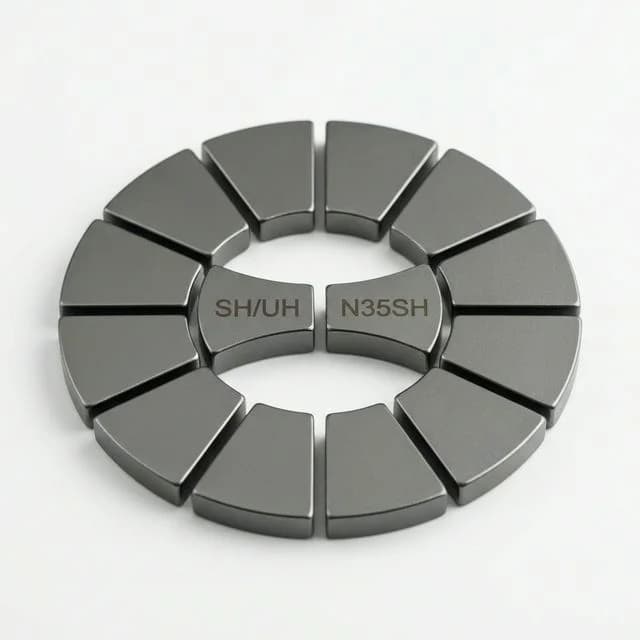
A laminated magnet is not a single, solid block of NdFeB. Instead, it is an assembly created by taking a whole magnet, precisely slicing it into multiple thin layers, and bonding those layers back together using a high-temperature, electrically insulating structural adhesive.
The Physics of Segmentation
Eddy current loss ($P_e$) in a conductive body exposed to an alternating magnetic field is proportional to the square of the dimension perpendicular to the magnetic flux. The simplified relationship can be expressed as:
$P_e \propto f^2 \cdot B^2 \cdot d^2$
Where:
- $f$ = Frequency of the alternating field
- $B$ = Peak magnetic flux density
- $d$ = Characteristic dimension (thickness) of the conductor
By dividing a solid magnet of width $W$ into $N$ segments, the dimension $d$ of each individual conductive piece becomes approximately $W/N$. Because the power loss scales with the square of this dimension ($d^2$), dividing a magnet into 5 insulated segments doesn't just reduce the eddy currents by a factor of 5; it can reduce the theoretical eddy current loss by nearly a factor of 25.
This exponential reduction in heat generation allows the motor to run significantly cooler, preserving the remanence (magnetic strength) and potentially allowing procurement teams to downgrade to a lower-temperature (and lower-cost) base magnet grade.
Eddy Current Distribution: Solid vs. Laminated Magnet
Notice how the insulating glue layers in the laminated magnet break the macro-eddy currents into much smaller, weaker localized loops, drastically reducing total joule heating.
The Procurement Reality: Why Do Laminated Magnets Cost So Much More?
When procurement teams transition a motor design from solid to laminated magnets, they often experience "sticker shock." The unit price of a laminated magnet can be 30% to 100% higher than its solid counterpart. Understanding the manufacturing reality is critical for effective price negotiation and supplier evaluation.
The cost premium is not arbitrary; it is driven by intense labor, material loss, and specialized capital equipment.
1. The Yield Loss from Kerf
To create a laminated magnet, a larger block must be sliced using wire EDM (Electrical Discharge Machining) or specialized multi-wire diamond saws. Every cut removes a portion of the expensive NdFeB material, known as the "kerf." If the cutting wire is 0.2mm thick, you lose 0.2mm of material for every single cut. If you slice a magnet into 10 segments, you might lose 15% to 20% of the total raw material just in NdFeB dust. You are paying for the material that was washed away.
2. Extensive Machining Time
NdFeB is extremely hard and brittle. Multi-wire sawing is a slow process. A solid magnet that takes minutes to grind to size might take hours to slice into delicate 2mm thick wafers. This consumes massive amounts of machine time, increasing overhead costs.
3. Assembly and Pressing
Once sliced, the segments must be meticulously cleaned, coated with a proprietary high-temperature epoxy, and pressed back together in a precision fixture. This requires specialized tooling and curing ovens. Furthermore, because the glue adds thickness (typically 20-50 microns per layer), the assembled block will be larger than the target dimension.
4. Final Secondary Grinding
Because the glued assembly is slightly oversized and the edges may not perfectly align after pressing, the entire laminated block must undergo a final round of precision grinding to meet the strict tight tolerances required for EV motor insertion.
5. Stringent Testing
Suppliers must conduct peel strength tests, shear tests at 150°C+, and insulation resistance tests (Megger testing) to ensure the glue lines haven't shorted out during the final grinding process. All of these steps add significant labor and scrap rates to the bill of materials.
Use the sample-to-mass-production handoff checklist when laminated assemblies move from prototype slicing to pilot and SOP control plans.
Engineering Parameters & Specification Table
When drafting RFQs or engineering drawings for laminated assemblies, you must specify variables that do not exist for solid magnets. The following table outlines the critical parameters that must be defined to avoid catastrophic motor failures in the field.
| Specification Parameter | Typical EV Requirement | Engineering Rationale | Procurement/Cost Impact |
|---|---|---|---|
| Number of Segments ($N$) | 3 to 15 segments | Determined via 3D FEA based on motor RPM and pole count. | High. More segments = more cutting time and more material kerf loss. |
| Segment Thickness | 1.5mm to 4.0mm | Thinner segments reduce eddy currents exponentially but weaken mechanical integrity. | High. Extremely thin slices below 2mm increase scrap rates due to breakage. |
| Insulation Layer Thickness | 20 μm to 50 μm | Must be thick enough to prevent electrical shorting, but thin enough to maintain magnetic volume. | Medium. Requires precision pressing fixtures and high-end adhesives. |
| Adhesive Shear Strength | Greater than 15 MPa at 150°C | Centrifugal forces at 20,000 RPM attempt to shear the magnet apart. Adhesive must not fail at peak temps. | Medium. Requires specialized aerospace-grade epoxies (e.g., Henkel, 3M). |
| Insulation Resistance | Greater than 50 MΩ at 500V DC | Proves the segments are electrically isolated. If the glue fails to insulate, it acts as a solid magnet. | Low cost, but critical for Quality Assurance (QA) pass/fail. |
| Direction of Lamination | Axial or Circumferential | Must cut perpendicular to the induced eddy current loops for maximum effect. | None. Just depends on the fixture orientation during cutting. |
| Overall Dimensional Tolerance | ±0.03mm | IPM slots have zero clearance for oversized assemblies. | High. Requires extremely careful final grinding of the glued assembly. |
| Surface Coating Strategy | Epoxy / Passivation | Must protect the exposed NdFeB from corrosion. Often applied after lamination. | Medium. Plating (like NiCuNi) can short the segments if not masked properly. |
| Base Magnet Grade | N42UH, N48SH, etc. | The underlying material. | High. Lamination might allow you to downgrade from EH to SH, saving massive HRE costs. |
| Maximum Operating Temp | 150°C - 200°C | Determines both the NdFeB grade and the specific thermal limit of the adhesive used. | High. Exceeding the adhesive Tg (Glass Transition Temp) causes structural failure. |
Supplier Evaluation: Laminated Magnet Sourcing Checklist
Not all magnet suppliers have the capability to produce high-yield, automotive-grade laminated assemblies. When auditing a supplier or reviewing a PPAP (Production Part Approval Process), use this checklist to separate tier-one manufacturers from brokers or low-tier factories.
- In-House Slicing Capability: Does the supplier utilize in-house multi-wire diamond saws or do they outsource the slicing? Outsourcing breaks traceability and quality control on kerf tolerances.
- Automated Glue Dispensing: Is the epoxy applied manually with a brush (high variation, thick glue lines) or via automated precise dispensing/screen printing systems?
- Thermal Aging Facilities: Can the supplier provide shear test data for the glued assembly at your peak motor operating temperature (e.g., 160°C for 500 hours)?
- Electrical QA: Does the end-of-line testing include automated insulation resistance measurement across every single glue joint?
- Cleanroom Assembly: Are the segments bonded in a controlled, dust-free environment? Any metallic dust trapped in the glue line will create a short circuit and render the lamination useless.
- Coating Compatibility: If you require a final coating (like black epoxy), has the supplier proven that their final curing oven cycle won't degrade the structural adhesive holding the magnet together?
The Ultimate Trade-off: Lamination vs. Dysprosium
For EV procurement directors, the decision to use laminated magnets is ultimately an economic equation balancing two different cost adders: The cost of Heavy Rare Earths versus the cost of precision machining.
If a motor design is experiencing 180°C hot spots due to eddy currents, the engineering team essentially has two choices:
Option A: Brute Force Chemistry Upgrade the magnet to an AH or TH grade that contains 8% to 10% Dysprosium.
- Pros: Simple manufacturing, single solid block, mechanically robust.
- Cons: Exceptionally high raw material cost. High exposure to geopolitical rare earth price spikes. Lower Br (remanence) leading to lower torque.
Option B: Elegant Physics Utilize a laminated SH or UH grade magnet (only 1% to 4% Dysprosium) and let the segmentation handle the heat reduction.
- Pros: Insulates the supply chain from Dy price shocks. Maintains higher remanence. Ultimately results in a cooler, more efficient motor.
- Cons: Higher processing cost (machining/gluing). Requires rigorous supplier QA to prevent mechanical failure at high RPM.
In modern high-performance EV platforms, Option B (Lamination) is winning. The cost of wire-cutting and gluing, while high, is generally stable and predictable. The cost of Dysprosium is not. By mastering the sourcing of laminated assemblies, you build a more predictable, scalable, and resilient supply chain.
Frequently Asked Questions (FAQ)
1. Does the glue line reduce the magnetic performance of the motor?
Yes, marginally. The insulation layers are non-magnetic. If a 20mm wide magnet contains four 50-micron glue lines, you have lost 0.2mm (1%) of your active magnetic volume. However, the motor efficiency gained by running 30°C cooler vastly outweighs this minor volume loss.
2. Can we use metallic plating (Ni-Cu-Ni) on laminated magnets?
It is highly dangerous to electroplate a laminated assembly after it is glued. The metallic plating acts as a conductive bridge across the segments, short-circuiting the insulation and allowing macro-eddy currents to flow, entirely defeating the purpose of lamination. If coating is required, non-conductive epoxy coatings or pre-lamination segment passivation are required.
3. What happens if the adhesive fails in an IPM motor?
In an Interior Permanent Magnet (IPM) rotor, the magnets are fully enclosed in steel slots. If the glue fails, the segments won't fly out into the stator. However, the segments will vibrate against each other, pulverizing the material into NdFeB dust and causing a catastrophic loss of motor balance and flux.
4. How thin can a supplier realistically slice a magnet for high-volume EV production?
While segments as thin as 1.0mm are possible in prototype labs, for high-yield, cost-effective mass production, a segment thickness of 2.0mm to 3.0mm is the standard "sweet spot" balancing eddy current reduction with mechanical handling strength.
Need Support Sourcing Segmented Assemblies?
Transitioning from solid to laminated magnets introduces complex supply chain and QA risks. Ensuring that the structural adhesive survives 20,000 RPM centrifugal forces at 160°C requires tier-one manufacturing capability.
Are you designing a high-speed rotor or looking to cost-down an existing high-HRE magnet? Contact our engineering team to review your drawings. We can provide guidance on optimal segment counts, adhesive selection, and manufacturing feasibility to ensure you aren't over-specifying tolerances that drive up costs unnecessarily.
Reach out at [email protected] with your magnet drawing, target rotor speed, hotspot assumption, coating requirement, annual volume, and validation timeline for a DFM (Design for Manufacturing) review.
Sources
The following references and engineering standards provide the foundational data and methodologies regarding eddy current reduction and rare earth minimization strategies in EV traction motors.
| Source / Standard | Why it matters for EV Procurement & Engineering | URL |
|---|---|---|
| IEEE Transactions on Energy Conversion | Provides the peer-reviewed mathematical models proving the quadratic relationship between segment thickness and joule heating loss. | IEEE Xplore Digital Library |
| Motor Design Limited (Motor-CAD) | The industry-standard software used by EV OEM engineers to simulate thermal profiles and validate the necessity of magnet lamination. | Ansys Motor-CAD |
| U.S. Department of Energy (DOE) Critical Materials Assessment | Highlights the geopolitical necessity of reducing Dysprosium usage through advanced manufacturing techniques like segmentation. | DOE Critical Materials |
| Henkel / Loctite Technical Data Sheets (TDS) | Defines the maximum shear strength and Glass Transition Temperatures (Tg) of industrial epoxies used to bond NdFeB segments. | Henkel Adhesives |
| SAE International - High-Speed EV Rotor Standards | Provides guidelines on the mechanical stress limits and validation testing required for bonded magnet assemblies in automotive drivetrains. | SAE International |
Source review date: 2026-06-23. Scope: global EV and industrial traction-motor sourcing; final lamination count, adhesive family, coating route, and acceptance thresholds still require motor-specific FEA, supplier process evidence, and dynamometer validation.
Disclaimer: Adhesive performance and eddy current reduction percentages are highly dependent on specific motor topologies, pole counts, and inverter switching frequencies. Always validate designs through comprehensive FEA modeling and physical dynamometer testing.
Need OEM support?
Email [email protected] with your drawing package, quantity stages, and target timeline.