
Grain Boundary Diffusion (GBD) in EV Motor Magnets: A Sourcing and Engineering Guide
How procurement and engineering teams should evaluate GBD technology to balance Heavy Rare Earth (HRE) costs and thermal performance in EV traction motors.
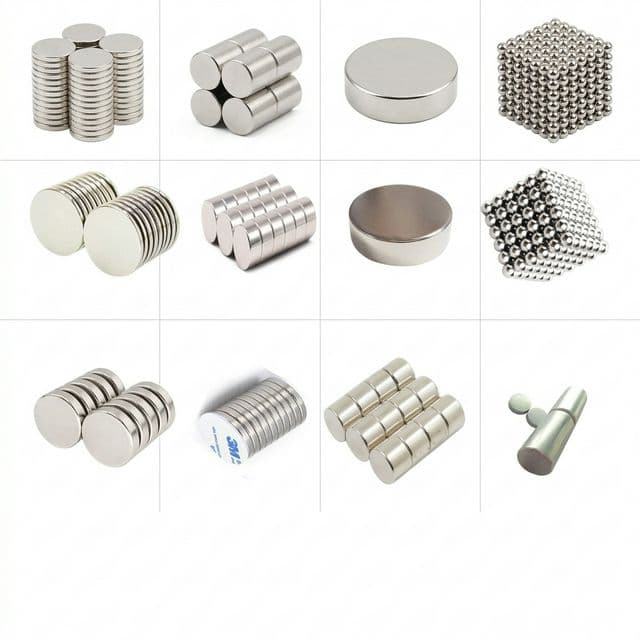
The Strategic Importance of Heavy Rare Earth Reduction in EV Motors
The transition to high-efficiency electric vehicle (EV) traction motors has accelerated the demand for high-temperature neodymium-iron-boron (NdFeB) permanent magnets. In typical traction motor architectures, particularly Interior Permanent Magnet (IPM) designs, magnets are subjected to intense thermal stress and opposing demagnetizing fields. To prevent irreversible demagnetization at operating temperatures of 150°C to 200°C, magnet manufacturers traditionally relied on alloying Heavy Rare Earth (HRE) elements—specifically Dysprosium (Dy) and Terbium (Tb)—into the NdFeB melt.
While this traditional alloying approach successfully increases the intrinsic coercive force (Hcj) of the magnet, it introduces severe procurement and performance trade-offs. Heavy rare earths are exceptionally expensive, subject to extreme price volatility, and geographically concentrated in their supply chains. Furthermore, homogeneously alloying Dy or Tb into the magnet's crystal structure inherently degrades the remanence (Br) and maximum energy product (BHmax). In engineering terms, buying thermal stability traditionally meant sacrificing magnetic strength and paying a massive cost premium.
For modern EV procurement and engineering teams, accepting this trade-off is no longer viable. The market demands longer vehicle range, which requires high remanence, while cost-down pressures demand the elimination or drastic reduction of expensive HREs. This is where Grain Boundary Diffusion (GBD) technology fundamentally alters the sourcing landscape.
Understanding GBD is not merely an engineering exercise; it is a critical procurement capability. Sourcing teams that correctly specify and audit GBD magnets can secure high-coercivity performance (e.g., UH and EH grades) while insulating their supply chains from Dysprosium price shocks. This guide provides a comprehensive framework for evaluating GBD technology, auditing suppliers, and managing the unique engineering constraints introduced by diffusion processes.
What is Grain Boundary Diffusion (GBD) and How Does it Work?
To understand why GBD is revolutionary, we must first look at the microstructure of a sintered NdFeB magnet. A magnet is not a solid block of a single phase; it consists of primary Nd2Fe14B grains (the main magnetic phase) surrounded by a thin, Nd-rich grain boundary phase.
Demagnetization under high temperatures and opposing fields usually originates at the surface of these primary grains, where microscopic defects exist. If you can protect the outer shell of the individual grains, you can significantly boost the magnet's overall resistance to demagnetization (coercivity) without altering the core of the grain.
The GBD Process Flow
Grain Boundary Diffusion is a post-sintering surface treatment process. Instead of mixing Dysprosium or Terbium into the raw material alloy before sintering, the magnet is produced using a low-HRE or zero-HRE base alloy. After the magnet is sintered and machined to its near-final dimensions, the GBD process begins:
- Surface Coating: The machined magnet is coated with a layer of HRE material. This can be applied via vapor deposition, screen printing of Dy/Tb pastes, dip coating, or sputtering.
- High-Temperature Heat Treatment: The coated magnet is placed in a vacuum furnace at temperatures typically between 800°C and 950°C.
- Diffusion: At these elevated temperatures, the Dy or Tb atoms migrate from the surface of the magnet into the interior. Crucially, they do not diffuse uniformly. Because the grain boundary phase melts at a lower temperature than the primary grains, the HRE atoms travel primarily along the liquid grain boundaries, penetrating deep into the magnet.
- Core-Shell Formation: As the HRE atoms diffuse along the boundaries, they partially substitute Neodymium (Nd) atoms at the very outer edge of the primary Nd2Fe14B grains. This creates a "core-shell" structure. The core of the grain remains pure Nd2Fe14B (maintaining high remanence), while the outer shell becomes a (Nd,Dy)2Fe14B or (Nd,Tb)2Fe14B layer that possesses massive coercive force, acting as a shield against demagnetization.
- Annealing: A secondary, lower-temperature heat treatment is performed to stabilize the microstructure and optimize the magnetic properties.
The Engineering Result
The result is a magnet that achieves the thermal stability of a traditional high-Dy grade but utilizes 50% to 70% less Heavy Rare Earth material. Because the core of the primary grains remains largely free of Dy/Tb, the remanence (Br) drop is negligible compared to traditional alloying. Engineers get a stronger magnet; procurement gets a cheaper and more stable bill of materials.
HRE Concentration Profile: Traditional Alloying vs. GBD
Notice how GBD concentrates expensive Heavy Rare Earths (HRE) exactly where they are needed—at the surface and grain boundaries—rather than wasting them in the core.
The Cost Economics: Why Procurement Must Care
The justification for Grain Boundary Diffusion is overwhelmingly commercial. Rare earth pricing is subject to massive geopolitical and supply-demand fluctuations. Over the past decade, the price of Dysprosium has often been 10 to 20 times higher than that of Neodymium, while Terbium can be 30 to 50 times more expensive.
Traditional Grade Pricing Model
In a standard N48SH or N42UH grade magnet, the base alloy might contain 4% to 8% Dysprosium by weight. When Dy prices spike, the total cost of the magnet increases linearly with the alloy percentage. Buyers are forced into indexing contracts where the magnet price fluctuates wildly month-to-month based on the Asian Metal rare earth index.
GBD Grade Pricing Model
A GBD equivalent grade (e.g., N48SH-GBD) starts with a base alloy containing 0% to 2% Dysprosium. The remaining HRE requirement is fulfilled by diffusing a microscopic amount of Dy or Tb into the surface. The total HRE weight is reduced by up to 70%.
This fundamentally shifts the risk profile of the contract:
- Lower Base Cost: The baseline cost of the magnet drops significantly.
- Reduced Volatility: Because the magnet contains vastly less Dy/Tb, the overall price is much less sensitive to HRE market spikes. Procurement teams can secure more stable, predictable long-term pricing.
- Decoupling from China's HRE Quotas: Heavy rare earths (Dy, Tb) are disproportionately mined in Southern China and Myanmar. Neodymium and Praseodymium (NdPr) are more widely available globally (e.g., Australia, USA). GBD allows manufacturers to rely primarily on Light Rare Earths, drastically reducing exposure to geopolitical HRE export quotas.
Engineering Limitations of GBD
While GBD offers massive cost and magnetic benefits, it is not a direct, drop-in replacement for all applications. Engineering teams must understand the strict physical limitations of the diffusion process to avoid late-stage validation failures.
1. The Thickness Constraint (Depth of Penetration)
GBD is a diffusion process, and atoms can only travel so far into the magnet's interior. Typically, Dysprosium diffuses effectively up to 3mm to 4mm from the surface, while Terbium, which diffuses slightly better, might reach 4mm to 5mm.
- Impact: If your EV motor magnet is 15mm thick in the direction of magnetization, the GBD process will heavily fortify the outer 4mm on each side, but the deep core (the middle 7mm) will remain unprotected and possess the lower coercivity of the base alloy.
- Design Rule: GBD is highly effective for thin magnets (under 8mm thick). For very thick magnets (e.g., 10mm+), engineers must run finite element analysis (FEA) to ensure that the demagnetizing field during a severe fault condition (like a short circuit) does not penetrate deep enough to demagnetize the weaker core.
2. Machining After GBD is Strictly Forbidden
Because the ultra-high coercivity is concentrated at the surface, you cannot grind or machine the magnet after the GBD heat treatment.
- Impact: If a supplier attempts to correct a dimensional out-of-tolerance issue by grinding the magnet after GBD, they will literally grind away the protective Dysprosium layer, resulting in catastrophic demagnetization in the motor.
- Design Rule: Magnets must be machined to their final, precise dimensions before GBD. Suppliers must have exceptional pre-GBD machining capability to account for any slight dimensional changes during the high-temperature diffusion and annealing steps.
3. Coating Compatibility
The GBD process leaves the magnet surface slightly altered. Standard passivation or epoxy coatings must be tested to ensure strong adhesion to the GBD-treated surface. High-quality suppliers utilize specific pre-treatment acid washes to prepare GBD surfaces for final plating (like Ni-Cu-Ni or Epoxy).
Comparing Traditional Sintering vs GBD
Use this structured comparison to align engineering expectations and sourcing targets when deciding whether to approve a GBD path.
| Feature / Metric | Traditional High-HRE Alloying | Grain Boundary Diffusion (GBD) | Procurement & Design Impact |
|---|---|---|---|
| HRE Content (Dy/Tb) | High (4% - 10% by weight) | Low (0% - 3% by weight) | GBD provides massive cost savings and insulates against price volatility. |
| Remanence (Br) | Lowered (HREs dilute magnetization) | Maintained (Core is pure NdFeB) | GBD yields higher motor torque and efficiency for the same volume. |
| Coercivity (Hcj) Distribution | Uniform throughout the magnet | Gradient (High at surface, lower in core) | GBD requires FEA thermal modeling if magnet thickness exceeds 8mm. |
| Machinability | Can be ground to final size after sintering | Cannot be ground after GBD process | GBD suppliers must have superior dimensional control prior to heat treatment. |
| Production Lead Time | Standard | Extended by 3 to 5 days | GBD adds specialized coating and secondary vacuum furnace cycles to lead time. |
| Ideal Motor Topology | SPM, Large industrial motors | EV Traction IPM, High-speed rotors | GBD is perfect for thin IPM magnets where surface demag risk is highest. |
Traceability and Quality Control: Avoiding "Fake" GBD
As GBD has become an industry buzzword, some lower-tier suppliers may claim to provide GBD grades without properly executing the process, or they may use inferior coating methods that result in uneven diffusion. Uneven diffusion leads to "soft spots" on the magnet surface, which will silently demagnetize in the field, causing motor failure and torque ripple.
To protect your supply chain, procurement and quality teams must demand specific traceability evidence.
The GBD Supplier Audit Checklist
Do not approve a GBD supplier without verifying the following capabilities during a factory audit or via a formal Quality Control Plan (QCP) submission:
- In-House GBD Furnaces: Does the supplier outsource the GBD process? Outsourcing breaks traceability. Top-tier EV suppliers operate their own specialized vacuum diffusion furnaces.
- Coating Uniformity Verification: How does the supplier apply the Dy/Tb layer? (Vapor deposition and sputtering offer the most uniform coverage; manual screen printing can cause dangerous inconsistencies).
- Cross-Sectional Micro-analysis: Can the supplier provide SEM (Scanning Electron Microscope) or EPMA (Electron Probe Microanalyzer) reports showing the depth profile of the Dy/Tb diffusion?
- Pre-GBD Dimensional Control: Does the control plan explicitly ban mechanical grinding after the GBD annealing cycle?
- Thermal Shock Testing: Are production batches subjected to 150°C/200°C thermal aging tests to verify irreversible flux loss is within spec?
- Batch Segregation: Is there a strict digital tracking system linking the base alloy batch, the GBD furnace run, and the final shipping lot?
GBD and EV Motor Architectures
The effectiveness of GBD is heavily dependent on the motor's rotor architecture.
Interior Permanent Magnet (IPM) Motors: Most modern EVs use IPM rotors, where thin rectangular magnets are inserted into slots within the rotor lamination. The highest demagnetization stress occurs at the sharp corners and outer edges of the magnet nearest the air gap. This aligns perfectly with the GBD profile. GBD provides maximum coercive armor exactly where the opposing stator field hits the hardest, while leaving the deep core highly magnetic to push flux into the stator. This is why GBD is universally adopted in modern EV traction platforms.
Surface Permanent Magnet (SPM) Motors: In SPM designs, large, thick arc magnets are bonded directly to the rotor surface. Because these magnets are often thicker (10mm to 15mm), the GBD penetration depth may not reach the core. Furthermore, SPM magnets face massive eddy current heating directly on their surface. While GBD helps, engineers must be incredibly careful that thermal gradients don't exceed the coercivity limits of the less-protected core. Segmentation of the magnets is often required in combination with GBD for SPM designs.
Frequently Asked Questions (FAQ)
1. Does GBD affect the mechanical strength of the magnet?
Generally, no. The GBD process alters the grain boundaries at a microscopic level. However, because machining is forbidden after GBD, the sharp edges of the magnet cannot be chamfered post-process. Edge chipping must be controlled by proper handling and pre-GBD radiusing.
2. Can we use Terbium (Tb) instead of Dysprosium (Dy) in GBD?
Yes. Terbium is significantly more effective at increasing coercivity than Dysprosium, and it diffuses slightly better. For the most extreme temperature requirements (e.g., EH or AH grades operating at 200°C+), Tb-GBD is the preferred method. However, Terbium is rarer and far more expensive than Dysprosium, so it is reserved for peak-performance platforms.
3. How do we verify that a magnet is actually GBD treated on incoming inspection?
Standard incoming inspection (measuring overall flux or running a BH curve tracer) cannot definitively prove GBD, because a BH curve measures the bulk property of the magnet. To prove GBD, you must destructively cut the magnet in half and measure the coercive force of the core versus the surface, or use X-ray fluorescence (XRF) to check the surface composition versus the core. This is why relying on supplier process audits (as listed above) is critical.
4. Is the lead time longer for GBD magnets?
Yes. The GBD process requires specialized coating, a high-temperature diffusion bake (up to 24 hours), and a secondary annealing step. Factor in an additional 3 to 7 days of production lead time when transitioning from traditional sintered grades to GBD grades.
Conclusion & Next Steps
Grain Boundary Diffusion is the most powerful tool available to EV motor programs seeking to decouple high thermal performance from extreme rare earth cost volatility. By shifting from high-alloying to surface diffusion, OEMs can secure higher remanence, lower bill-of-materials costs, and a more resilient supply chain.
However, success requires discipline. Engineering must design within the thickness limits of diffusion, and procurement must mandate strict traceability and no-grind policies.
If your team is transitioning to low-HRE designs or preparing an RFQ for GBD traction magnets, you need a partner who controls the diffusion process in-house with full automotive traceability.
Are you evaluating GBD feasibility for your next motor platform? Email our engineering team at [email protected] with your magnet dimensions, operating temperature (hotspot), and peak demagnetizing field. We will provide a specific feasibility review on diffusion depth and potential HRE cost reductions.
References
- Magnetics Magazine (2025). "Advancements in Grain Boundary Diffusion for Electric Vehicle Traction Motors." Industry review on HRE reduction trends.
- IEEE Transactions on Magnetics. "Depth Profiling of Dysprosium in Nd-Fe-B Sintered Magnets Prepared by Grain Boundary Diffusion." Technical validation of diffusion depth limits.
- Automotive Supply Chain Insights (2026). "Decoupling EV Costs from Dysprosium Volatility." Procurement analysis on rare earth indexing contracts.
- Journal of Alloys and Compounds. "Microstructure and magnetic properties of (Nd,Dy)-Fe-B core-shell structures." Metallurgical breakdown of the GBD mechanism.
- U.S. Department of Energy (DOE) Critical Materials Assessment. Evaluation of heavy rare earth supply chain risks and mitigation technologies in modern electrification.
Need OEM support?
Email [email protected] with your drawing package, quantity stages, and target timeline.