
OEM Magnet Programs: Sample-to-Mass-Production Handoff Without Surprises
A stage-gate handoff method for OEM motor magnet programs to reduce rework between sample approval, pilot build, and mass production.
Buyer TL;DR
- Convert sample success into explicit stage-gate controls instead of informal handoff memory.
- Assign one owner per gate output and define escalation SLAs for high-severity issues.
- Block gate sign-off when high-risk actions are still open without approved containment.
- Run 30/60/90-day ramp reviews with CAPA and on-time-delivery tracking.
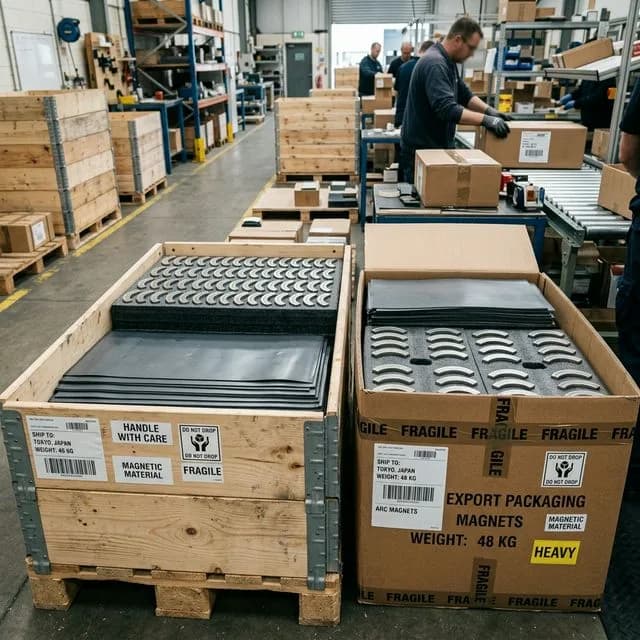
Why handoff failures happen
Many teams approve a sample but do not freeze the assumptions that made the sample succeed. During pilot or mass production, silent changes in tolerances, coating expectations, or inspection thresholds trigger avoidable rework.
A handoff process should convert sample success into documented production controls, not informal memory.
Ownership map by function (RACI-lite)
Assign one owner per deliverable. Shared ownership without a final approver is the most common reason handoff packages remain incomplete.
- Engineering owner: drawing freeze, critical specs, deviation limits
- Quality owner: control plan, inspection template, nonconformance flow
- Supply chain owner: volume ramp plan, logistics requirement, fallback path
- Program owner: gate dates, escalation routing, customer communication
Three-stage control model
Use explicit stage gates so each transition has a clear readiness criterion and owner accountability.
- Sample gate: drawing assumptions + initial quality checks confirmed
- Pilot gate: process capability and traceability flow demonstrated
- Mass-production gate: shipment criteria, packaging spec, and escalation path frozen
Gate exit criteria that prevent rework
Each gate should have objective pass criteria. Avoid "looks good" approvals with no measurable standard.
- Sample gate pass: critical dimensions and magnetic checks documented against revision
- Pilot gate pass: process capability evidence and lot traceability validated
- Mass-production gate pass: packaging, labeling, and shipment acceptance locked
- No open high-severity issue allowed at gate sign-off
Documents that must travel with the handoff
If these documents are incomplete, schedule risk rises sharply. Keep versions controlled and visible to procurement, engineering, and quality leads.
- Finalized drawing set and revision history
- Critical characteristic list with acceptance limits
- Inspection template (incoming + outgoing)
- Lot traceability fields and nonconformance workflow
- Packaging and logistics requirement sheet
Deviation and escalation protocol
Define in advance what constitutes a minor deviation versus a stop-ship condition. Fast and clear escalation rules reduce customer-facing surprises.
- Deviation classes: minor, major, and stop-ship with decision authority
- Response times: same-day triage and next-day containment target
- Temporary disposition rules before final corrective action closure
- Customer communication template for schedule-impacting events
Risk controls for B2B programs
A practical handoff plan includes fallback scenarios. If one path slips, teams should know who decides, what changes, and how customer commitments are protected.
- Fallback material/grade path with decision trigger
- Escalation contact matrix for quality or schedule events
- Pilot-volume contingency aligned with customer milestones
- Pre-shipment review checklist before each major batch
30-60-90 day ramp checklist
A simple ramp calendar keeps pilot learning connected to production stability.
- Day 30: close sample-phase open issues and confirm pilot readiness
- Day 60: verify pilot yield trend, logistics reliability, and CAPA closure speed
- Day 90: confirm SOP shipment consistency and freeze recurring controls
Anonymous case: pilot-pass sample still failed at first SOP batch
A customer-approved sample moved to pilot successfully, but first SOP lots hit repeated packaging and traceability mismatches. The team introduced explicit gate exit criteria and a stop-ship escalation matrix.
Result: nonconformance closure cycle shortened and shipment stability recovered before next customer milestone.
- Initial state: gate approvals without objective exit criteria
- Action: added ownership map, deviation classes, and response-time rules
- Outcome: fewer recurring handoff errors and clearer accountability
Download handoff checklist templates (CSV + XLSX)
Use this checklist to run sample, pilot, and SOP gate reviews with clear owner accountability.
Operational takeaway
Sample approval is not the finish line. It is the start of process control. Teams that treat handoff as a formal deliverable usually cut downstream friction and improve schedule confidence.
For OEM programs, you can use [email protected] to align sample, pilot, and production boundaries in one structured discussion before release.
Decision Tables
Stage-Gate Control Table
This table converts handoff discussions into auditable gate controls with clear ownership and escalation expectations.
| Gate | Required Evidence | Owner | Escalation SLA | Primary KPI |
|---|---|---|---|---|
| Sample gate | Released drawing + initial dimensional and magnetic checks | Engineering + Quality | Same-day triage for high severity | Sample pass rate and issue closure speed |
| Pilot gate | Control plan + traceability + capability evidence | Quality + Engineering | 24h containment target | Pilot yield trend and traceability integrity |
| Pre-SOP gate | Shipment criteria + packaging + labeling standard | Quality + Supply Chain | Same-day decision for stop-ship events | Shipment readiness and damage prevention |
| SOP release gate | Deviation matrix + escalation contact list | Program + Quality | Escalation owner reachable within defined SLA | On-time shipment with stable quality |
| 30/60/90 ramp reviews | Issue closure, CAPA speed, shipment stability | Program Office | Weekly review cadence until trend stabilizes | Recurring defect rate and OTD performance |
Gate approval should be blocked if high-severity actions remain open without approved containment.
Visual Decision Maps
OEM Handoff Stage-Gate Map
Visualization of sample, pilot, and SOP gates with required outputs and escalation checkpoints.
The value of this map is execution discipline: objective gate exits and explicit escalation ownership.
Buyer FAQ
Why do some programs fail after sample approval but before SOP stability?
Because sample success is often not converted into controlled production criteria. Missing gate exit definitions and unclear ownership cause recurring surprises in pilot and first SOP lots.
What is the minimum handoff package to avoid recurring rework?
At minimum: released drawing revision, critical characteristics, inspection templates, traceability fields, packaging requirements, and deviation/escalation rules with named owners.
How quickly should teams respond when a high-severity quality issue appears?
Same-day triage with next-day containment is a practical baseline for B2B programs with customer milestone pressure. Delayed containment is a common source of schedule and trust damage.
References and Evidence
- IATF 16949 Overview
IATF Global Oversight · Accessed 2026-04-07
Automotive QMS baseline for cross-functional control and escalation accountability.
- AIAG APQP
Automotive Industry Action Group (AIAG) · Accessed 2026-04-07
Stage-gate planning reference aligned with sample/pilot/SOP handoff structure.
- AIAG PPAP
Automotive Industry Action Group (AIAG) · Accessed 2026-04-07
Production-approval discipline reference for launch-readiness documentation.
- ISO 9001 Family
International Organization for Standardization · Accessed 2026-04-07
General quality-management control baseline for handoff repeatability.
Need OEM support?
Email [email protected] with your drawing package, quantity stages, and target timeline.