Arc Magnets Canada: Sourcing Checker & Import Guide
Determine the optimal supply route for EV and industrial motor arc magnets in Canada. Compare local distribution against direct manufacturing, estimate lead times, and review import risks.
Sourcing Checker
Adjust project parameters to see the recommended sourcing path for Canadian delivery.
Sourcing Arc Magnets in Canada: Key Considerations
As of 2026, public evidence shows Canada has important rare-earth mining and midstream processing assets (such as SRC's Rare Earth Processing Facility in Saskatchewan), but not a clearly documented, high-volume domestic source for finished custom sintered NdFeB or SmCo arc motor magnets. That distinction matters: upstream rare-earth capacity does not automatically remove the need for overseas magnet sintering, coating, magnetization, and export logistics.
Recent supply-chain moves point toward more Western mine-to-metal and magnet capacity. However, they do not yet prove that Canadian buyers can source custom arc magnets locally at full motor production scale. Canadian motor developers still need to choose between fast local stockists for prototyping and overseas factories that can manufacture to a strict drawing.
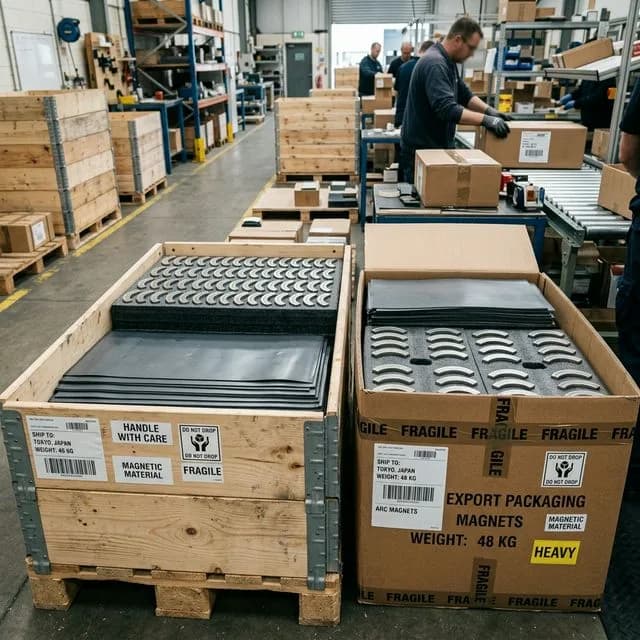
Decision Conclusions for Canadian Buyers
| Conclusion | Evidence Basis | Action |
|---|---|---|
| Local stock is a prototype shortcut, not a custom arc magnet strategy. | Canadian distributors can reduce waiting time when catalog geometry is acceptable, but motor arcs usually need application-specific radius, angle, grade, coating, and magnetization direction. | Ask for the drawing, grade, coating, and magnetization vector before accepting a local substitute. |
| Custom motor arcs usually require direct overseas manufacturing. | Publicly visible Canadian rare-earth activity is strongest in upstream/midstream capacity, while finished sintered NdFeB or SmCo arc magnet production is not yet visibly available at commercial scale domestically. | Use an RFQ package with 2D drawings, tolerance stack, coating, temperature grade, magnetization direction, and annual volume bands. |
| Landed cost matters more than unit price for Canadian buyers. | The 2026 CBSA tariff schedule is the reference point for HS 8505.11.00 permanent magnets, while CRA tax guidance shows GST/HST/PST exposure varies by province and transaction context. | Compare local price against ex-works price plus freight, shielding, tax exposure, duty treatment, broker fees, and schedule risk. |
| Air freight is a schedule tool, not a default logistics mode. | IATA Dangerous Goods Regulations are the air-cargo reference for regulated shipments, and magnetized material can require screening, shielding, acceptance checks, and shipment documentation. | Confirm magnetic field test, shielding method, and courier acceptance before committing to an urgent air shipment. |
How the Canada Route Decision Is Made
Typical Canadian Supply Chain Flow for Custom EV Magnets
Sourcing Risk Matrix
| Risk Event | Likelihood | Impact | Mitigation |
|---|---|---|---|
| Geometry or magnetization mismatch | Medium | High | Quote from drawings, require pole orientation confirmation, and validate samples before volume release. |
| Landed-cost undercount | High | High | Model GST/HST, duty exposure, broker fees, currency movement, shielding weight, and rework costs. |
| Air shipment rejected or delayed | Medium | Medium | Use suppliers experienced with UN2807/magnetized-material screening and request test records. |
| Local stock locks in a weak thermal grade | Medium | High | Check operating temperature, demagnetization margin, and coating before using stock magnets in motor tests. |