
Arc Industrial Magnet Checker
Run the checker first for geometry fit, thermal/retention boundaries, and next-step action from your arc magnet drawing inputs. Then use the report sections for evidence, risk, and sourcing tradeoffs.First screen solves the tool intent: input geometry, demand, and lead-time constraints, then get a deterministic fit plus procurement verdict. Deeper sections provide evidence, boundary conditions, tradeoffs, and risk controls for both common query interpretations: arc magnet drawing intent (field-to-checker mapping) and industrial arc magnets procurement intent.
Evidence updated on May 9, 2026.
Published: May 9, 2026
Evidence updated: May 9, 2026 (stage1b research-enhance: added drawing/GD&T boundary, ASTM method anchors, ISO 9227 limit conditions, and USGS revision recency marker)
Review cadence: every 6 months or earlier when material-policy data shifts.
Distinct angle: this page resolves arc-angle versus OD-class ambiguity first, then converts listing-level intent into one RFQ-ready decision flow.
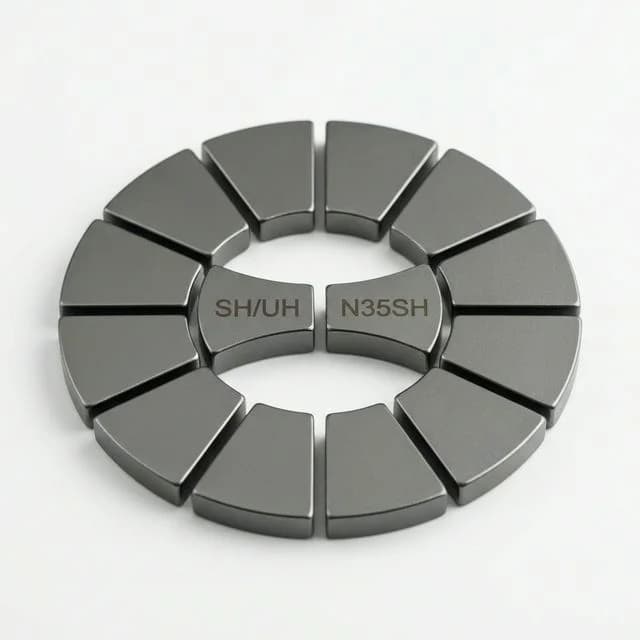
Tool Layer: Run The Fit Checker
Input geometry, operating assumptions, and purchase constraints; then get interpreted output, uncertainty, quote estimate, and next step.
| Drawing field | Checker input | Decision impact | Fallback if missing | Source |
|---|---|---|---|---|
| Outer / inner diameter | Outer diameter + Inner diameter | Defines radial thickness, mean diameter, and arc-length basis. | Block quote and request drawing revision with OD/ID tolerances. | S1/S27 |
| Arc angle and segment count | Arc angle + Segment count | Sets coverage ratio versus pole layout and ring closure risk. | Use stock-intent preset only for rough screening, not RFQ approval. | S1/S27 |
| Axial length | Length | Changes mass, tip-speed load, and retention-demand calculation. | Assume conservative upper bound and mark retention output as low confidence. | S1/S27 |
| Datum reference frame + GD&T profile/position controls | Boundary condition (outside numeric calculator fields) | Locks the measurement basis for OD/ID/angle so suppliers and incoming inspection evaluate the same geometry intent. | Mark as review-required and request datum/GD&T completion before supplier comparison. | S27/S28 |
| Operating thermal envelope | Ambient temp + Hotspot rise + Grade | Determines thermal margin and grade-switch escalation branch. | Treat result as review-required and request duty-cycle thermal data. | S3/S4/S19 |
| Mechanical retention assumptions | Max RPM + Adhesive shear + Safety factor | Controls required shear threshold and retention margin outcome. | Do not proceed to PO; run mechanical validation path first. | S5 |
| Magnetic-property report standard and method | Grade + thermal/retention interpretation branch | Separates marketing grade codes from measured Br/HcJ and demag-curve behavior when comparing suppliers. | Treat cross-supplier substitution as pending confirmation (待确认) until method-labeled IEC/ASTM evidence is provided. | S24/S26/S30/S31 |
| Coating + corrosion-test condition | Boundary condition (outside core numeric model) | Prevents direct conversion of salt-spray hours into service-life claims under real rotor thermal/vibration duty. | Keep corrosion-life conclusion as pending confirmation (待确认) and request product-specific acceptance criteria. | S29 |
| Procurement target | Annual demand + Target lead time | Shapes MOQ class, quote band, and lead-time risk signal. | Return technical pass only; delay sourcing verdict until targets are explicit. | S2B/S6 |
Empty state
Run checker to generate geometry fit, thermal margin, retention margin, estimated quote class, and an action-oriented verdict.
Report Summary: Conclusions, Numbers, Fit/Unfit
This layer translates calculator output into decisions with boundaries and audience fit guidance.
1) Tool-first intent is size-specific
Public listings for this exact SKU publish dimensions, grade, polarity split, and max temperature, so users expect an immediate fit/readiness answer, not generic magnet theory [S1][S2].
2) Thermal and retention are the two critical failure gates
A “dimension match” alone does not imply readiness. Thermal margin and retention margin determine practical reliability. This page keeps both as explicit screening gates with disclosed evidence and limits. The adhesive baseline is anchored to ISO 10123 steel pin/collar test context in LOCTITE 648 data, so production transfer must still be validated [S5].
3) Supply concentration is a first-order risk variable
IEA magnet-specific data shows high concentration in 2024: around 60% for mined magnet rare earths, 91% for refined output, and 94% share in sintered permanent-magnet production for one country. This means quote timing and second-source readiness should be controlled like technical gates [S18].
4) Grade choice is a tradeoff, not a one-way upgrade
SH/SmCo paths can reduce heat risk but can increase cost, lead time, and process complexity. DOE 2023 still classifies Nd/Pr/Dy/Tb as critical for EV/wind magnet chains, so grade-switch decisions should include supply-risk criteria, not only thermal criteria [S15].
5) EU-bound programs need both compliance and diversification gates
Candidate List table showed 253 entries with a latest inclusion marker of February 4, 2026 in the checked record [S9]. REACH/RoHS obligations still trigger from explicit thresholds (>0.1% w/w and related notification windows), so document ownership must be locked before shipment planning. CRMA adds 2030 diversification signals (10/40/25 capacity benchmarks and 65% single-country dependency cap) that should shape contract language earlier in the cycle [S10][S11][S14].
6) Air-route feasibility has a hard magnetic-field gate
For carriage by aircraft, published FAA and 49 CFR wording uses a magnetic-field threshold of 0.00525 gauss measured at 4.5 m (15 ft). Crossing that threshold can block the air route even when checker geometry and thermal results pass [S16][S17].
7) U.S. landed cost can step-change on a fixed date gate
USTR's published Section 301 modification creates heading 9903.91.06 effective January 1, 2026 with additional duty language tied to subdivision (g), which lists 8505.11.00. For U.S.-bound sourcing, this makes import date and customs classification a first-order pricing control, not a post-PO detail [S20].
8) Tariff modeling needs both base-line and overlay logic
Current HTS Revision 7 (2026) separates base permanent magnet lines (8505.11 vs 8505.19), while Chapter 99 note 31(g) and heading 9903.91.06 add a date/scope overlay for part of that space. Treat base classification and additional duty scope as two linked gates, not one shorthand number [S21][S22][S23].
9) Grade labels are insufficient without method context
IEC 60404-8-1 specifies property/tolerance baselines, while IEC 60404-18 and IEC 60404-5 define measurement-method boundaries. Without method-labeled evidence, cross-supplier grade substitution can hide demag/curve differences and produce false confidence [S24][S25][S26].
10) Drawing-intent RFQs require datum/GD&T governance
ASME Y14.5 and ISO 5459 both frame how datum and GD&T meaning is established. Without this layer, OD/ID/angle equality can still mask non-equivalent metrology logic and create supplier-comparison errors [S27][S28].
11) Salt-spray evidence has hard interpretation limits
ISO 9227 defines NSS/AASS/CASS procedures, but explicitly does not make those results a universal ranking or long-life prediction tool. Coating life claims beyond this method should be treated as pending confirmation (待确认) until product-specific evidence is provided [S29].
12) Grade substitution needs numeric + method evidence
ASTM A1101 gives NdFeB property-range context and documentation expectations, while ASTM A977 shows demag/recoil measurement and reporting limits. This reduces “same code, different test basis” substitution failures [S30][S31].
Geometry
Coverage window
Thermal margin
Retention buffer
| Profile | Fit | Reason |
|---|---|---|
| Replacement job with known duty cycle and compatible pole layout | Suitable | Dimension-specific stock path plus checker can quickly validate geometry and boundary conditions. |
| High-temperature continuous-duty traction case | Conditional | Often needs SH/SmCo path and stronger retention strategy beyond stock assumptions. |
| Cost-first project with weak process control | Not suitable | Without tolerance, curing, and QC control, failure risk can exceed savings from a cheaper listing. |
Methodology And Evidence
Tool logic, source chain, and known unknowns are disclosed so users can judge confidence boundaries.
- Parse and validate geometry/operating inputs with explicit ranges.
- Compute geometric metrics (thickness, arc length, chord, coverage).
- Compute thermal and retention screening metrics with grade/safety assumptions.
- Output verdict, uncertainty, and minimum executable next action.
Evidence is layered from direct size-intent listings to material and retention references, then supply-risk context. Items without strong public evidence are explicitly marked as unknown.
Known unknowns
- Public listing data can show grade and polarity direction, but usually omits full tolerance stack, coating-thickness distribution, and lot-acceptance method.
- No reliable public retention-fatigue dataset currently covers exact arc industrial magnet OD-class geometry across full RPM-temperature-life combinations.
- Lead-time and MOQ volatility are region and quarter dependent.
- Public listings rarely include pre-shipment magnetic-field test evidence at package level, so air-route feasibility cannot be assumed from product listing alone.
- Supplier listings often omit measurement-method metadata for magnetic properties, so cross-supplier grade equivalence remains uncertain until IEC-aligned evidence is provided.
- Public data cannot pre-validate transaction-level customs classification/origin outcomes for each assembly; U.S. tariff exposure still requires broker confirmation before award.
- Public sources do not provide a reliable universal mapping from salt-spray hours to rotor-life outcomes across all coating systems and duty profiles, so long-life corrosion claims remain pending confirmation.
| Area | Gap before enhancement | Effective information increment | Status |
|---|---|---|---|
| Macro supply concentration evidence | Page had U.S.-centric price/import data, but lacked a global concentration baseline. | Added IEA 2025 concentration metrics (top-three refining share 82%->86% and export-control expansion) to connect pricing risk with concentration structure [S13]. | Closed |
| EU procurement boundary | RoHS/REACH obligations were present, but diversification policy boundaries were not explicit. | Added CRMA 2030 benchmarks and <=65% single-country dependency boundary for strategic raw materials [S14]. | Closed |
| Core material criticality context | Fit checker emphasized geometry and thermal gates but underexplained long-cycle material criticality. | Added DOE critical-material context for Nd/Pr/Dy/Tb in EV and wind magnet value chains [S15]. | Closed |
| Retention-fatigue certainty boundary | Boundary text mentioned uncertainty, but did not expose a status-style decision label. | Explicitly marked this area as pending confirmation (暂无可靠公开数据) and kept a minimum validation path. | Closed with explicit uncertainty |
| Air-logistics feasibility boundary | Page covered compliance and supply risk, but did not provide a hard air-shipment magnetic-field threshold. | Added FAA + 49 CFR 173.21 threshold gate (>0.00525 gauss at 4.5 m) with executable pre-shipment action path [S16][S17]. | Closed |
| Thermal coefficient interpretation boundary | Thermal margin gate existed, but did not explain reversible temperature coefficient non-linearity and Curie-vs-operating distinction. | Added thermal-drift table with representative RTC values and non-linearity caveat; explicitly separated Curie temperature from usable operating window [S19]. | Closed |
| Magnet-specific concentration evidence | Concentration narrative relied on broader mineral-system metrics and underrepresented magnet-specific supply-chain concentration. | Added IEA rare-earth-magnet-specific shares (mined/refined/sintered magnet production) and demand trajectory to tighten procurement interpretation [S18]. | Closed |
| U.S. landed-cost date boundary | Page lacked a hard policy date gate linking U.S.-bound permanent-magnet sourcing to tariff-effective timing. | Added Section 301 date-gate evidence: heading 9903.91.06 effective January 1, 2026, with +25% and subdivision (g) list including 8505.11.00 [S20]. | Closed |
| U.S. import-source concentration clarity | Price and reliance data existed, but country-level source split and stockpile-pressure context were not explicit. | Added USGS import-source shares (China 71%, Malaysia 13%, Japan 5%, Estonia 5%), world mine split, and FY2025 stockpile potential acquisition indicators [S6A]. | Closed |
| Heavy rare-earth element-level exposure | Heavy RE risk was described at summary level without element-specific concentration boundaries. | Added element-level import exposure rows (Tb 100% China, Ho 100% China, Yb 86% China) and kept explicit net-import-reliance signal at 100% [S12]. | Closed with explicit uncertainty |
| HTS classification and tariff-scope boundary precision | Tariff section described date gate but did not anchor to the active HTS release text for base-line split (8505.11 vs 8505.19) and 9903.91.06 scope mechanics. | Added USITC current release anchor (2026HTSRev7), Chapter 85 split data, and Chapter 99 note 31(g)/9903.91.06 scope mechanics with explicit transaction-level uncertainty label [S21][S22][S23]. | Closed with explicit uncertainty |
| Magnetic-property measurement comparability boundary | Thermal discussion existed, but supplier-grade comparability lacked a standard-based measurement boundary. | Added IEC 60404-8-1/18/5 framework to distinguish property specification from measurement method and to prevent grade-shorthand overconfidence in supplier comparison [S24][S25][S26]. | Closed |
| Arc-magnet drawing datum and GD&T boundary | Checklist mapped numeric fields but lacked a standards-based boundary for datum-system and GD&T interpretation. | Added ASME Y14.5 and ISO 5459 boundaries plus explicit missing-datum fallback to avoid false “same drawing” assumptions across suppliers [S27][S28]. | Closed |
| Coating durability claim boundary | Page mentioned coating risk but did not clearly state what salt-spray evidence can and cannot prove. | Added ISO 9227 limitation: salt-spray methods are not for ranking corrosion resistance or predicting long-term service life; unresolved life claims remain pending confirmation (待确认) [S29]. | Closed with explicit uncertainty |
| NdFeB grade and test-method comparability | IEC boundary existed, but procurement interpretation lacked ASTM numeric-range and method-reporting anchors used in many magnet specifications. | Added ASTM A1101 property/documentation boundaries and ASTM A977 method/reporting limits to reduce grade-label substitution risk [S30][S31]. | Closed |
| USGS revision recency marker | Supply tables cited USGS metrics, but report revision lineage was not explicitly surfaced. | Added USGS 2026 version-history marker (v1.2 reposted on April 16, 2026) to strengthen recency traceability for sourcing decisions [S32]. | Closed |
| ID | Source | Key data | Context | Date marker |
|---|---|---|---|---|
| S1 | ALB Materials - Arc magnets for motors | Article groups arc-magnet OD ranges and includes a 45.0-89.9 mm bucket with motor-focused inquiry fields (OD/ID, angle, thickness, length, grade, coating). | Supports the dominant pattern for this keyword cluster: size-first custom RFQ rather than one fixed retail SKU. | Article accessed on April 21, 2026 |
| S2 | Stanford Magnets - Neodymium arc magnets | Supplier page states broad size inventory and explicitly requests custom quotes for sizes not listed, while listing motor/generator usage and geometry-specific orientation constraints. | Used to justify why an arc industrial magnet query needs a tool+RFQ path with explicit geometry fields instead of SKU-only selection. | Page accessed on April 21, 2026 |
| S2A | SuperMagnetMan arc-magnet collection (M5050 example) | Collection page shows an arc-angle example (M5050): 20 mm OD, 15 mm ID, 13 mm length, N52, sale price $11.95, stock 440 units, MOQ 1 set (4 pieces). | Confirms that part of this keyword intent is direct stock purchase, but stock geometry and polarity still need fit validation before order. | Collection page accessed on April 21, 2026 |
| S2B | K&J Magnetics custom neodymium magnets | Custom inquiry flow asks for shape, dimensions, quantity, grade, coating, magnetization/orientation, lead time, and notes. | Supports the tool design: purchase decisions for this keyword typically require RFQ completeness, not angle-only or OD-only input. | Page accessed on April 21, 2026 |
| S3 | Arnold Magnetic Technologies NdFeB grade reference | Public grade table distinguishes H/SH/UH classes and shows thermal-performance tradeoffs across NdFeB grades. | Used for grade-boundary and thermal-margin interpretation. | Reference accessed on April 18, 2026 |
| S4 | Arnold RECOMA SmCo reference | Sm2Co17 table lists high-temperature operating capability relative to NdFeB classes. | Supports high-temperature fallback comparison in this page. | Reference accessed on April 18, 2026 |
| S5 | Henkel LOCTITE 648 technical data sheet | TDS reports ISO 10123 compressive shear values (steel pins/collars): 13.5 N/mm2 at 15 min and 31 N/mm2 at 72 h, with cure-speed/gap sensitivity. | Used to calibrate retention-screening assumptions and to disclose lab-test geometry limits. | TDS May 2021, accessed on April 18, 2026 |
| S6 | USGS Mineral Commodity Summaries 2026 - Rare Earths | USGS reports Nd oxide 56->73 $/kg (2024->2025), NdPr oxide 55->69 $/kg, import compounds 8,120->21,000 t, net import reliance 53%->67%, while import value moved from $168M to $165M. | Used in procurement volatility and risk-mitigation sections. | USGS report published in February 2026 |
| S6A | USGS Mineral Commodity Summaries 2026 - Rare Earths (trade mix) | USGS lists import-source mix for compounds/metals (2021-24): China 71%, Malaysia 13%, Japan 5%, Estonia 5%; world mine output 390,000 t in 2025e with China at 270,000 t; FY2025 stockpile potential acquisitions include 450 t NdFeB magnet block. | Used to quantify U.S. import-source concentration and supply-continuity planning beyond spot-price signals. | USGS report published in February 2026 |
| S7 | NEMA MG-1 Part 12 | NEMA guidance notes best performance when terminal voltage unbalance stays within 1%. | Used as a downstream motor-validation boundary after magnet selection screening. | Watermark PDF accessed on April 18, 2026 |
| S8 | Apex Magnets arc-motor category listing | Category listing exposes dimension-based SKUs, set polarity splits, and product-level pull-force fields, confirming buyers compare geometry + stock + lead-time in one pass. | Adds transactional SERP evidence for structured dimension filters even when exact arc industrial magnet stock items vary by supplier cycle. | Category page accessed on April 21, 2026 |
| S9 | ECHA Candidate List table | Candidate List page shows 253 entries in total; latest inclusion date displayed as 04-Feb-2026. | Used to set REACH/SVHC volatility checks for EU-bound magnet procurement. | ECHA page accessed on April 18, 2026 |
| S10 | ECHA Candidate List obligations | For articles >0.1% w/w SVHC, suppliers must communicate safe-use info; consumer requests require response within 45 days; producer/importer notification applies above 0.1% w/w and >1 t/y, due within 6 months. | Used in compliance-gate and RFQ document-check sections. | ECHA page accessed on April 18, 2026 |
| S11 | EUR-Lex Commission Delegated Directive (EU) 2015/863 | RoHS Annex II lists ten restricted substances with limits 0.1% w/w (most) and 0.01% for cadmium in homogeneous material. | Used to define baseline RoHS evidence pack requirements for EU deliveries. | Directive text accessed on April 18, 2026 |
| S12 | USGS Mineral Commodity Summaries 2026 - Rare Earths (Heavy) | USGS reports heavy rare-earth net import reliance at 100% (2021-2025e); 2021-24 shipping data shows terbium and holmium compounds/metals at 100% China origin and ytterbium at 86% China origin, alongside April 2025 export-control tightening and November 2025 partial suspension. | Used to frame element-level heavy-rare-earth concentration risk and contingency sourcing plans. | USGS report published in February 2026 |
| S13 | IEA Global Critical Minerals Outlook 2025 - Executive Summary | IEA reports rare-earth demand grew 6-8% in 2024; top-three refining share for key energy minerals rose 82%->86% (2020->2024); more than half of a broader mineral set is now under export controls. | Adds concentration and policy-shock evidence that affects lead-time and second-source strategy beyond one quote cycle. | IEA report year 2025, page accessed on April 21, 2026 |
| S14 | EUR-Lex Regulation (EU) 2024/1252 (Critical Raw Materials Act) | Regulation states 2030 EU benchmarks (10% extraction, 40% processing, 25% recycling) and a diversification target: no more than 65% from one third country at any processing stage for any strategic raw material. | Defines procurement boundary conditions for EU-facing programs and contract clauses on diversification. | Published in OJ on May 3, 2024; page accessed on April 21, 2026 |
| S15 | U.S. DOE Critical Materials Assessment 2023 | DOE highlights Nd, Pr, Dy, and Tb as critical for clean-energy deployment, specifically noting rare-earth magnets in EV motors and wind generators. | Used to separate short-term SKU availability from structural material criticality risk in long-cycle programs. | DOE report published in July 2023; accessed on April 21, 2026 |
| S16 | FAA PackSafe - Magnets (air carriage threshold) | FAA states that any package or magnet above 0.00525 gauss measured at 4.5 m (15 ft) from package surface cannot fly; below that threshold it is allowed in checked or carry-on context. | Adds an operational logistics gate that can block air shipment even when geometry/thermal checks pass. | FAA page last updated on March 15, 2023; rechecked on May 9, 2026 |
| S17 | eCFR 49 CFR 173.21 (forbidden materials and packages) | Regulation states for carriage by aircraft, a package with magnetic field >0.00525 gauss at 4.5 m (15 ft) from any package surface is forbidden. | Used to convert air-shipment magnetic-field threshold into a PO-stage logistics screening gate. | eCFR page rechecked on May 9, 2026 |
| S18 | IEA Rare Earth Elements 2025 - Executive Summary | IEA states magnet rare-earth demand doubled since 2015; under current policy settings demand is projected to expand by about one-third by 2030; 2024 supply concentration includes 60% mined output and 91% refined output in China, with sintered permanent magnet production share rising from ~50% (2005) to 94% (2024). | Adds magnet-specific concentration and demand-growth evidence, replacing generic-only concentration interpretation. | IEA page accessed on April 21, 2026 |
| S19 | Arnold technical paper - Understanding and Using Reversible Temperature Coefficients | Paper provides representative reversible temperature coefficients (for example, NdFeB around -0.10%/C class and SmCo around -0.035%/C class for Br in selected examples) and warns RTC values are approximate and non-linear across wide temperature ranges. | Used to explain why thermal margin is a screening trigger and why Curie/operating boundaries cannot be inferred from one linear coefficient. | Technical paper year 2010; accessed on April 21, 2026 |
| S20 | USTR Federal Register notice (89 FR 76581, Sept 18 2024) - Section 301 modifications | Notice adds HTS heading 9903.91.06 effective January 1, 2026, with “applicable subheading +25%” for subdivision (g); list includes statistical reporting number 8505.11.00. | Used as a landed-cost date gate for China-origin permanent magnets in U.S.-bound procurement plans. | Published in Federal Register on September 18, 2024; effective date block starts January 1, 2026 |
| S21 | USITC HTS current release details API | USITC endpoint reports current release as 2026HTSRev7 with releaseStartDate 04/29/2026 and title "Revision 7 (2026)". | Pins tariff interpretation to a specific active HTS revision instead of a stale chapter snapshot. | USITC endpoint checked on May 9, 2026 |
| S22 | USITC HTS Chapter 85 (Revision 7, 2026) | Chapter 85 table lists heading 8505 permanent magnets, with subheading 8505.11.00 ("of metal") and 8505.19.30 ("other"); the general duty column shows 2.1% for 8505.11.00 and 4.9% for 8505.19.30 in the chapter schedule view. | Adds a base-duty classification boundary before any Chapter 99 additional-duty logic is applied. | Chapter downloaded and checked on May 9, 2026 |
| S23 | USITC HTS Chapter 99 U.S. Note 31(g) and heading 9903.91.06 | U.S. note 31(g) lists 8505.11.00 as in-scope effective January 1, 2026; heading 9903.91.06 states applicable subheading duty +25% for in-scope products of China. | Converts the 2026 tariff change into a deterministic date/scope gate tied to chapter text. | Chapter downloaded and checked on May 9, 2026 |
| S24 | IEC 60404-8-1:2023 (publication 68440) | IEC states this standard specifies minimum values of principal magnetic properties and dimensional tolerances for permanent magnet materials; publication date 2023-09-20, edition 4.0. | Defines a standard baseline for grade/spec comparability across suppliers. | IEC page accessed on May 9, 2026 |
| S25 | IEC 60404-18:2025 (publication 76495) | IEC defines open-circuit DC magnetic-property measurement methods using superconducting magnet setups, including self-demagnetizing-field correction; publication date 2025-02-20. | Sets applicability boundaries for interpreting open-circuit magnet data versus simplified listing claims. | IEC page accessed on May 9, 2026 |
| S26 | IEC 60404-5:2015 (publication 22142) | IEC defines methods for magnetic flux density, polarization, field strength, and determination of demagnetization curve/recoil line for permanent magnet materials; publication date 2015-04-16, edition 3.0. | Used to separate standardized magnetic-property measurement from marketing-grade shorthand in supplier listings. | IEC page accessed on May 9, 2026 |
| S27 | ASME Y14.5-2018 (R2024) Dimensioning and Tolerancing | ASME describes Y14.5 as the authoritative GD&T guideline and states it establishes symbols, rules, definitions, requirements, defaults, and recommended practices for engineering drawings and digital product-definition files. | Used to set drawing-intent boundaries: OD/ID/arc-angle values are insufficient when datum and profile/position controls are undefined. | ASME page checked on May 9, 2026 (2018 edition, reaffirmed 2024) |
| S28 | ISO 5459:2024 (GPS — Datums and datum systems) | ISO states this document specifies terminology, rules, and methodology for indicating and understanding datums and datum systems in technical product documentation. | Used to bound cross-supplier drawing interpretation when arc-magnet geometry must be measured against consistent datum logic. | ISO OBP entry checked on May 9, 2026 |
| S29 | ISO 9227:2022 (Salt spray tests) | ISO 9227 defines NSS/AASS/CASS procedures, but explicitly says it does not define specimen/exposure interpretation details and is not intended for material ranking or long-term corrosion-life prediction. | Used to prevent overclaiming coating durability from one salt-spray value in RFQ comparisons. | ISO page checked on May 9, 2026 |
| S30 | ASTM A1101-16 (NdFeB permanent magnet specification) | ASTM abstract lists approximate NdFeB ranges (Br about 1.08 to 1.5 T; HcJ about 875 kA/m to above 2785 kA/m) and states the specification includes composition, properties, workmanship, sampling, certification, and packaging-marking requirements. | Used to add numeric property and documentation boundaries when comparing supplier grade claims. | ASTM page checked on May 9, 2026 |
| S31 | ASTM A977/A977M-07(2020) high-coercivity magnet test method | ASTM scope covers initial magnetization, demagnetization, and recoil curves; notes non-applicability to thin films/very small unusual shapes; and requires reporting of B/H sensing methods because different test systems can yield non-identical results. | Used to convert “same grade code” comparisons into method-aware evidence checks for substitution decisions. | ASTM page checked on May 9, 2026 |
| S32 | USGS Mineral Commodity Summaries 2026 version history | USGS lists first posting on February 6, 2026, then reposted revisions on March 5, 2026 (v1.1) and April 16, 2026 (v1.2). | Used to anchor supply-risk tables to the latest published revision marker rather than the initial release only. | USGS version history checked on May 9, 2026 |
| Metric | 2024 | 2025 | Decision impact | Source |
|---|---|---|---|---|
| Neodymium oxide average price | 56 $/kg | 73 $/kg | Quote validity windows should be shorter for Nd-heavy options. | S6 |
| NdPr oxide average price | 55 $/kg | 69 $/kg | Fallback grade and re-quote trigger clauses should be pre-defined. | S6 |
| U.S. imports of rare-earth compounds | 8,120 t | 21,000 t | Lead-time assumptions should include dependency on external refined supply. | S6 |
| Net import reliance (compounds + metals) | 53% | 67% | Single-source contracts are more exposed to policy and logistics shocks. | S6 |
| U.S. rare-earth import value | $168M | $165M | Volume can rise while value softens; do not use one pricing signal alone to set quote validity windows. | S6 |
| Gate | Threshold | Deadline / scope | Procurement action | Source |
|---|---|---|---|---|
| RoHS restricted substances in homogeneous material | 0.1% w/w for Pb/Hg/Cr6+/PBB/PBDE/DEHP/BBP/DBP/DIBP; 0.01% for Cd | EU EEE market access baseline | Request supplier declaration explicitly mapped to Annex II substances. | S11 |
| REACH Article 33 communication | SVHC in article >0.1% w/w | Consumer requests must be answered within 45 days | Prepare customer-facing safe-use response template before shipment. | S10 |
| REACH Article 7(2) notification to ECHA | SVHC >0.1% w/w and >1 tonne/year per producer or importer | Submit no later than 6 months after list inclusion | Assign importer-of-record responsibility and calendar legal deadline. | S10 |
| SCIP database submission (WFD route) | Article contains Candidate List substance >0.1% w/w | Applies when placing article on EU market | Confirm SCIP submission owner and evidence archive before EU dispatch. | S10 |
| Signal | Value | Decision impact | Source |
|---|---|---|---|
| World rare-earth mine output vs China share | 390,000 t world total (2025e), China 270,000 t | Global mine growth does not remove concentration risk; keep second-source qualification on schedule-critical programs. | S6A |
| U.S. compounds/metals import-source mix (2021-24) | China 71%, Malaysia 13%, Japan 5%, Estonia 5%, other 6% | Lead-time assumptions should include dependency on one dominant source plus intermediary refining routes. | S6A |
| U.S. stockpile potential acquisitions (FY2025) | 300 t NdPr oxide, 450 t NdFeB magnet block, 60 t SmCo alloy (potential acquisitions) | Public stockpile demand can compete with commercial sourcing windows; use buffer stock and quote-expiry controls. | S6A |
| Signal | Value | Decision impact | Source |
|---|---|---|---|
| Heavy rare-earth net import reliance (U.S.) | 100% (2021-2025e) | Programs relying on Dy/Tb margining should assume external dependency unless proven otherwise by supplier traceability. | S12 |
| Terbium compounds/metals import source split (2021-24) | China 100% | Thermal-margin strategies that require Tb should trigger explicit fallback-grade planning before quote lock. | S12 |
| Holmium compounds/metals import source split (2021-24) | China 100% | Element-level concentration can create hidden schedule risk even when total heavy-rare-earth imports appear stable. | S12 |
| Ytterbium compounds/metals import source split (2021-24) | China 86%, Germany 4%, Chile 4%, Republic of Korea 3%, other 3% | Partial diversification exists for some elements; element-specific sourcing strategy is more accurate than one pooled “heavy REE” assumption. | S12 |
| Gate | Effective date | Scope | Landed-cost impact | Procurement action | Source |
|---|---|---|---|---|---|
| Section 301 heading 9903.91.06 linkage | January 1, 2026 | USTR notice ties subdivision (g) list to heading 9903.91.06 and includes 8505.11.00 in the listed statistical reporting numbers. | Applicable subheading duty +25% (products of China). | Add date-based re-quote gate and broker-reviewed tariff classification before PO sign-off. | S20 |
| Stacking with other duty/exaction paths | January 1, 2026 | Notice language states additional ad valorem duties may apply in addition to other applicable duties, fees, and charges. | Landed-cost variance can exceed one-sheet quote assumptions when duty stacking is ignored. | Model at least two landed-cost scenarios (base vs stacked) and lock contract language for re-open triggers. | S20 |
| Current HTS release anchor check | Current release 2026HTSRev7 (starts 04/29/2026) | USITC current-release endpoint indicates active schedule revision, which should be referenced when validating 8505 and Chapter 99 logic. | Using an older release can misstate both base duty and additional-duty treatment. | Record release ID/date in quote packet and rerun customs review when release changes. | S21 |
| Boundary | Verified data | Decision impact | Source |
|---|---|---|---|
| Base HTS split in Chapter 85 | Heading 8505 includes permanent magnets with separate lines 8505.11.00 ("of metal") and 8505.19.30 ("other"); chapter table shows 2.1% vs 4.9% in general-duty column for these lines. | Base-duty assumptions should branch by classification path before any Section 301 overlay is modeled. | S22 |
| Section 301 scope list for 9903.91.06 | U.S. note 31(g) in Chapter 99 lists 8505.11.00 as in-scope effective January 1, 2026. | Programs mapped to 8505.11.00 need date-gated landed-cost controls and contract re-open triggers. | S23 |
| Additional-duty mechanism text | Heading 9903.91.06 states applicable subheading duty +25% for covered entries on/after January 1, 2026. | Single-rate pricing sheets can materially understate landed cost if additive duty logic is omitted. | S23 |
| Transaction-level customs determination boundary | Open schedule text does not determine final origin/classification outcomes for each transaction by itself. | Status remains pending broker confirmation (待确认) for transaction-level treatment. | S21/S22/S23 |
| Standard | Key scope | Applicability boundary | Procurement action | Source |
|---|---|---|---|---|
| ASME Y14.5-2018 (R2024) | Defines the baseline language for geometric dimensioning and tolerancing on engineering drawings and digital product definition. | Numeric OD/ID/angle values do not resolve interpretation conflicts when datum reference frame and profile/position controls are not declared. | Require supplier drawing pack to state datum frame and key GD&T callouts before approving interchangeability. | S27 |
| ISO 5459:2024 | Defines terminology, rules, and methodology for datums and datum systems in technical product documentation. | Without explicit datum-system logic, cross-supplier metrology evidence can appear compatible while evaluating different reference structures. | Escalate to drawing clarification when datum systems are missing or non-equivalent across quoted suppliers. | S28 |
| IEC 60404-8-1:2023 (Edition 4.0) | Specifies minimum principal magnetic-property values and dimensional tolerances for permanent magnet materials. | Grade labels are not directly comparable unless supplier data maps to the same standard context and tolerance assumptions. | Request datasheet clause references and test-condition mapping to IEC 60404-8-1 before cross-supplier ranking. | S24 |
| IEC 60404-18:2025 (Edition 1.0) | Defines open-circuit DC magnetic-property measurement methods using superconducting magnet methods with self-demagnetizing-field correction. | Open-circuit measurement outputs are method-sensitive and should not be merged with simplified listing claims without method disclosure. | Ask suppliers to state whether open-circuit measurements were used and capture correction methodology in RFQ attachments. | S25 |
| IEC 60404-5:2015 (Edition 3.0) | Defines measurement methods for B, J, H and determination of demagnetization curve and recoil line for permanent magnet materials. | Marketing grade shorthand without measurement-method disclosure can hide demag-curve differences relevant to high-temperature or high-load duty. | Escalate to curve-level evidence request when duty profile is sensitive to irreversible demagnetization risk. | S26 |
| ASTM A1101-16 (NdFeB permanent magnet specification) | Provides NdFeB property-range context plus guidance for composition, properties, workmanship, sampling, certification, and packaging-marking requirements. | A supplier grade label without ASTM/IEC-aligned property evidence can hide material and documentation mismatches. | Map quoted grade claims to numeric Br/HcJ evidence and require certificate/packaging-marking consistency before release. | S30 |
| ASTM A977/A977M-07(2020) | Defines permanent-magnet demagnetization/recoil measurement method boundaries and reporting expectations for test-system sensing methods. | Different test systems can produce non-identical values; method metadata is mandatory for high-risk substitution decisions. | Require method-labeled test reports and reject grade-equivalence claims without B/H sensing context. | S31 |
| ISO 9227:2022 (Salt spray tests) | Defines NSS/AASS/CASS corrosion-test procedures and cabinet-environment controls for coated metallic systems. | ISO explicitly states results are not for ranking materials or predicting long-term corrosion life in service. | Treat salt-spray evidence as a defect-screen input only; keep service-life claims as pending confirmation (待确认) until product-specific data is provided. | S29 |
| Metric | Baseline | Latest | Decision impact | Source |
|---|---|---|---|---|
| China share of global magnet rare-earth mined production | N/A | 60% (2024) | Mining concentration alone can still bottleneck quote feasibility for Nd/Pr programs. | S18 |
| China share of global magnet rare-earth refined output | N/A | 91% (2024) | Refining-stage concentration can dominate delivery risk even when raw-material availability looks stable. | S18 |
| China share of sintered permanent-magnet production | ~50% (2005) | 94% (2024) | Magnet-manufacturing concentration creates late-stage conversion risk beyond ore/refining contracts. | S18 |
| Magnet rare-earth demand trajectory | Demand index doubled since 2015 | +~33% by 2030 under current policies; +50% outside China by 2035 | Programs should plan second-source and timeline buffers before pilot freeze, not after first quote. | S18 |
| Heavy rare-earth U.S. net import reliance | 100% (2024) | 100% (2025e) | Programs requiring Dy/Tb buffering should pre-approve fallback grades and schedule contingencies. | S12 |
| Benchmark | Target | Procurement implication | Source |
|---|---|---|---|
| EU strategic raw-material extraction capacity | At least 10% of annual EU consumption | EU customer RFQs increasingly expect visibility into upstream extraction plans and risk controls. | S14 |
| EU strategic raw-material processing capacity | At least 40% of annual EU consumption | Processing-stage bottlenecks can drive long lead times even when ore availability looks sufficient. | S14 |
| EU strategic raw-material recycling capacity | At least 25% of annual EU consumption | Secondary-material pathways can become a required backup for high-volatility procurement windows. | S14 |
| Single-country dependency cap | No more than 65% of supply from one third country at any processing stage | Contract strategy should include diversification clauses rather than treating them as optional. | S14 |
| Material / boundary | Reversible Br coefficient | Reversible Hcj coefficient | Applicability boundary | Decision impact | Source |
|---|---|---|---|---|---|
| NdFeB (representative values in public examples) | about -0.10%/C class | grade-dependent; examples include about -0.47%/C class | Coefficient is temperature-range dependent and not globally linear. | A 20 C delta can translate into meaningful reversible flux shift, so fixed thermal margin should be treated as screening, not lifetime proof. | S3/S19 |
| SmCo (representative values in public examples) | about -0.035%/C class | varies by alloy and test range; open values are not consistently normalized across datasheets | Lower reversible Br drift than NdFeB in typical examples, but full loop data is still needed at program temperatures. | SmCo can protect thermal headroom in high-heat duty, but cost and brittleness tradeoffs remain. | S19 |
| Curie vs operating-temperature boundary | Not equivalent metrics | Not equivalent metrics | Example grade sheets can show Curie temperature around 310 C while usable operating limits are far lower. | Do not convert Curie temperature directly into usable duty window; validate with load-line and thermal duty data. | S3/S19 |
| Gate | Threshold | Scope | Procurement action | Source |
|---|---|---|---|---|
| FAA PackSafe magnetic-field screen | >0.00525 gauss at 4.5 m (15 ft) from package surface | Air carriage screening (passenger-facing guidance) | Require gauss-measurement evidence before air-booking; route by ground/sea when threshold cannot be met. | S16 |
| 49 CFR 173.21 aircraft-forbidden clause | Package above the same 0.00525 gauss @ 4.5 m threshold | U.S. hazardous-material transportation rule context for carriage by aircraft | Insert a logistics gate in RFQ checklist: magnet field test result, packaging method, and carrier path decision. | S17 |
| Gate | Current rule | Evidence basis | Limitation | Minimum next action |
|---|---|---|---|---|
| Thermal margin gate | Flag when thermal margin < 15 C | Grade temperature classes plus reversible temperature-coefficient behavior and non-linearity cautions from technical references [S3][S4][S19]. | No universal public standard defines 15 C as a pass/fail threshold for every motor architecture, and one coefficient cannot represent full loop behavior across broad ranges. | Treat as screening trigger; validate with duty-cycle thermal test or calibrated model. |
| Retention margin gate | Flag when retention margin < 3 MPa | Derived from adhesive baseline and ISO 10123 steel pin/collar shear data in LOCTITE 648 TDS [S5]. | TDS geometry and curing setup differ from coated arc magnets in production assemblies. | Run process-specific coupon/rotor tests before reliability sign-off. |
| Coverage-ratio gate | Preferred window 0.85-1.10 | Geometric fit heuristic based on arc angle versus pole pitch relation in this checker. | No open standard maps one ratio window to all slot/pole combinations and harmonic targets. | Verify with electromagnetic simulation or measured back-EMF/cogging data. |
| High tip-speed escalation | Escalate when tip speed > 80 m/s | Conservative internal trigger to force mechanical-retention review at higher centrifugal stress. | No reliable public dataset currently covers fatigue-retention limits for exact arc industrial magnet OD-class arcs across full life cycles. Status: pending confirmation (暂无可靠公开数据). | Use sleeve/groove retention path and run overspeed plus thermal cycling tests. |
| Air-shipment magnetic-field gate | Escalate logistics path when package field is >0.00525 gauss at 4.5 m | FAA PackSafe guidance and 49 CFR 173.21 aircraft-forbidden clause [S16][S17]. | This gate is specific to aircraft carriage; it does not replace full ground/sea transport compliance checks. | Measure packaged-field strength before booking and lock fallback route in schedule baseline. |
| U.S. tariff date gate (China-origin permanent magnets) | Escalate landed-cost review when U.S. entry date is on/after January 1, 2026 and tariff-line context includes 8505.11.00. | Chapter 99 U.S. note 31(g) and heading 9903.91.06 in current HTS release show Jan 1, 2026 scope and applicable subheading +25% for 8505.11.00 context [S21][S23]. | Final duty outcome remains transaction-specific and depends on customs origin and final classification; open schedule text alone cannot pre-clear one transaction path. Status: pending transaction-level customs confirmation (待确认). | Freeze HTS/origin confirmation with customs broker before award and keep a date-sensitive re-quote trigger in contract controls. |
| Magnetic-property comparability gate | Escalate data-confidence review when supplier grade claims omit measurement standard or test-method context. | IEC 60404-8-1 defines minimum property/tolerance specification context, while IEC 60404-18 and IEC 60404-5 define measurement-method boundaries (open-circuit and demag/recoil measurements) [S24][S25][S26]. | Open public listings often provide grade shorthand without method metadata, so curve-level comparability is frequently incomplete. | Request method-labeled datasheets or test reports before selecting cross-supplier grade substitutions. |
Comparison And Tradeoffs
Alternative options are compared with explicit tradeoffs instead of one-way recommendation language.
| Option | Temperature path | Procurement profile | Main risk | Best for |
|---|---|---|---|---|
| Stock catalog arcs near typical arc industrial magnet OD class (N45H/N48H) | Moderate thermal window (~120 C class) | Fastest when inventory exists; lowest qualification overhead | Catalog geometry may miss your exact ID/angle/tolerance stack. | Prototype turns where drawing tolerance and duty envelope are still flexible |
| Custom N48SH / N52SH arc industrial magnet program | Higher thermal class (~150 C) with stronger coercivity path | Higher MOQ and quoting cycle with drawing/tolerance alignment | Higher cost and longer lead-time exposure in volatile Nd windows | Programs that need stable thermal headroom and repeatable supply |
| Sm2Co17 custom arc segment | High-temperature capability (up to ~300 C class) | Specialized vendors and longer machining/inspection cycle | Lower magnetic loading and higher material brittleness/cost | High-heat environments where NdFeB thermal margin is persistently negative |
| Geometry fallback (same grade, lower RPM / sleeve / improved cooling) | Depends on system thermal redesign | Can keep existing grade if mechanical/thermal redesign is feasible | Program delay if redesign is discovered late | Projects with fixed BOM contracts but flexible rotor/mechanical design |
| Scenario | Mistaken decision | Failure mode | Minimum correction | Source |
|---|---|---|---|---|
| Thermal/retention metrics pass in checker | Assume shipment readiness and release PO without compliance package review. | RoHS/REACH/SVHC obligations can still block EU delivery despite a technically acceptable geometry result. | Run compliance-gate checklist in parallel with technical screening before PO release. | S9/S10/S11 |
| Adhesive shear value looks high in TDS | Scale steel pin/collar ISO 10123 numbers directly to coated arc magnets in rotor duty. | Bond-gap, substrate, curing, and thermal cycling differences can invalidate direct transfer of TDS values. | Use coupon/rotor tests with production process windows before reliability sign-off. | S5 |
| Spot market appears calm during RFQ week | Lock single-source pricing and skip contingency language in supply contract. | Concentrated refining and export-control shifts can re-open lead-time and cost risk mid-program. | Add re-quote trigger and second-source fallback at contract stage. | S12/S13/S14 |
| Checker looks positive in late 2025 | Reuse quote for 2026 U.S. imports without a tariff-date check. | China-origin permanent magnets in 8505.11.00 context can enter the +25% additional-duty path after January 1, 2026, invalidating landed-cost assumptions. | Gate PO release on customs-reviewed HTS/origin confirmation and a date-based re-quote checkpoint. | S20/S23 |
| Supplier A and Supplier B both claim the same grade | Treat grade code labels as directly interchangeable without checking magnetic-property test-method context. | Different measurement frameworks (for example open-circuit versus other method assumptions) can hide demag/recoil behavior differences relevant to duty profile. | Request method-labeled datasheets and map claims to IEC 60404-8-1 plus relevant measurement standards before substitution. | S24/S25/S26 |
Assumption: Need an arc industrial magnet set quickly and existing thermal/RPM envelope is already validated.
Recommended path: Use stock-grade path, run checker, require retention margin >= 3 MPa and thermal margin >= 15 C before order.
Expected outcome: Shortest turnaround with bounded risk if operating envelope remains unchanged.
Assumption: Ambient rises from 35 C to 60 C, and duty cycle extends to near-continuous operation.
Recommended path: Switch to high-temp preset, evaluate SH/SmCo branch, and verify whether cooling or grade change is lower total risk.
Expected outcome: Avoids underestimating demagnetization and adhesive aging risk in high-heat use.
Assumption: RPM target increases while OD remains in a common arc-earth range and packaging envelope cannot grow.
Recommended path: Run high-speed preset, focus on retention demand and coverage ratio, then decide sleeve vs RPM rollback.
Expected outcome: Prevents hidden centrifugal retention failure after prototype pass.
Assumption: Program needs cost reduction without missing delivery schedule in a volatile rare-earth market.
Recommended path: Use comparison matrix: grade fallback vs geometry redesign; lock re-quote thresholds and dual-source backup.
Expected outcome: Turns market volatility into explicit decision gates instead of last-minute firefighting.
Risk Matrix And Mitigation
Misuse risk, cost risk, and scenario mismatch are presented with concrete triggers and actions.
Prioritize rows with high impact + medium/high probability before any PO release.
Rare-earth pricing and policy shocks are treated as schedule-risk inputs, not just purchasing data. Use contract-level re-quote and fallback clauses before pilot freeze. USGS 2026 records both 2025 price moves and export-control volatility signals, while IEA 2025 adds magnet-specific concentration escalation context [S6][S12] [S13][S18].
| Risk | Probability | Impact | Trigger | Mitigation |
|---|---|---|---|---|
| Thermal overload causes irreversible flux loss | Medium | High | Thermal margin < 15 C in peak duty or seasonal high ambient | Upgrade grade class, reduce hotspot through cooling path changes, and validate with worst-case thermal profile. |
| Adhesive-only retention margin is insufficient at target RPM | Medium | High | Retention margin < 3 MPa after safety factor | Add mechanical retention (sleeve/groove), increase cured shear baseline, or reduce tip speed. |
| Segment count / arc angle mismatch creates flux ripple or assembly gap | Medium | Medium | Coverage ratio outside 0.85-1.10 screening window | Recalculate pole pitch, adjust arc angle, and verify assembly stack-up tolerances before PO release. |
| Procurement shock from rare-earth price and policy changes | High | Medium | Nd/NdPr market jump or export-policy updates during RFQ cycle | Use dual-source qualification, re-quote trigger clauses, and grade fallback paths in the sourcing plan. |
| U.S. landed-cost jump from tariff-date boundary | Medium | High | Planned U.S. import date crosses January 1, 2026 for China-origin permanent magnets in tariff line 8505.11.00 context. | Add broker-reviewed HTS/origin check, re-quote gate by import date, and dual-source fallback before PO release. |
| Tariff-line misclassification hides true landed cost | Medium | High | Quote assumes one HTS path without checking whether the final classification context is 8505.11.xx versus 8505.19.xx and related Chapter 99 overlays. | Anchor quote review to current HTS release text and freeze broker-reviewed subheading/origin confirmation before award. |
| False confidence from incomplete public listing data | High | Medium | Missing tolerance stack, coating-thickness distribution, or lot-level retention-test evidence | Force critical spec checklist: tolerance, coating, magnetization orientation, and incoming QC method. |
| EU shipment risk from incomplete RoHS/REACH evidence | Medium | High | Supplier quote lacks RoHS substance declaration and SVHC article statement for the latest Candidate List cycle | Gate PO release on RoHS Annex II declaration, REACH Article 33 communication template, and SVHC/SCIP responsibility confirmation. |
| Air shipment blocked by magnetic-field threshold | Medium | Medium | Package magnetic field exceeds 0.00525 gauss at 4.5 m (15 ft), which can make aircraft carriage non-compliant. | Add pre-shipment gauss test plus shielding/packaging review and prepare ground/sea fallback route before committing launch schedule. |
FAQ By Decision Intent
Grouped FAQ keeps the page actionable for sizing, reliability, and procurement decisions.
Arc magnets Australia sourcing guide and import checker
Arc magnets Canada sourcing guide and import checker
Arc magnet drawing checklist and executable input map
Arc magnet high temperature SmCo magnet checker and report
Arc ferrite magnet checker and decision report
Arc ferrite magnet suppliers checker and report
1105 brushless motor N52SH arc magnets checker
1407 motor N52SH arc magnets checker
Hub motor tool-and-report page
Advantages of eccentric arc sintered NdFeB magnets checker
Arc magnet magnetic field diagram checker and report
Minimum package: OD/ID/length, arc angle, segment count, magnetization orientation, coating, RPM envelope, and hotspot estimate.
If thermal margin < 15 C or retention margin < 3 MPa, mark it as blocker in your request so fallback options are prioritized.
Include target RPM and duty cycle; these two inputs drive retention stress and decision branch selection.
Attach current supplier specs if available so we can run a direct delta check instead of generic recommendations.
Need adjacent context before RFQ?