
1407 brushless motor N52SH arc magnets checker and decision report
This 1407 motor N52SH arc magnets checker starts with a fast-fit run, then uses the evidence layer to decide whether your current N52SH arc-magnet direction is ready for prototype, needs review, or needs a fallback path.
Published April 8, 2026. Evidence updated April 9, 2026 (stage2 SEO/GEO recheck). Quarterly evidence review planned (next review target: July 8, 2026).
Tool-first SLA
~30 sec
Primary risk gates
3
Decision outputs
Prototype / Review / Fallback
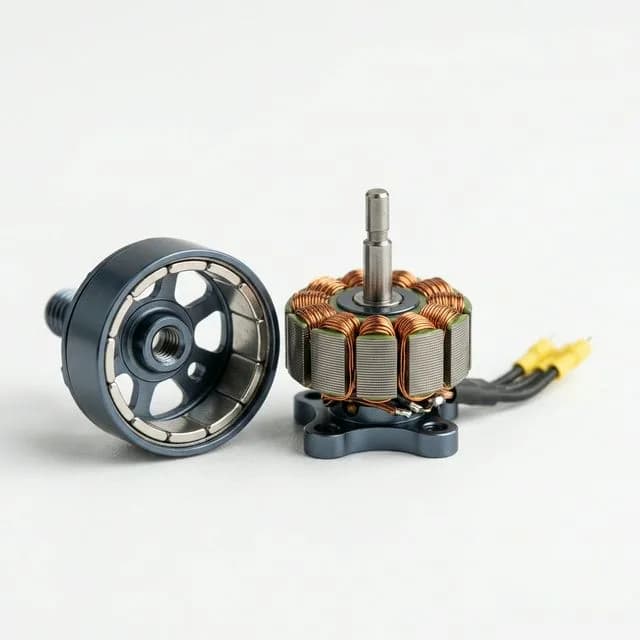
Tool layer: 1407 N52SH arc-magnet fit checker
Enter your current geometry and operating assumptions. The tool returns a deterministic verdict with explicit boundaries and action guidance.
Boundary defaults in this tool
Arc coverage target 0.76-0.88, thermal margin >=15 C, adhesive margin >3 MPa, and confidence score >=80 for prototype-ready.
Grade labels can vary by supplier. Confirm BHmax, Hcj, and max operating temperature from supplier datasheet/COA before release.
Report summary: key conclusions and audience fit
This section translates tool outputs into quick decision statements, key numbers, and fit boundaries for different use contexts.
Most 1407-size outrunner layouts avoid dead zones and assembly collision when total magnetic arc coverage stays inside this window.
If estimated magnet peak temperature leaves less than 15 C margin to the grade limit, reliability becomes duty-cycle sensitive.
Adhesive shear margin below 3 MPa typically requires groove/sleeve reinforcement for high-RPM 1407 outrunner use.
Below this gate, teams should shift from quick selection to validation planning before drawing freeze or RFQ release.
USGS 2026 data shows a 2024 to 2025 neodymium oxide price jump, so procurement assumptions must include re-quote triggers.
| Profile | Fit | Decision rationale |
|---|---|---|
| FPV 3-4 inch quadcopter team | Suitable | Strong torque density target with constrained rotor diameter where N52SH energy density can reduce copper-current demand in 14xx-size builds. |
| High ambient + continuous-duty ducted fan | Conditional | Can work if thermal path and adhesive aging are validated. Otherwise SH-to-UH migration and lower kv loading may be safer. |
| Cost-first low-speed actuator | Not ideal | N52SH premium may not return value at low RPM and moderate flux demand. N42/N48 classes are often better economics. |
| Freestyle quad with high-crash duty | Conditional | Requires added retention design (groove/carbon sleeve/overmold) beyond adhesive-only assumptions used in fast screening. |
Methodology and evidence
Tool logic and report conclusions share one evidence chain so the interaction layer and deep content layer remain consistent.
| ID | Source | Key data used | Use in page | Date context | Link |
|---|---|---|---|---|---|
| S1 | Arnold Magnetic Technologies NdFeB grade table | Public grade table lists N52 max operating temperature at 60 C vs G52SH at 150 C, with N52 Hcj min 11 kOe vs G52SH 20 kOe and Br coefficient around -0.120%/C. | Used to bound grade-label interpretation, demagnetization-resistance differences, and thermal derating assumptions. | Supplier table accessed April 8, 2026 | Open |
| S2 | Arnold technical note on high-performance motor magnet tradeoffs | In high-performance motor design discussion, SmCo reversible coefficient is shown near -0.03%/C versus NdFeB near -0.1%/C. | Supports thermal-stability tradeoff framing versus magnetic output density. | Technical article accessed April 8, 2026 | Open |
| S3 | Henkel LOCTITE 648 technical data sheet (en-GL PDF) | Compressive shear on steel is listed at about 13.5 N/mm2 (15 min) and 31 N/mm2 (72 h at 23 C), with service temperature around -55 C to 180 C. | Justifies retention margin checks and warns against using uncured/nominal-only adhesive values. | TDS dated May 2021, accessed April 8, 2026 | Open |
| S4 | NEMA MG-1 Part 12 (polyphase motors) | Section 12.45 states motor performance is best when terminal voltage unbalance does not exceed 1%. | Used as a reliability boundary reference when moving from checker output to release decisions. | Watermark PDF accessed April 8, 2026 | Open |
| S5 | USGS MCS 2026 - Rare Earths commodity data (raw CSV) | U.S. neodymium oxide reference price moved from $56/kg (2024) to $73/kg (2025), while NdPr oxide moved from $55/kg to $69/kg. | Provides dated procurement volatility signals for BOM and sourcing decisions. | USGS 2026 dataset, accessed April 8, 2026 | Open |
| S6 | USGS MCS 2026 Fig2 net import reliance | For rare earth compounds and metals, U.S. net import reliance is listed as 67% for 2025. | Adds macro supply-risk boundary for grade and supplier decisions. | USGS 2026 dataset, accessed April 8, 2026 | Open |
| S7 | USGS MCS 2026 Fig3 major import sources | Import-source shares for rare earth compounds/metals are listed as China 71%, Malaysia 13%, Japan 5%, and Estonia 5%. | Used for supplier concentration and dual-source mitigation guidance. | USGS 2026 dataset, accessed April 8, 2026 | Open |
| S8 | USGS MCS 2026 Table T4 export controls | USGS table lists a 2025 China export licensing requirement entry that includes rare earths, with data updated through Nov 21, 2025. | Used to justify policy-trigger clauses in sourcing and fallback plans. | USGS 2026 dataset, accessed April 8, 2026 | Open |
| S9 | USGS Mineral Commodity Summaries 2026 (Rare Earths PDF) | Table and narrative include Nd oxide ($56 to $73/kg), NdPr oxide ($55 to $69/kg), apparent consumption (9,010 to 27,000 t), import reliance (53% to 67%), and 2025 policy timeline notes. | Used for dated procurement triggers, import-volume context, and supply-policy volatility boundaries. | USGS report published February 2026, accessed April 8, 2026 | Open |
| S10 | Arnold N52 datasheet (N52-151021 PDF) | Lists Br 14,200 to 14,800 G, HcJ min 11,000 Oe, BHmax 49 to 53 MGOe, a(Br) -0.12%/C, a(Hcj) -0.62%/C, and Curie temperature 310 C. | Used to separate room-temperature magnetic output from demagnetization resistance and Curie-temperature misinterpretation. | Supplier PDF revision 2015-10-21, accessed April 8, 2026 | Open |
| S11 | Arnold G52SH datasheet (N52SH_GBDD_181031 PDF) | Lists Br 13,800 to 14,700 G, HcJ min 20,000 Oe, BHmax 47 to 52 MGOe, a(Br) -0.12%/C, and a(Hcj) -0.55%/C. | Used to quantify N52 vs G52SH tradeoff: similar Br class but much higher coercivity and wider thermal boundary for SH grade. | Supplier PDF revision 2018-10-31, accessed April 8, 2026 | Open |
| S12 | DFARS 225.7018-2 restriction text (Acquisition.gov) | Restriction applies through Dec 31, 2026 to covered magnets melted/produced in covered countries, and from Jan 1, 2027 expands to mined/refined/separated/melted/produced traceability. | Used to define compliance risk and procurement gating for defense-linked programs. | Regulatory page accessed April 8, 2026 | Open |
| S13 | Applied Sciences (MDPI), 2023, DOI 10.3390/app13137411 (rotor sleeve process study) | Reports 20 to 25% tensile reduction at 30 to 45 deg winding angles vs hoop; 13%/12% tensile/shear reduction at 130 N vs 70 N tension; and 16% reduction at 3 min/C dry-winding rise rate. | Used to add quantitative process-variability boundaries for sleeve-assisted retention decisions. | Published June 22, 2023; accessed April 8, 2026 | Open |
| Metric | 2024 | 2025 | Delta | Decision implication | Source |
|---|---|---|---|---|---|
| Neodymium oxide reference price (U.S.) | $56/kg | $73/kg | +30% | Cost-down decisions based on 2024 quotes can fail in 2025 if no re-pricing trigger is defined. | S5 |
| NdPr oxide reference price (U.S.) | $55/kg | $69/kg | +25% | Material-grade alternatives need sensitivity checks, not static premium assumptions. | S5, S9 |
| Rare-earth compounds/metals net import reliance (U.S.) | 53% | 67% | +14 pp | Single-source plans become less resilient; procurement and engineering gates should be linked. | S6, S9 |
| Rare-earth compounds imports (U.S.) | 8,120 t REOeq | 21,000 t REOeq | +159% | Volume shock requires lead-time and price re-quote gates instead of fixed annual assumptions. | S9 |
| Apparent U.S. consumption (compounds + metals) | 9,010 t REOeq | 27,000 t REOeq | +200% | Demand swing can outpace qualification cycles; pre-approve fallback grades and suppliers before pilot lock. | S9 |
| Import value context (U.S.) | $168M | $165M | -2% value with +169% import-volume note | Price-only dashboards can hide mix and availability risk; track both tonnage and value. | S9 |
| Top import-source concentration (USGS 2021-2024 average) | China 71%, Malaysia 13%, Japan 5%, Estonia 5% | No newer public split in same table | Structurally concentrated | Dual-source qualification is a reliability control, not only a purchasing preference. | S7, S9 |
| Policy trigger timeline in 2025 | No comparable multi-step sequence shown | Apr controls tightened; Oct expanded; Nov Oct-wave suspended for 1 year (Apr wave remained) | High policy volatility | Add clauses for re-approval, lead-time escalation, and substitute-material fallback. | S8, S9 |
| FY2025 U.S. stockpile potential acquisitions | Not listed in this summary table | 300 t NdPr oxide + 450 t NdFeB block + 60 t SmCo alloy | Strategic demand pull | Strategic buying can amplify commercial lead-time risk; do not release single-quote procurement plans. | S9 |
| Decision point | Boundary | Implication | Source |
|---|---|---|---|
| N52 vs G52SH coercivity split | N52 public sheet lists Hcj minimum at 11 kOe, while G52SH lists Hcj minimum at 20 kOe with similar Br class. | SH-grade selection is mainly a demagnetization-resistance decision, not a simple room-temperature flux upgrade. | S1, S10, S11 |
| Curie temperature misread risk | N52 datasheet lists Curie temperature at 310 C, but grade-table max operating temperature for N52 is 60 C. | Do not treat Curie temperature as allowable design temperature; use max operating temperature and Hcj margin for screening. | S1, S10 |
| Thermal derating slope for NdFeB | Br temperature coefficient is about -0.120%/C for both N52 and G52SH rows in the referenced sheets. | Thermal derating in this checker uses a conservative -0.12%/C screening slope across both grades. | S1, S10, S11 |
| GBD process size applicability | Arnold notes GBD-Neo process favors thickness below 6 mm or laminated materials. | For very thin 1407 segments this can be a fit advantage, but thick-segment assumptions should not be copied without supplier confirmation. | S1 |
| SmCo alternative boundary | Technical note cites SmCo around -0.03%/C vs NdFeB around -0.1%/C reversible coefficient scale. | SmCo can offer better thermal stability but usually at lower magnetic energy density and higher cost. | S2 |
| Adhesive retention assumptions | LOCTITE 648 compressive shear values and service-temperature range are condition-dependent and tied to cure state/test setup. | Use safety factors and validation tests; avoid treating a catalog number as guaranteed in-rotor capacity. | S3 |
| Defense-compliance boundary | DFARS clause gates covered magnets by origin and processing stages, with stricter upstream traceability taking effect on January 1, 2027. | Defense-linked programs should add traceability evidence at RFQ stage instead of waiting for purchase-order release. | S12 |
| Metric | N52 | G52SH | Decision implication | Source |
|---|---|---|---|---|
| Br range at 20 C | 14,200 to 14,800 G | 13,800 to 14,700 G | Room-temperature remanence overlap is high; this is not enough to justify SH premium by itself. | S1, S10, S11 |
| Hcj minimum | 11,000 Oe (875 kA/m) | 20,000 Oe (1,592 kA/m) | Main SH benefit is demagnetization headroom under thermal and reverse-field stress. | S1, S10, S11 |
| BHmax range | 49 to 53 MGOe | 47 to 52 MGOe | Higher-temperature grade does not guarantee higher BHmax; verify torque targets against full operating envelope. | S10, S11 |
| Reversible Hcj coefficient | -0.62%/C | -0.55%/C | G52SH coercivity drops slower with temperature in these sheets, supporting high-duty thermal use cases. | S10, S11 |
| Max operating temperature | 60 C | 150 C | The 90 C window difference changes acceptable duty-cycle envelope and should be treated as a hard screening gate. | S1 |
| Curie temperature | 310 C | Pending confirmation (待确认/暂无可靠公开数据) | Curie values are material limits, not recommended operating limits for retained magnet performance. | S10 |
| Process variable | Baseline | Shifted condition | Observed change | Decision boundary for this page | Source |
|---|---|---|---|---|---|
| Sleeve winding angle | Pure hoop winding | 30 deg to 45 deg winding angles | Tensile strength reduced by 20 to 25% | If your retention concept uses off-hoop layup, keep extra burst-test margin before downgrading mechanical assist. | S13 |
| Manufacturing-process contribution | Idealized process assumption | Measured process losses in study | Strength loss contribution around 30% | Do not treat nominal material data as finished-part strength; include process-capability evidence in supplier review. | S13 |
| Wet winding tension | 70 N | 130 N | Tensile -13%, shear -12% | Tension-control windows should be part of pilot acceptance criteria when sleeve retention is used. | S13 |
| Dry winding temperature rise rate | 1 min/C | 3 min/C | Strength reduced by 16% | Cure-ramp control affects retention strength and should be audited in process-control documents. | S13 |
Transferability note: this evidence comes from high-speed PM rotor sleeve studies and is marked as directional support only for 1407 design screening.
| Trigger | Timeframe | What changes | Decision impact | Source |
|---|---|---|---|---|
| DFARS baseline gate | Through Dec 31, 2026 | DoD acquisitions cannot use covered magnets melted or produced in covered countries. | Defense-linked RFQs need melt/produce traceability evidence before award. | S12 |
| DFARS expanded traceability gate | From Jan 1, 2027 | Restriction expands to mined, refined, separated, melted, or produced covered magnets. | Supplier approvals that pass 2026 rules may fail in 2027 without upstream origin mapping. | S12 |
| Recycled NdFeB exception boundary | Current DFARS text | Recycled NdFeB is excepted only when milling and sintering occur in the United States. | A recycled-material claim alone is not enough; require process-location proof. | S12 |
| Topic | Status | Current evidence | Minimum next step |
|---|---|---|---|
| U.S. 2024-2025 rare-earth market and sourcing concentration | Known with public data | Quantified in USGS 2026 raw CSV tables and mapped into this page. | Re-check quarterly and update procurement thresholds if trend shifts. |
| Voltage-unbalance boundary for motor reliability context | Known with standard reference | NEMA MG-1 Part 12.45 cites best performance when terminal unbalance does not exceed 1%. | Use as release-checklist context; not a substitute for application-specific validation. |
| Rotor-sleeve process transfer from published high-speed studies | Partially known with public data | MDPI 2023 quantifies sleeve-process sensitivity, but test context is high-speed PM motors (up to 200 m/s) rather than open 1407 rotor geometry. | Treat public process deltas as directional only and confirm on 1407-specific burst and thermal-aging tests. |
| DFARS compliance applicability for non-defense programs | Known boundary | DFARS 225.7018 is a DoD procurement rule and is not a universal civil-market requirement. | Apply this gate only when customer contract scope includes DoD or derivative defense compliance flowdown. |
| 1407 rotor burst-speed failure distribution by grade/coating | Pending confirmation (待确认/暂无可靠公开数据) | No reliable open dataset with statistically useful sample size was found in this round. | Collect internal burst-test database or supplier qualification report before tightening the 70 m/s gate. |
| Cross-supplier Cpk distribution for 1407 arc-angle tolerance | Pending confirmation (待确认/暂无可靠公开数据) | Public sources do not provide comparable Cpk by grade/coating/tolerance stack for 1407-sized segments. | Require process-capability evidence in RFQ and pilot PPAP-like submissions. |
| Gap | Fix action | Status |
|---|---|---|
| Supplier-grade naming and temperature boundaries were under-specified. | Added source-backed boundary table clarifying label ambiguity and requiring BHmax/Hcj/max-temp verification before release. | Closed in stage1b round 2 |
| Procurement and policy risk lacked dated quantitative evidence. | Added USGS 2024-2025 market delta table (price, import reliance, source concentration, export-control signal). | Closed in stage1b round 2 |
| Retention discussion did not anchor to explicit adhesive data context. | Replaced generic adhesive note with LOCTITE 648 TDS-backed values and condition caveats. | Closed in stage1b round 2 |
| No explicit disclosure for missing public 1407 reliability datasets. | Added known-vs-pending evidence panel with 待确认/暂无可靠公开数据 labels and concrete next-step data requirements. | Partially closed; pending public data |
| N52 vs G52SH comparison lacked datasheet-level quantitative boundaries. | Added grade-evidence table with Br/Hcj/BHmax/temperature-coefficient/max-temp differences from N52 and G52SH source sheets. | Closed in stage1b round 3 |
| Procurement risk lacked direct demand-shock and stockpile signal context. | Expanded market delta table with import volume, apparent consumption, import-value context, and FY2025 stockpile acquisition signals from USGS 2026. | Closed in stage1b round 3 |
| Defense-compliance trigger conditions were not explicitly mapped. | Added DFARS 225.7018 timeline table with 2026 and 2027 gate differences and recycled-material exception boundary. | Closed in stage1b round 3 |
| Retention process risk lacked quantitative non-ideal-process evidence. | Added peer-reviewed sleeve-process sensitivity table (winding angle/tension/cure-ramp deltas) and transferability caveat for 1407. | Partially closed; 1407-specific validation still pending |
Comparison, risk, and scenario decisions
This section is for tradeoff decisions, not glossary reading. Pick a path based on constraints, not magnet grade labels alone.
Risk actions below incorporate this round's dated market and policy evidence (USGS 2026 source set).
| Option | Magnetic output | Thermal profile | Primary risk | Sourcing/cost |
|---|---|---|---|---|
| N52SH arc segments | Highest energy class in this shortlist | High-temperature class, typically around 150 C class usage | Tighter process window and higher sensitivity to coating and retention quality at high speed. | Premium cost, longer lead-time risk in peak cycles |
| N48H arc segments | Slightly lower energy than N52SH | Often suitable up to 120 C class usage | Can underperform if torque target is near limit; may require larger magnet volume. | Better cost and wider supplier coverage |
| Sm2Co17 arc segments | Lower remanence than top NdFeB grades | Excellent high-temperature stability | Brittle material and higher machining complexity in thin 1407 segment sizes. | High material cost and specialized vendors |
| Risk | Probability | Impact | Mitigation path |
|---|---|---|---|
| Thermal demagnetization drift | Medium to high | High | Keep thermal margin >=15 C, validate hotspot with embedded probe, and include duty-cycle derating in RFQ package. |
| Adhesive-only retention failure at overspeed | Medium | High | Use mechanical assist (groove/sleeve), apply safety factor >=1.8, and run burst-speed qualification. |
| Arc segmentation mismatch | Medium | Medium | Control arc-angle tolerance and pole indexing; include incoming inspection with fixture-based go/no-go checks. |
| Supply lead-time spike | Medium to high | Medium | Dual-source critical grades, freeze coating specs early, and predefine policy-trigger fallback actions in sourcing contracts (especially after 2025 import/consumption spikes). |
| Policy-driven rare-earth export control changes | Medium | High | Map each grade to an alternate source/material path and trigger re-approval when export-control status changes. |
| Sleeve process-window drift (if using sleeve-assisted retention) | Medium | High | Control winding angle, tension, and cure-ramp parameters; require process-capability data instead of nominal material-only declarations. |
| Contract non-compliance in defense-linked programs | Low to medium | High | Screen suppliers against DFARS 225.7018 timeline gates and capture upstream traceability evidence before source lock. |
| Scenario | Assumptions | Process | Outcome |
|---|---|---|---|
| 28k RPM 4-inch racing quad motor | OD 16.8 mm, 12 poles, 24 deg arc, 1.8 mm thickness, ambient 32 C, rise 62 C | Screen checker output, then verify with spin-burst retention test. | Often lands in prototype-ready when adhesive margin remains above 3 MPa and thermal margin above 20 C. |
| 21k RPM enclosed ducted fan motor | Ambient 50 C and hotspot rise above 75 C in sealed housing | Checker flags reduced thermal margin and pushes review-required. | Teams usually add airflow or move to higher-temperature grade before release. |
| 15k RPM cost-down redesign | Torque target is moderate and temperature is controlled | Run checker baseline then compare against N48H and larger arc coverage. | Cost reduction can still work, but only if re-quoted against current rare-earth price windows and confidence stays above 75. |
Decision FAQ
Questions are grouped by decision intent so teams can move from uncertainty to next action quickly.
90 arc magnets for sale checker and RFQ report
90 arc neodymium magnets intent-split checker
Axial flux motor magnets checker
10 kW axial flux generator screening tool
54mm x 46mm x 20mm arc magnets neodymium magnet checker
1 phase to 3 phase back-EMF conversion guide
17yearold designed electric motor rareearth magnets hybrid checker
Minimum package for fast support: magnet geometry, RPM target, thermal envelope, coating preference, and current retention method.
If thermal margin is below 15 C or adhesive margin below 3 MPa, include that as a blocker so fallback recommendations can be prioritized.