84 XLH Stator and Magnets Checker: Fit Triage, Risk Boundaries, and Repair Decision Guide
Run an immediate 84 XLH stator and magnets screening tool first, then use the evidence-backed report to decide whether to continue, repair, or stop-and-inspect. This page is intentionally built as one URL for both replacement intent and decision-depth intent.
Evidence trust signals
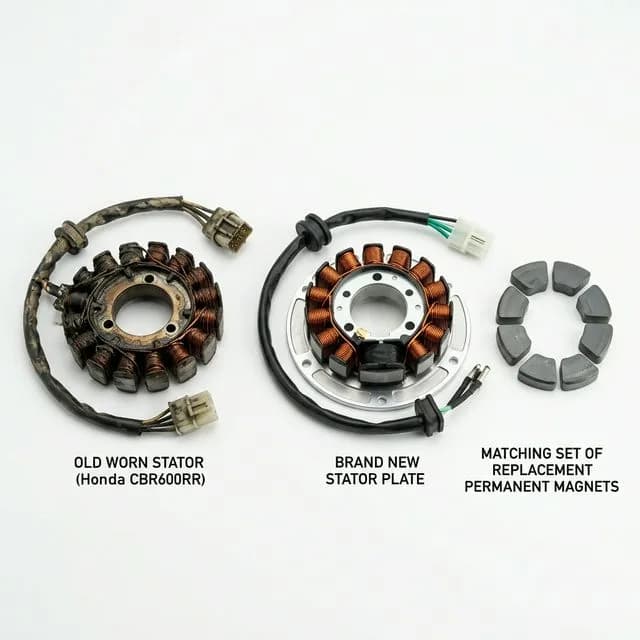
Report summary: conclusions, key numbers, fit boundaries
This layer explains why the checker output is trustworthy enough for triage and where final certainty still depends on model-level documentation.
Primary intent fit
Tool-first vintage stator triage
Designed for replacement/diagnosis intent, not generic EV design education.
Core numeric anchors
14.2-14.5 V battery context + ±18 mV/C + >15.0 V alert
Charging interpretation now includes battery chemistry and temperature conditions, not a single fixed voltage band.
Evidence mix
Harley SIP + NHTSA Part 573 + Harley M1507 + ODYSSEY + Fluke
Core conclusions now anchor on OEM/regulatory/manufacturer sources; community signals remain low-confidence context only.
Main boundary
1984 final release still requires model-specific manual confirmation
Open-public references are still insufficient for one universal 1984 threshold table, so the checker remains conservative by design.
| Gap found | Decision risk if not fixed | Round action | Status |
|---|---|---|---|
| Battery-side charging boundary lacked temperature and hard overvoltage conditions | Using one fixed charge band can hide heat-related overcharge behavior and miss irreversible battery damage risk. | Added ODYSSEY-based alternator context (14.2-14.5 V at 25C), ±18 mV/C compensation boundary, and urgent >15.0 V warning logic. | Closed in this round |
| Cross-era diagnostic transfer risk was underexplained | Users may copy modern bulletin thresholds directly into a 1984 XLH decision and over-trust non-matching platform logic. | Added explicit applicability table showing where Harley M1507 (2017-2023 scope) can inform process but cannot be used as direct 1984 pass/fail thresholds. | Closed in this round |
| Risk matrix lacked dated regulator-wire counterexample with event scale | Harness or regulator faults may be misattributed to stator or magnets, causing repeat repairs. | Added NHTSA Part 573 24V-672 dataset points (41,637 population, chronology, failure mode) and tied them to harness-first isolation actions. | Closed in this round |
| Fitment lineage signal still lacked explicit OEM part-list boundary | Users may carry shorthand year assumptions into wrong stator/regulator lineage decisions. | Added Harley SIP alternator/regulator row evidence (86+ listing) and reinforced VIN/manual confirmation before part authorization. | Closed in this round |
| Public OEM threshold table for every 1984 XLH sub-variant remains incomplete | Generic screening values may be over-interpreted as final-release criteria. | Kept explicit uncertainty wording, retained pending-evidence section, and added non-overclaim guardrail language next to threshold tables. | Open (explicitly disclosed) |
| Topic | Current evidence status | Minimum next step |
|---|---|---|
| Public OEM electrical pass/fail values for every 1984 XLH sub-variant | As of April 20, 2026, open-public references remain fragmented and are not published as one consolidated threshold table for all 1984 XLH sub-variants. | Keep conservative screening boundaries and force model-specific manual confirmation before final release decisions. |
| Original M-890 recall bulletin text quality in open mirrors is inconsistent | NHTSA-hosted archive copy is available, but machine-readable OCR quality is limited in open indexing paths. | Treat M-890 as corroborative historical context and do not use it as the sole numeric authority. |
| Rotor magnet material and adhesive history on rebuilt vintage units | Many field units are rebuilt with unknown aftermarket rotor provenance, and open sources rarely include traceable material data. | Treat unknown rotor provenance as a confidence downgrade and require visual plus clearance inspection before restart. |
| New fact | Time context | Decision impact | Source |
|---|---|---|---|
| NHTSA Part 573 recall 24V-672 reports regulator-output wire chafing that can open the 60-amp main fuse and cause simultaneous propulsion + electrical loss. | Filed Sep 11, 2024; chronology closes at Sep 4, 2024 recall decision | No-charge complaints must include harness-path checks; stator-only diagnosis is unsafe. | S8 |
| Harley M1507 (rev Dec 21, 2022) sets a >13.8 V checkpoint at 3000 rpm and includes rotor-magnet inspection after stator checks. | Bulletin scope: 2017-2023 Touring/Trike + 2018-2023 Softail | Use as process reference and counterexample flow, not as direct 1984 numeric transfer. | S9 |
| The same M1507 bulletin uses <0.5 ohm criteria for regulator power and ground circuit resistance checks. | Revision date Dec 21, 2022 | Separate harness/regulator path resistance from stator winding resistance to avoid root-cause mix-ups. | S9 |
| ODYSSEY manual defines 14.2-14.5 V alternator charging context at 25C, ±18 mV/C compensation, 13.6 V float, and warns that voltages above 15.0 V can cause irreversible damage. | Manual AMER-EN-IOM-ODY-0523; accessed Apr 20, 2026 | Adds battery-type and temperature guardrails, plus urgent overvoltage action trigger. | S7 |
| Fluke guidance states test-lead resistance commonly falls in 0.2-0.5 ohm and good leads should read about 0.5 ohm or less. | Accessed Apr 20, 2026 | Lead compensation and lead-quality checks become mandatory before low-ohm stator conclusions. | S5, S6 |
| Harley SIP alternator/regulator catalog row lists stator 29967-84A and regulator 74523-84A as 86+ usage in that section. | Accessed Apr 20, 2026 | Blocks cross-year fitment assumptions under ambiguous "84 XLH" search intent. | S3 |
| Observed pattern | Evidence | Page decision |
|---|---|---|
| Marketplace listings dominate top results | Top results for this query pattern are heavily parts-listing pages (rotor, stator, and alternator bundles) plus fitment snippets. | Tool-first UX must answer immediate replacement/diagnosis intent before long-form explanation. |
| Forum + video troubleshooting intent is strong | Community threads and YouTube repairs rank alongside listings, focused on loose magnets, stator rub, and charging checks. | Report layer should include risk triggers, not just catalog-style copy. |
| Official model-specific thresholds are fragmented | General charging/stator test methods are available, but exact pass/fail numbers still depend on service-manual model details. | Output must disclose uncertainty and require model-manual confirmation for final decisions. |
| Query is ambiguous across vintage platforms | The apostrophe form (`84'xlh`) can mean 1984 XLH, mixed XLH year ranges, or informal shorthand from listings/forums. | Input includes model family and boundary notes to avoid false certainty. |
| Metric | Screening band | Decision reason | Source |
|---|---|---|---|
| Battery-side charging context (25C) | 14.2-14.5 V alternator context | Defines normal battery-centric charging behavior and prevents mixing stator checks with battery chemistry limits. | S7 |
| AGM2 charging constraints (25C) | 14.1-14.7 V deep cycle; 13.6 V float; >15.0 V avoid | Adds a hard battery-protection boundary so sustained overvoltage is not treated as harmless just because the engine runs. | S7 |
| Charge-voltage temperature compensation | ±18 mV/C per 12 V battery from 25C | A fixed voltage rule can be wrong across seasons; compensation keeps hot/cold decisions from false positives. | S7 |
| Modern Harley bulletin decision gate | >13.8 V at 3000 rpm (scope-limited) | Useful process anchor, but only for the model-year families declared in M1507 and not a direct 1984 threshold. | S9 |
| Regulator circuit path resistance | <0.5 ohm (power and ground path checks) | Separates wiring-path integrity from winding integrity, reducing wrong part replacement on harness-driven faults. | S9 |
| Lead resistance and measurement fidelity | 0.2-0.5 ohm common; <=0.5 ohm preferred lead check | Low-ohm measurements are easily distorted without REL/zero compensation. | S5, S6 |
| XLH alternator/regulator lineage boundary | Catalog row in referenced section lists 86+ usage for stator/regulator pair | Blocks direct carry-over of nearby-year fitment assumptions under ambiguous `84 XLH` intent. | S3, S4 |
| Rotor magnet condition | No loose/cracked/contact marks | Harley diagnostic flow requires rotor-magnet inspection in low/no-charge isolation paths. | S9 |
| Decision rule | Valid scope | Not valid when | Guardrail action | Source |
|---|---|---|---|---|
| 13.8 V @ 3000 rpm decision gate | Following Harley M1507 workflow for its declared model-year/platform scope | Directly reused as a final threshold for 1984 XLH without model manual | Use as workflow pattern only; keep 1984 output as conservative screening. | S9 |
| 14.2-14.5 V alternator context and ±18 mV/C compensation | Battery-centric charging interpretation with known battery type and temperature | Battery chemistry unknown or charger/regulator temperature behavior not verified | Treat voltage outside boundary as escalation and verify battery type before final release. | S7 |
| <0.5 ohm regulator path resistance | Harness/regulator circuit integrity checks in Harley bulletin-style diagnostics | Misused as stator winding pass/fail threshold | Keep winding resistance and wiring-path resistance as separate checks. | S9 |
| 86+ catalog part-lineage entry (29967-84A / 74523-84A row) | Validating year-family fitment boundaries in OEM parts tables | Assuming all "84 XLH" searches map to that same catalog lineage | Require exact model-family plus VIN/manual confirmation before ordering. | S3, S4 |
| Audience | Fit | Why |
|---|---|---|
| DIY mechanic with multimeter + visual access | Good fit | Can run the checker quickly and convert readings into action sequencing. |
| Shop advisor triaging legacy charging complaints | Good fit | Useful for standardizing intake decisions before teardown quoting. |
| User with basic DMM but no REL/lead-compensation workflow | Partial fit | Use the tool, but mark lead compensation status honestly and follow re-test prompts before ordering parts. |
| Buyer searching only for direct OEM part number | Partial fit | Tool clarifies fault direction but does not replace model-specific part catalog matching. |
| User without any measurements or visual inspection | Not fit | Insufficient data leads to medium-confidence output and mandatory test-first path. |
| User expecting legal/compliance advice | Not fit | This page provides engineering screening only, not legal or warranty decisions. |
Methodology and evidence layer
The report layer exists to justify trust: what is measured, how verdicts are produced, and where evidence is thin.
| Step | What we do | Output |
|---|---|---|
| Input normalization | Collect battery/stator readings, continuity status, magnet/harness condition, and low-ohm measurement fidelity inputs. | Validated numeric + categorical inputs |
| Measurement fidelity control | Apply lead-resistance compensation logic for sub-1 ohm resistance checks and downgrade confidence if compensation is skipped. | Measured vs effective resistance boundary note |
| Boundary scoring | Evaluate charging band, AC output tier, resistance band, and hard-fault signals (ground leak, loose magnets). | Risk score + pass/fail flags |
| Verdict mapping | Map score and hard triggers into one of three decision states with interpretation. | likely-serviceable / repair-plan-needed / stop-and-inspect |
| Action path generation | Attach minimum executable next step and uncertainty disclosure near the result. | Actionable follow-up, not raw numbers only |
S3-S10 carry the core safety, fitment, metrology, and charging boundary logic. S14-S15 remain community-only context and are never standalone pass/fail authority.
| ID | Source | Key data used | Confidence | Date context |
|---|---|---|---|---|
| S1 | SERP snapshot for query `84 XLH stator and magnets` | Current top results remain listing/forum/video-heavy, validating tool-first plus boundary-rich page structure. | Medium | Checked April 20, 2026 |
| S2 | NHTSA archived TSB file for Harley bulletin M-890 (Safety Recall Code 058) | Public archive confirms bulletin file availability, but machine-readable text quality is limited; treated as corroborative historical evidence only. | Medium (official archive, limited OCR) | Archive file accessed April 20, 2026 |
| S3 | Harley-Davidson Service Info: XL-family parts-catalog alternator/regulator section | Used to confirm that alternator and regulator decisions must follow exact family/year lineage rather than one copied shorthand fitment assumption. | High (OEM parts catalog) | Catalog copyright era 1980s; accessed April 20, 2026 |
| S4 | Harley-Davidson Service Info: Sportster parts catalog document | Parts-catalog guidance includes full-VIN ordering requirement and model-specific listings, reinforcing that fitment decisions cannot rely on shorthand year text alone. | High (OEM parts catalog) | Accessed April 20, 2026 |
| S5 | Fluke: How to Measure Resistance with a Digital Multimeter | States test-lead resistance is typically 0.2-0.5 ohm and recommends REL/zero compensation, critical for sub-1 ohm stator checks. | High (instrument manufacturer) | Accessed April 20, 2026 |
| S6 | Fluke: Testing Your Test Leads | Defines <=0.5 ohm as good test-lead resistance benchmark and flags higher readings for troubleshooting. | High (instrument manufacturer) | Accessed April 20, 2026 |
| S7 | ODYSSEY Battery Installation/Operation Manual | Provides 14.2-14.5 V alternator context, 14.1-14.7 V deep-cycle range, 13.6 V float, ±18 mV/C compensation, and >15.0 V damage warning. | High (battery manufacturer manual) | Manual identifier AMER-EN-IOM-ODY-0523; accessed April 20, 2026 |
| S8 | NHTSA Part 573 Recall Report 24V-672 | Documents regulator-output harness chafing short-to-ground risk and potential total electrical power loss without prior warning. | High (regulatory filing) | Submission date September 11, 2024; accessed April 20, 2026 |
| S9 | NHTSA archive: Harley Service Bulletin M1507 (Low/No Charging Diagnostics) | Declares 13.8 V@3000 rpm checkpoint, rotor magnet inspection step, and <0.5 ohm regulator path checks within modern platform scope. | High (OEM bulletin hosted in NHTSA archive) | Revision date December 21, 2022; accessed April 20, 2026 |
| S10 | Harley Service Literature index (manual and supplement mapping) | Lists 1979-1985 XL/XR service manual and 1984 supplement references, supporting manual-specific threshold boundaries for vintage diagnosis. | High (OEM service literature index) | Accessed April 20, 2026 |
| S11 | RevZilla Shop Manual: stator/regulator test sequence | Provides practical test order for battery voltage, AC output, resistance, and continuity checks. | Medium | Article date January 2, 2024; accessed April 20, 2026 |
| S12 | Partzilla stator troubleshooting guide | Reinforces no-continuity expectation to ground and manual-specific threshold dependency. | Medium | Accessed April 20, 2026 |
| S13 | ElectroSport installation guide | Provides practical charging verification context used as secondary screening support. | Medium | Accessed April 20, 2026 |
| S14 | XLFORUM community thread | Community-reported Sportster magnet/stator failure patterns used for symptom awareness only. | Low (community) | Thread from 2010; accessed April 20, 2026 |
| S15 | Reddit Sportster discussion | Recent anecdotal reports of magnet chunks and bearing/magnet contact symptoms. | Low (community) | Thread from 2023; accessed April 20, 2026 |
Alternatives and tradeoffs
Comparison layer helps avoid a single-path bias after checker output.
| Option | Speed | Cost | Reliability outlook | When to use |
|---|---|---|---|---|
| Measurement-quality re-test (lead compensation first) | Fast | Low | Medium to high | Use when phase resistance is near boundary and test-lead compensation has not been confirmed. |
| Harness-first isolation sweep (connector wiggle + path resistance) | Medium | Low to medium | High for intermittent no-charge complaints | Use when charging is unstable or fuse events suggest wire-path faults before committing to stator replacement. |
| Continue running without checks | Immediate | Low now, high if failure escalates | Poor | Not recommended if any charging or magnet symptoms exist. |
| Stator-only replacement | Medium | Medium | Medium | Only when rotor magnets and clutch shell are confirmed healthy and aligned. |
| Rotor + stator corrective service | Medium to slow | Higher | High when root cause is magnet movement | Use when chipped/loose magnets or stator-rub evidence is present. |
| Full charging-path audit (stator + regulator + harness) | Slowest | Highest | Highest diagnostic certainty | Best for mixed symptoms, repeated failures, or unknown service history. |
| Scenario | Assumptions | Tool outcome | Minimum next step |
|---|---|---|---|
| 1984 XLH with weak charging at cruise | Battery rest 12.3 V, 3k voltage 13.0 V, stator AC 22 VAC, no ground continuity, chipped magnets. | stop-and-inspect (score 34) | Inspect/replace rotor-side magnet carrier + stator path before further road use. |
| 1985-1987 XLH with stable charging and clean rotor | Battery rest 12.6 V, 3k voltage 14.4 V, stator AC 48 VAC, clean magnets, no ground continuity, harness clean. | likely-serviceable (score 86) | Document baseline and schedule periodic visual magnet inspection. |
| Low-ohm stator reading without lead compensation | Measured phase resistance 0.35 ohm, test leads 0.32 ohm, compensation not applied, battery 3k 13.9 V. | repair-plan-needed (confidence downgraded) | Apply REL/lead compensation and re-run resistance test before confirming stator replacement. |
| No-charge complaint with harness abrasion signs | Battery 3k 12.8 V, AC output unstable, harness near crankcase shows rub mark, continuity test intermittent. | repair-plan-needed to stop-and-inspect boundary | Prioritize harness short-path inspection together with stator/regulator checks; do not assume stator-only fault. |
| Unknown XLH-family variant with no continuity test | Battery 3k 13.4 V, stator AC 28 VAC, magnet wear visible, ground test not performed. | repair-plan-needed (medium confidence) | Run ground continuity + resistance validation before any parts order. |
| Overcharge complaint after regulator swap | Battery 3k 15.4 V, stator AC 52 VAC, resistance normal, magnets visually clean. | stop-and-inspect boundary (battery overvoltage) | Pause operation, inspect regulator grounding and routing first, and do not continue until charging is back inside battery-safe range. |
Risk matrix and mitigations
Misuse risk, cost risk, and scenario mismatch risk are mapped with concrete mitigation actions.
| Risk | Probability | Impact | Mitigation action | Trigger |
|---|---|---|---|---|
| Loose or shifted rotor magnets | Medium in legacy cases | High | Stop-run decision, inspect rotor/clutch shell, clear debris, verify clearance before restart. | Visual shift/chips/contact marks |
| Low-ohm reading contaminated by test-lead resistance | High | Medium | Capture lead resistance, apply REL/zero compensation, and retest before declaring winding failure. | Phase resistance near boundary with compensation = no |
| False confidence from missing ground test | High | High | Require continuity-to-ground test before final verdict acceptance. | Ground test marked "not tested" |
| Overvoltage damaging AGM/VRLA battery and electronics | Medium | High | Escalate regulator-path check immediately when sustained voltage exceeds battery-side guidance; treat >15.0 V as urgent and stop-run-until-verified. | Battery 3k voltage > 15.0 V (sustained) or heat-compensation ignored |
| Undercharging misattributed to battery only | High | Medium | Cross-check stator AC output and phase resistance before replacing battery. | Battery 3k voltage < 13.2 V |
| Harness short-to-ground misdiagnosed as stator-only fault | Medium | High | Run harness routing/abrasion check in parallel with stator checks; NHTSA recall evidence shows harness faults can collapse power without prior warning. | Intermittent/no-charge plus harness rub or fuse-opening signs |
| Cross-family part mismatch under “84 XLH” intent | Medium | Medium | Verify exact model family and OEM part lineage before replacement authorization. | Part-number decision made without family/year validation |
| Modern bulletin thresholds over-applied to vintage platform | Medium | Medium to high | Use modern Harley bulletins as workflow references only and keep final vintage release tied to model-specific manual and VIN confirmation. | 13.8 V or <0.5 ohm gates used as direct 1984 final pass/fail |
| Harness heat damage ignored | Medium | Medium | Inspect connector heat marks and repair harness path before new stator install. | Harness condition = heat-damaged |
FAQ and conversion layer
Decision-focused FAQ first, then direct CTA and related internal routes.