NdFeB Magnet Coatings for EV Motors: Corrosion Resistance vs. Adhesion Trade-offs
Compare Ni-Cu-Ni, epoxy, phosphating, zinc, and passivation for EV motor NdFeB magnets; assess corrosion resistance, glue adhesion, SST/PCT, and RFQ risks.
The Hidden Failure Point in EV Traction Motors
In the race to develop high-efficiency, high-power-density electric vehicle (EV) traction motors, engineering and procurement teams obsess over the magnetic grade, maximum energy product (BHmax), and Dysprosium (Dy) content of Neodymium-Iron-Boron (NdFeB) magnets. However, one of the most critical causes of catastrophic motor failure is rarely the magnetic alloy itself—it is the failure of the magnet's surface coating.
NdFeB magnets are inherently highly reactive. When exposed to the harsh operating conditions of an EV motor—including severe temperature cycling, humidity, automatic transmission fluid (ATF), and chemical contaminants—an unprotected NdFeB magnet will rapidly oxidize. This corrosion leads to pulverization, volumetric expansion, and irreversible loss of magnetic flux.
However, specifying a coating for EV motor magnets is not as simple as maximizing corrosion resistance. In high-speed Interior Permanent Magnet (IPM) rotors, magnets are mechanically retained using high-strength structural adhesives (glue). The most corrosion-resistant coatings often possess smooth, low-surface-energy finishes that severely compromise glue adhesion. If the adhesive bond fails at 20,000 RPM, the resulting rotor imbalance and physical collision will destroy the stator.
This guide provides a comprehensive framework for engineering and procurement teams to evaluate the critical trade-offs between corrosion resistance, coating thickness, and adhesive compatibility when specifying NdFeB magnets.
Scope, Date, and Use Limits
This guide was prepared for global EV traction motor sourcing and design reviews on July 19, 2026. It applies mainly to sintered NdFeB magnets used in Interior Permanent Magnet (IPM) rotors, surface-mounted permanent magnet rotors, and oil- or humidity-exposed traction motor assemblies.
Use it to structure coating selection, RFQ fields, and supplier validation gates. Do not treat the SST, PCT, HAST, thickness, or pull-off values below as universal acceptance limits: final results depend on magnet grade, chamfer radius, part geometry, plating bath control, adhesive chemistry, ATF exposure, storage humidity, and the rotor assembly process. Before production release, validate the exact magnet coating lot with the adhesive, rotor topology, thermal cycle, and fluid exposure used in your program.
The Chemistry of NdFeB Vulnerability
To understand why coatings are mandatory, one must understand the microstructure of a sintered NdFeB magnet. Sintered Neodymium magnets consist of a primary magnetic phase ($Nd_2Fe_14B$) surrounded by a Nd-rich grain boundary phase.
The Nd-rich phase is highly anodic compared to the primary phase. In the presence of moisture, a galvanic cell is formed, leading to rapid intergranular corrosion. The corrosion travels along the grain boundaries, causing the primary grains to detach and flake off—a phenomenon often described as "magnet rot."
Furthermore, Neodymium readily reacts with hydrogen to form Neodymium Hydride ($NdH_3$). This hydriding process causes severe volume expansion within the crystal lattice, leading to internal stresses that fracture the magnet from the inside out. For EV motors intended to last 15 to 20 years, hermetic sealing of the magnet surface is non-negotiable.
The Core Trade-off: Salt Spray vs. Glue Adhesion
When specifying a surface treatment, engineers must balance two competing requirements:
- Environmental Protection: The coating must pass rigorous automotive testing, such as 500+ hours of Salt Spray Testing (SST) and Pressure Cooker Testing (PCT) or Highly Accelerated Stress Testing (HAST).
- Mechanical Retention: The coating must provide a substrate that allows structural adhesives (typically epoxies or methacrylates) to bond securely, preventing magnet ejection under extreme centrifugal forces.
Highly polished, multi-layer metallic coatings excel at environmental protection but fail at adhesion. Conversely, porous conversion coatings provide excellent mechanical "bite" for adhesives but offer minimal standalone corrosion resistance.
Diagram: Coating layers of Ni-Cu-Ni vs. Epoxy and their impact on adhesion.
Comparative Analysis of EV Magnet Coatings
The following table outlines the performance characteristics of the primary surface treatments used in EV traction motors.
| Coating Type | Typical Thickness (μm) | Corrosion Resistance (SST) | Glue Adhesion Strength | Temp Resistance | Relative Cost | Best For |
|---|---|---|---|---|---|---|
| Ni-Cu-Ni | 10 - 25 μm | Excellent (48 - 96 hrs) | Poor / Fair | > 200°C | Moderate | Surface-mounted rotors (SPM) with mechanical retention (sleeves). |
| Epoxy (E-Coat) | 15 - 30 μm | Outstanding (> 500 hrs) | Good | ~ 150°C - 200°C | Moderate / High | Harsh environments; motors exposed to direct moisture or salt. |
| Zinc (Zn Plating) | 5 - 15 μm | Fair (12 - 24 hrs) | Fair | ~ 120°C | Low | Enclosed, low-stress auxiliary motors (wipers, seat motors). |
| Phosphating | 1 - 3 μm | Very Poor (< 2 hrs) | Excellent | > 200°C | Very Low | High-speed IPM rotors where magnets are fully encapsulated in glue. |
| Ni-Cu + Epoxy | 20 - 35 μm | Ultimate (> 1000 hrs) | Good | ~ 150°C | High | Military, aerospace, or extreme heavy-duty commercial EV applications. |
| Passivation | < 1 μm | Negligible | Excellent | > 200°C | Lowest | Temporary protection during transit before potting. |
Note: Salt Spray Test (SST) hours vary heavily based on the specific plating bath quality, edge chamfering, and part geometry. Always request lot-specific PCT and SST data.
Deep Dive into Primary Coating Options
1. Nickel-Copper-Nickel (Ni-Cu-Ni)
The tri-layer Ni-Cu-Ni electroplating process is the historical industry standard. The base Nickel layer provides strong adhesion to the NdFeB substrate, the Copper layer adds ductility and fills micropores, and the top Nickel layer provides a hard, bright, corrosion-resistant finish.
- Advantages: Excellent dimensional stability, high temperature resistance, and strong barrier against humidity.
- The Adhesion Problem: The top layer of electrolytic Nickel is very smooth and has low surface energy. When epoxy glue is applied to Ni-Cu-Ni, the adhesive relies almost entirely on chemical bonding rather than mechanical interlocking. Under thermal cycling and high vibration, this bond is highly susceptible to shear failure.
- Mitigation: If Ni-Cu-Ni is required, procurement teams should specify a roughened or matte Nickel finish rather than bright Nickel, or require plasma cleaning of the magnets immediately prior to gluing.
2. Electrophoretic Epoxy (E-Coating)
Epoxy coatings are applied via electrodeposition, ensuring a highly uniform layer even on sharp corners and complex geometries.
- Advantages: Unmatched corrosion resistance in salt and acidic environments. Epoxy is slightly flexible, meaning it won't micro-crack under physical impact or thermal expansion like brittle metallic platings.
- Disadvantages: Traditional epoxies can degrade at the extreme upper temperature limits of EV motors (>180°C), though high-temp formulations exist. Additionally, the coating is relatively thick (up to 30 μm), which increases the effective air gap and slightly reduces magnetic efficiency.
- Adhesion: Glue adhesion is generally good, as the epoxy adhesive bonds well to the epoxy coating. However, the weakest link becomes the bond between the epoxy coating and the raw magnet.
3. Phosphating (Chemical Conversion)
Phosphating is not a coating in the traditional sense; it is a chemical conversion process that creates a thin (1-3 μm) crystalline layer of iron phosphate on the magnet's surface.
- Advantages: Zero impact on the magnetic air gap due to its negligible thickness. The crystalline structure is highly porous, acting like a microscopic sponge.
- The IPM Strategy: For modern EV Interior Permanent Magnet (IPM) rotors, Phosphating is increasingly the preferred choice. The magnets are inserted into the rotor slots, and a structural epoxy is injected under vacuum. The epoxy flows into the pores of the phosphate layer, creating a massive mechanical interlock. Because the magnet is fully encapsulated by the glue and the laminated steel rotor, the glue itself acts as the primary corrosion barrier.
- Procurement Warning: Phosphated magnets will rust rapidly in normal factory air. Supply chain logistics must ensure they are vacuum-sealed with desiccants during shipping, and the rotor assembly plant must maintain strict climate control.
The Impact of Air Gap and Coating Thickness
Engineers fight for every millimeter of space in an EV motor to maximize flux density. The magnetic air gap—the physical distance between the rotor magnet and the stator iron—is inversely proportional to motor torque and efficiency.
If a procurement team specifies a 30 μm Epoxy coating instead of a 15 μm Ni-Cu-Ni coating, they are effectively adding 15 μm to the air gap. While this sounds microscopic, across a large traction motor, it can result in a measurable drop in efficiency, potentially costing the vehicle range.
Furthermore, coating thickness is rarely uniform. Electroplating suffers from the "dog-bone effect," where plating builds up thicker on sharp edges and thinner in the center of flat surfaces.
Engineering Best Practice: Always specify adequate edge chamfering (e.g., R0.5 or C0.5) on the raw magnet drawings. Sharp corners cannot be reliably coated, leading to micro-cracks where corrosion inevitably begins.
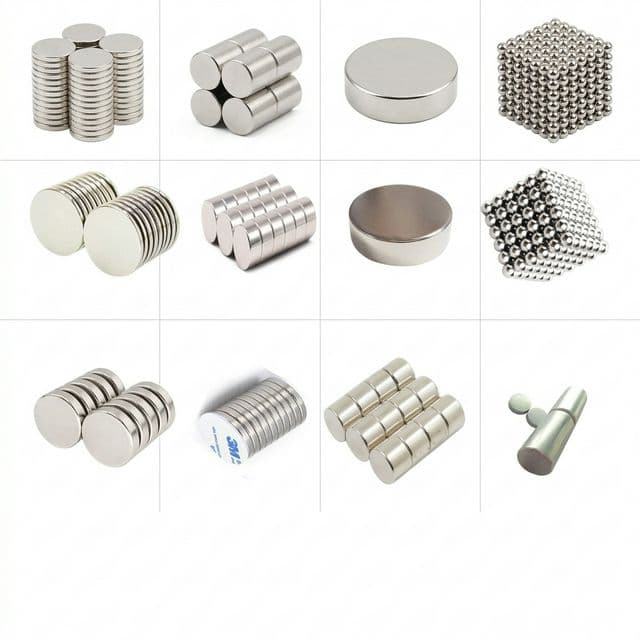
Visual comparison of NdFeB coating finishes and applications.
Procurement & Engineering Decision Matrix
For cross-functional teams, align your RFP requirements using the following decision matrix to prevent miscommunication between purchasing and engineering:
| Decision Dimension | Engineering Requirement | Procurement Action / RFQ Field | Risk of Failure | Mitigation Strategy | Typical KPI/Spec |
|---|---|---|---|---|---|
| Coating Type Selection | Must meet operational environment limits | Specify coating exactly (e.g., "Electrophoretic Epoxy, Black") | Magnet rot, volume expansion | Base selection on HAST/PCT results, not just SST | Coating spec sheet |
| Adhesive Compatibility | Glue must bond mechanically to the surface | Request "Pull-off Strength" data with specified glue | Rotor imbalance at 20k RPM | Plasma cleaning before gluing or specifying Phosphating | > 15 MPa shear strength |
| Thickness Tolerance | Keep air gap minimal for high flux density | Define thickness limits (e.g., $15\pm3\mu m$) | Loss of motor torque, assembly interference | Check Cpk on plating thickness in PPAP | $\Delta$ thickness < $5\mu m$ |
| Edge Chamfering | Prevent coating buildup (dog-bone effect) | Mandate R0.5 or C0.5 minimum chamfer on drawings | Micro-cracks at edges leading to early oxidation | Require automated tumbling/grinding | Uniform edge radius |
| Salt Spray (SST) Testing | Endure humidity and road salt over 15 years | Demand lot-level SST test reports | Premature corrosion in coastal/winter areas | Specify minimum hours (e.g., 96h for NiCuNi) | > 96h SST, < 5% rust |
| HAST / PCT Validation | Resist high pressure and temperature humidity | Add PCT requirement (120°C, 2 atm, 100% RH) | Internal hydriding and swelling | Accept weight loss only < 2 mg/cm² | Weight loss < 2 mg/cm² |
| Packaging & Transit | Magnets must not rust before rotor assembly | Mandate vacuum sealing with VCI and desiccants | Rust on arrival, unusable batches | Audit supplier packaging lines | Zero rust on delivery |
Supplier Audit & Procurement Checklist
When sourcing EV traction magnets, assessing the supplier's coating capabilities is just as critical as assessing their magnetic powder formulation. Use this checklist during supplier qualification:
- IATF 16949 Certification: Ensure the supplier holds automotive quality certifications specifically covering their in-house plating facility. Avoid suppliers who outsource their coating processes to third-party job shops, as traceability and quality control are easily lost.
- Chamfer Validation: Verify that the supplier uses automated CNC or tumbling processes to ensure consistent chamfers before coating. Inspect samples under magnification for edge coverage.
- PCT (Pressure Cooker Test) Data: Do not accept standard SST data alone. Demand PCT data (e.g., 2 atm, 120°C, 100% RH for 96 hours) to validate weight loss (mg/cm²). Automotive grade should typically show weight loss < 2 mg/cm².
- Cross-Cut Adhesion Test (ASTM D3359): For painted or epoxy-coated magnets, request cross-cut tape test results to verify the coating-to-magnet bond strength.
- Pull-Off Strength Testing: If gluing is required, request data on the shear and tensile pull-off strength of their specific coating when paired with industry-standard rotor adhesives (e.g., Henkel Loctite or DELO).
- Packaging Specifications: For uncoated or phosphated magnets, audit the vacuum packaging process. Ensure VCI (Volatile Corrosion Inhibitor) bags and sufficient desiccant are standard protocols.
For adjacent sourcing checks, compare coating evidence with your rotor architecture, supplier shortlist, and assembly process. If the program is still choosing a rotor family, review the SPM motor and IPM trade-offs before locking the coating specification; if purchasing is already benchmarking vendors, use the EV motor magnet manufacturer criteria to keep quote comparisons consistent.
Frequently Asked Questions (FAQ)
Can we use uncoated NdFeB magnets in an EV motor?
In most cases, no. Even if encapsulated in glue within an IPM rotor, microscopic voids in the adhesive can allow moisture penetration, leading to localized corrosion and eventual volumetric expansion that can crack the rotor core. Phosphating is considered the absolute minimum surface treatment.
What is the acceptable weight loss threshold during a PCT/HAST test for automotive grade NdFeB?
For high-performance EV traction motors, procurement should mandate a weight loss of less than 2 mg/cm² after a 96-hour Pressure Cooker Test (PCT) or Highly Accelerated Stress Test (HAST) at 120°C, 2 atm, and 100% relative humidity. Values above this indicate unacceptable vulnerability to long-term hydriding and oxidation.
How should procurement handle the fluctuating cost of epoxy resins versus nickel commodities?
When establishing long-term agreements (LTAs), buyers should decouple the base magnet cost (driven by Nd and Pr prices) from the coating surcharge. For Ni-Cu-Ni, tie the coating cost to LME Nickel indices. For Epoxy, fixing the cost annually is usually more stable, though heavy reliance on specialized electrophoretic baths can incur high fixed energy overheads that suppliers may attempt to pass on.
Why do some suppliers recommend a passivation layer instead of a coating?
Passivation creates a temporary oxide film that protects the magnet during short-term shipping and handling. It is not a permanent coating. Like phosphating, it is used when the final assembly process (like vacuum potting) provides the true environmental seal.
How does Automatic Transmission Fluid (ATF) affect magnet coatings?
Many high-performance EV motors use internal oil cooling, directly exposing the rotor to ATF. While metallic coatings (Ni-Cu-Ni) generally resist ATF well, some lower-grade epoxies can soften or swell over time when submerged in hot oil. Chemical compatibility testing at operating temperature is mandatory.
What is the typical failure mode if the coating fails?
Corrosion forms Nd-rich oxides that expand in volume. This expansion exerts immense internal pressure, causing the protective coating to blister and flake off. The loose magnetic debris can then migrate into the air gap, causing friction, heat, and eventually a catastrophic mechanical jam between the rotor and stator.
Conclusion & Strategic Sourcing
Selecting the right NdFeB magnet coating is an exercise in compromise. Procurement teams cannot simply specify "the most corrosion-resistant" option without consulting the manufacturing engineers responsible for rotor assembly.
If your motor relies on surface-mounted magnets and carbon fiber retaining sleeves, Ni-Cu-Ni or composite Epoxy coatings offer unmatched durability. If your design utilizes an IPM topology with high-strength structural adhesives, prioritizing a Phosphated surface will yield significantly stronger mechanical bonds while relying on the glue for environmental protection.
By aligning the coating specification with the specific rotor topology and assembly process, OEM buyers can eliminate a major source of field failures while optimizing procurement costs.
Sources and References
- NdFeB Material Background: NdFeB composition, corrosion vulnerability, thermal considerations, and common protective coating context. Wikipedia: Neodymium magnet
- Epoxy Coating Corrosion Data: Academic work on enhanced epoxy coatings for sintered NdFeB magnets, including salt spray resistance and coating structure. MDPI Coatings: Sintered NdFeB Magnet Epoxy Coating
- Comparative Coating Stability: Research comparing common NdFeB coating systems such as Zn, Ni/Cu/Ni, and epoxy under magnetic-property and salt-spray evaluation. MDPI Materials: NdFeB Coatings and Corrosion Resistance
Need to validate a coating strategy for your upcoming EV motor program? Our engineering team provides custom sampling, PCT validation, and adhesive compatibility testing. Contact our technical sales team to discuss your specific rotor requirements.
Need OEM support?
Email [email protected] with your drawing package, quantity stages, and target timeline.